

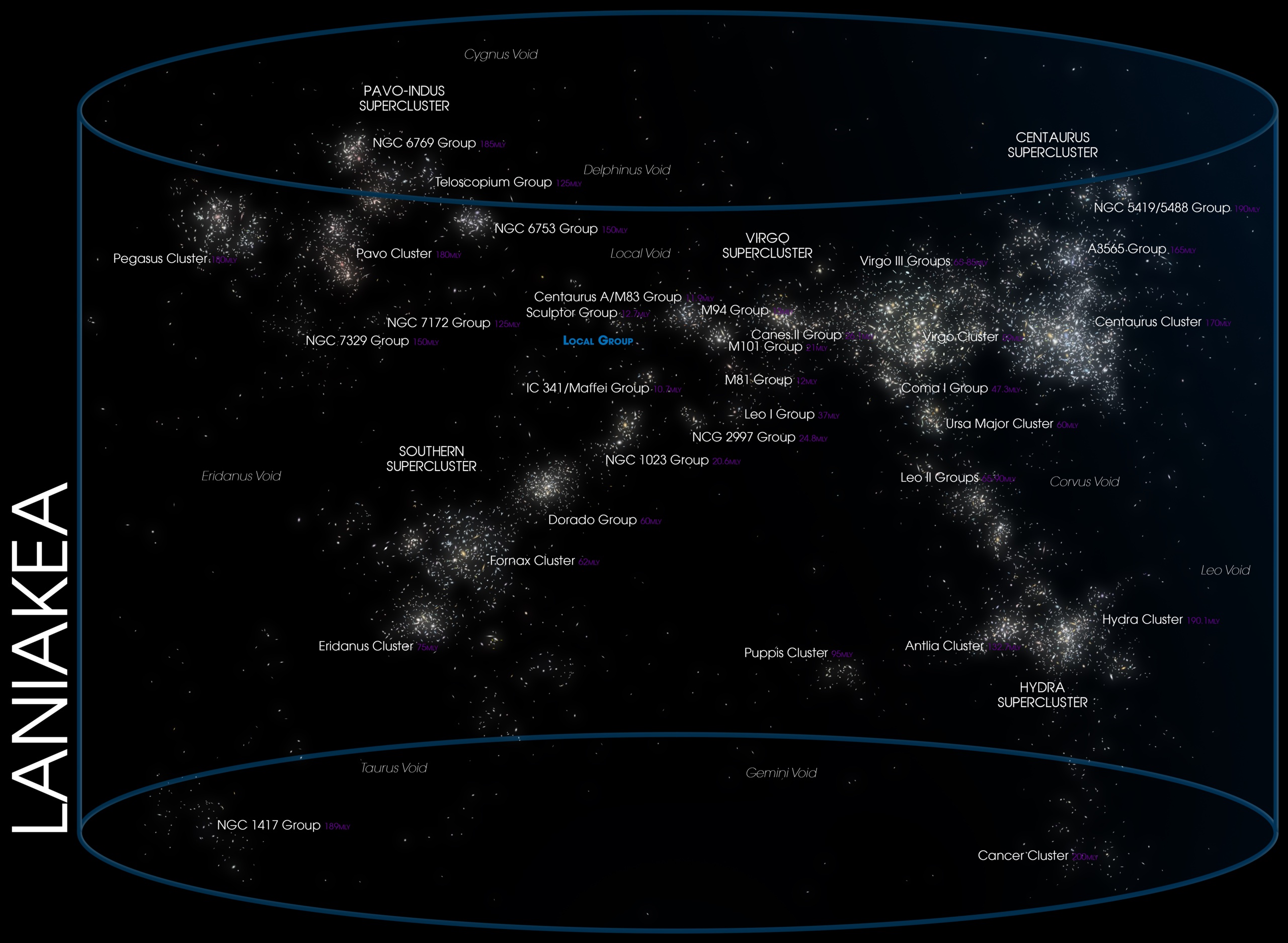
It is impossible to see the exact boundaries of superclusters, which are among the largest structures in the universe, with the naked eye. This is because they are not defined by their edges, but by the collective motion of their constituents.
The Milky Way was long thought to be a member of the Virgo Supercluster, a complex, tangled branch containing over 100 individual groups and clusters of galaxies and spanning more than a hundred million light-years. Astronomers arrived at this definition through some of the earliest galaxy surveys attempting to map the nearby parts of the universe.
These early surveys were not particularly sophisticated. Astronomers were able to see the scattered galaxies and also dense clusters of galaxies, called galaxy clusters. Since the 1950s, astronomers debated whether there was higher-order structure in the pattern of galaxies and wondered whether “supergalaxies” (or superclusters) existed.
However, as astronomers began to map the Universe deeply, they could no longer ignore the cosmic web. While some galaxies were at home in the galaxy clusters, most were inhabited by long, thin filaments and wide walls. This cosmic web was defined by the voids, the vast regions of almost nothing that dominate the volume of the Universe.
The largest parts of the cosmic web are the superclusters. But unlike clusters, they are not gravitationally bound. This means that the member galaxies of a supercluster have not yet completed their construction project. The superclusters are still in the process of forming. This fact makes it difficult to know exactly what a supercluster is.
Recently, astronomers have turned to dynamic definitions of a supercluster. This means that they consider not only the position of a particular galaxy in space, but also its motion. Since superclusters are constantly being built, this method studies what galaxies are trying to form.
This method allows astronomers to distinguish one supercluster from another. This is how we discovered that the Virgo Supercluster is just a single branch of a much larger structure called Laniakea, which contains an incredible 100,000 galaxies. And that is our home in the universe.
Like this:
Load…

Comments are closed.