
NASA’s SPHEREx Observatory completes its first map of the cosmos in 102 infrared wavelengths

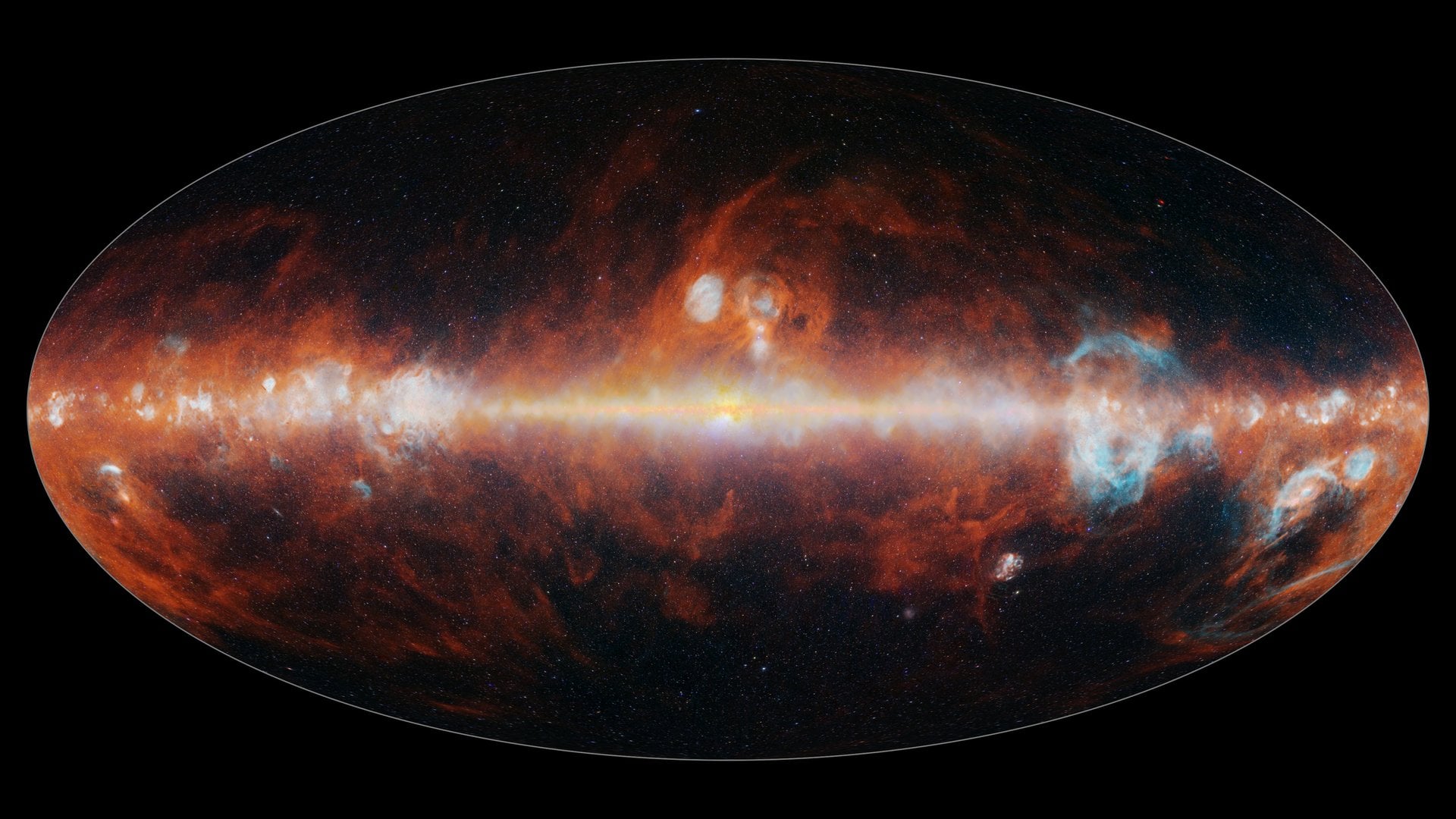
Launched in May, the Spectro-Photometer for the History of the Universe, Epoch of Reionization and Ices Explorer (SPHEREx) is designed to explore the cosmos in optical and near-infrared light. During its planned two-year mission, this observatory will survey the entire sky using a triple mirror telescope and mercury-cadmium-telluride photodetector arrays, collecting data on more than 450 million galaxies, including the 100 million stars in the Milky Way, to explore the origins of the universe.
On December 18, the mission released its first infrared map of the entire sky in 102 wavelengths, capturing parts of the universe invisible to the naked eye. This data will help scientists solve some of the biggest cosmological mysteries. This includes how cosmic inflation immediately after the Big Bang affected the distribution of galaxies in our universe. In addition, the data will shed light on how galaxies have evolved since then and how the components of life were distributed throughout the Milky Way.
While the IR wavelengths are not visible to the naked eye, they are represented by different colors on the maps. The main image (shown above) shows hot hydrogen gas in blue, cosmic dust in red, and stars in green, blue and white. While some of the maps highlight distant galaxies and stars in the Milky Way’s disk, with the wavelengths emitted by dust and hot gas removed to make them easier to see, other maps highlight nebulae and stellar nurseries, as well as dust – such as polycyclic aromatic hydrocarbons (PAHs) from which planets form.
Each wavelength provides unique information about the observed galaxies, their stars and other features. SPHEREx relies on six detectors that are equipped with a specially developed filter to split the collected light into different wavelengths. “The superpower of SPHEREx is that it captures the entire sky in 102 colors approximately every six months,” SPHEREx project manager Beth Fabinsky said in a NASA press release. “That’s an amazing amount of information to collect in a short amount of time. I think that makes us the mantis shrimp of telescopes because we have an amazing multicolor visual recognition system and we can also see a very wide area of our surroundings.”
The mission builds on the work of previous observatories, such as NASA’s Wide Field Infrared Survey Explorer (WISE), which have also mapped the entire sky. However, no other mission has achieved this in as many colors and with the same field of view as SPHEREx. The data obtained will be used to measure the distances to the more than 450 million observed galaxies, providing the first three-dimensional distance map of the cosmos. This will allow scientists to detect subtle differences in the accumulation and distribution of galaxies in the cosmos.
The space telescope began its observations in May and completed its first full-sky mosaic earlier this month. Each day, SPHEREx observed another swath of the sky, capturing about 3,600 images per day as it orbited the Earth from pole to pole. Over the course of six months, the observatory observed the entire 360-degree sky, collecting a vast trove of data and producing over 100 infrared maps. Shawn Domagal-Goldman, director of the Astrophysics Division at NASA Headquarters, said:
It’s incredible how much information SPHEREx has collected in just six months – information that will be especially valuable when used alongside data from our other missions to better understand our universe. We essentially have 102 new maps of the entire sky, each at a different wavelength and with unique information about the objects it sees. I think every astronomer will find something valuable here, as NASA’s missions enable the world to answer fundamental questions about how the universe came to be and how it changed to eventually create a home for us in it.
SPHEREx will conduct three additional sky scans during its two-year main mission, which will be merged to increase the sensitivity of its measurements. These measurements will provide insight into an event that occurred a billionth of a trillionth of a second after the Big Bang and has not been repeated since. The first dataset has been made available to the public and can be accessed here.
Further reading: NASA

Comments are closed.