

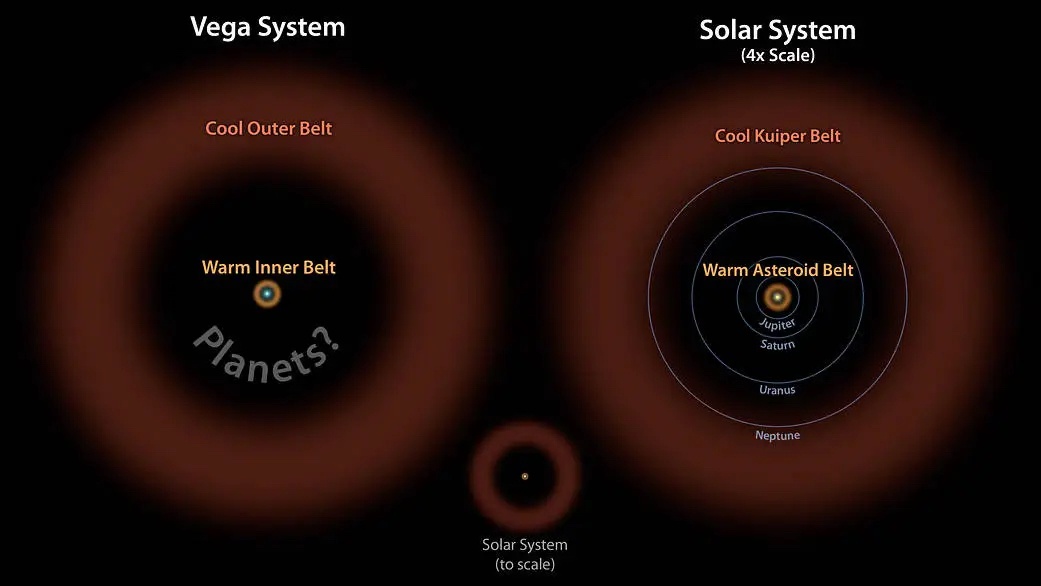
For northern sky watchers, Vega is a familiar sight in the summer sky. It is one of the brightest stars in the sky and in 2013 astronomers discovered a large ring of rocky debris surrounding the planet. The prospect of planets suddenly became a real possibility, so astronomers pointed the James Webb Space Telescope (JWST) at the star. The hunt reached ten times higher sensitivity than previous ground-based searches, but unfortunately no planets were discovered.
Vega lies in the constellation Lyra and is one of the prominent stars that make up the Summer Triangle, along with Aquila in Altair and Deneb in Cygnus. Vega itself is about 25 light-years from Earth, so astronomically speaking it is relatively close. It is a hot blue-white star with a visible surface temperature of about 9,600 degrees. At this temperature it is hotter than the Sun and is about 2.1 times larger in diameter.
The orbit of the ISS near Vega in Lyra. From right to left the station runs from sunlight into the earth's shadow. Its color goes from white to red. Photo credit: Bob King
The data collected by JWST was recently used to study Vega. The Space Telescope is perhaps the most advanced telescope ever put into orbit. It was launched in December 2021 as part of a partnership between NASA, the European Space Agency (ESA) and the Canadian Space Agency (CSA). It orbits the Sun at the second Lagrange point, which is about 1.5 million km from Earth. As telescopes go, it's not the largest (main mirror is 6.5 m in diameter), but because it's in space, it can outperform many ground-based instruments.
Among the many instruments on board JWST, NIRCam (near-infrared camera) and MIRI (mid-infrared camera) were used to explore the mysteries of Vega. Interest was sparked when the Infrared Astronomical Satellite (IRAS) detected an excess of long wavelengths attributed to a cold ring of dust emitting radiation at 25–100 µm. Further investigation revealed that the signal was very similar to the Kuiper Belt signal. The discovery led astronomers to conclude that they must be remnants of planet formation.
MIRI (Mid InfraRed Instrument), flight instrument for the James Webb Space Telescope, JWST, during ambient temperature alignment tests in the RAL Space cleanrooms at STFC's Rutherford Appleton Laboratory, November 8, 2010.
In a paper by a team of astronomers led by Charles Beichman of NASA's Exoplanet Science Institute, they describe their attempts to detect planets in the debris ring. They were able to use data from NIRCam's coronagraphic observations of Vega. Within this data, three sources were identified and analyzed using supporting data from MIRI. The sources were evaluated to determine whether astrometric data confirmed a connection with Vega. If it were part of the Vega system, the data would indicate a mass of these sources between 1 and 3 times the mass of Jupiter and a temperature in the region of 250 K.
Such an object likely disrupted the smooth disk structure, but MIRI data does not reveal any such effects. At least for now, it appears that the debris field around Vega shows no evidence of planet formation. Further studies using the instrumentation aboard JWST and other new observatories coming online could change this view, but for now it appears that Vega is simply alone and without a planetary system.
Source: Search for planets orbiting Vega with the James Webb Space Telescope
Like this:
Load…

Comments are closed.