

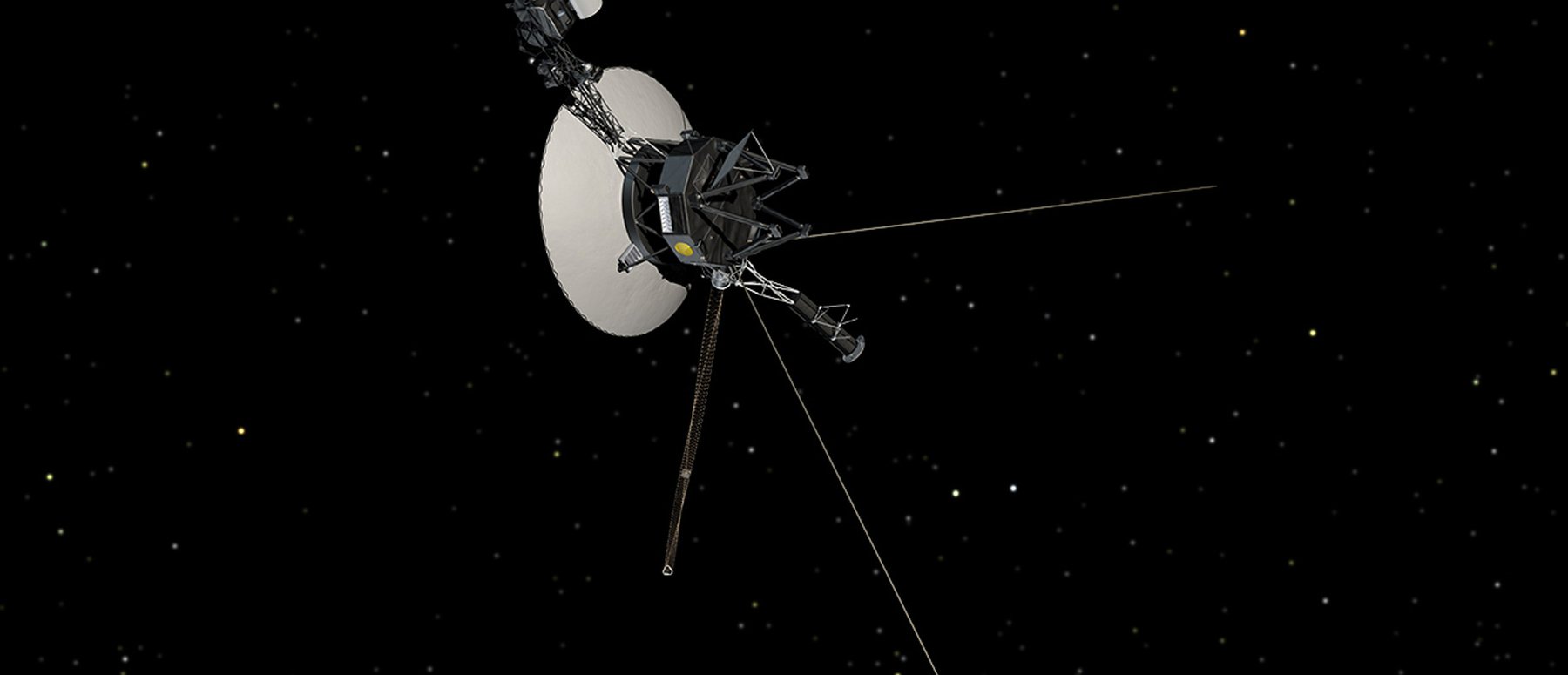
Voyager 1 was launched waaaaaay in 1977. I would have been 4 years old back then! It's an incredible achievement that technology that was developed SO long ago still works. But here we are in 2024, Voyager 1 and 2 are getting older. Earlier this week, NASA had to shut down one of Voyager 1's radio transmitters. This forced communications to rely on the low-power radio. Unfortunately, some 50-year-old technology sometimes malfunctions, and this was the result of a command to turn on a heater. The result was that Voyager 1 entered fault protection mode and switched communications! Oops.
Voyager 1 is a NASA spacecraft launched on September 5, 1977 as part of the Voyager program to explore the outer planets and beyond. Originally, Voyager 1's mission focused on flybys of Jupiter and Saturn, capturing incredible images before departure. In 2012, it became the first man-made object to enter interstellar space, crossing the heliopause – the boundary between the Sun's influence and interstellar space. It now continues to send data back to Earth from over 22 billion kilometers away, helping scientists learn more about the interstellar medium. There is also a “golden record” on board that contains sounds and images of life on Earth. Voyager 1 serves as a time capsule, intended to tell the story of our world to any alien civilizations it may encounter.
The ringed planet Saturn
Just a few days ago, on October 24th, NASA had to reconnect to Voyager 1 on its outward journey because one of its radio transmitters was switched off! Alien intervention perhaps! That would be exciting, but unfortunately not.
The transmitter appears to have been turned off due to a spacecraft fault protection system. Whenever a problem occurs with the onboard systems, the computer switches the systems into protection mode to prevent further damage. If the spacecraft draws too much power from the batteries, the same system shuts down less critical systems to conserve power. If the error protection system takes effect, it is the job of the engineers on site to correct the error.
Artist's impression of Voyager 1 entering interstellar space. (Source: NASA/JPL-Caltech)
However, there are also challenges here. Due to the enormous distance from Voyager 1, now about 15 billion miles away, it takes nearly 23 hours for any communication to come back or forth. For example, a data request means a 46 hour delay before the request arrives and the data is returned! Undaunted, the team sent a command to Voyager 1 on October 16 to turn on a heater. But even though the probe was supposed to have enough power, the command caused the system to turn off a radio transmitter to save power. This was discovered on October 18 when the Deep Space Network could no longer detect the spacecraft's usual ping.
Engineers correctly identified the likely cause of the problem and determined that Voyager was pinging with the alternate radio transmitter on a different frequency. This example has not been used since the early 1980s! After the error was detected, the team did not immediately switch back to the original channel in case the error triggered again. Instead, they are now working to understand the error before switching back.
Until then, Voyager 1 will continue to communicate with Earth via the lower-power transmitter as it continues its exploration into interstellar space.
Source: After the break, NASA's Voyager 1 communicates with the mission team
Like this:
Load…

Comments are closed.