

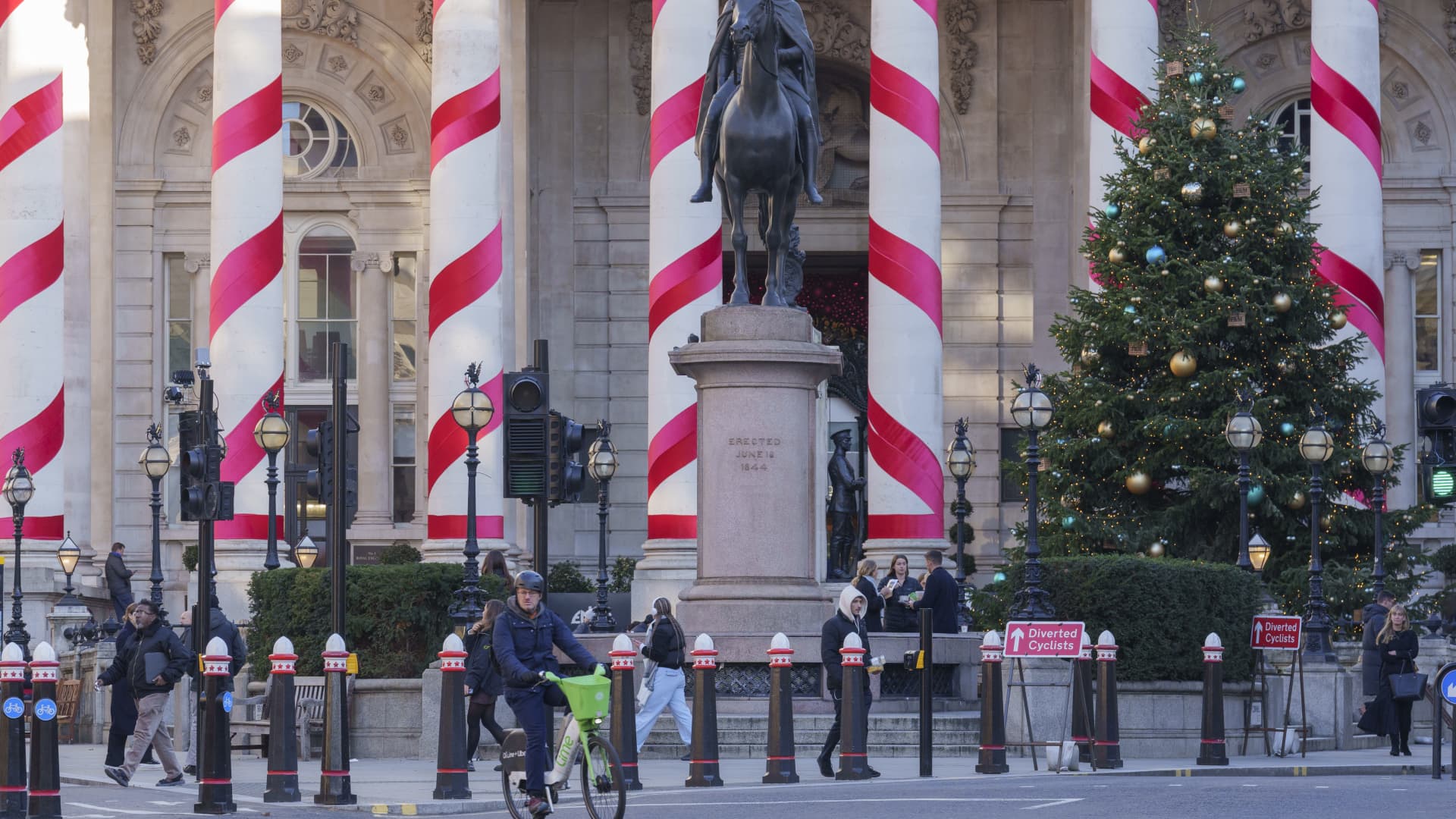
The pillars of the Royal Exchange are dressed for Christmas at the bank in the City of London, the capital's financial district, in London, England, on November 20, 2024.
Richard Baker | In pictures | Getty Images
LONDON – Inflation in the United Kingdom rose to 2.6% in November, the Office for National Statistics said on Wednesday, marking the second consecutive monthly increase in the overall figure.
The reading was in line with forecasts by economists polled by Reuters, rising from 2.3% in October.
Core inflation, excluding energy, food, alcohol and tobacco, was 3.5%, just below the Reuters forecast of 3.6%.
Overall price increases reached 1.7% in September, their lowest level in three and a half years, but were expected to rise further in the following months, partly due to an increase in the energy price cap set by the regulator this winter.
“This upward trend is expected to continue over the next few months,” Joe Nellis, economic adviser at accounting firm MHA, said in an email Wednesday, citing the energy market and “the long-term pressures of a tight domestic labor market.”
Nellis added that these structural problems were “exacerbated by the government's recent decisions”, including higher public sector pay deals, an increase in the minimum wage and pressure on companies through an increase in tax contributions for employers.
Persistent inflation in the services sector, the dominant part of the British economy, has led money markets to price in almost no chance of a rate cut during the Bank of England's final meeting of the year on Thursday. Those bets were confirmed earlier this week when the ONS reported that regular wage growth accelerated to 5.2% in the August-October period, up from 4.9% in the July-September period.
November data showed service sector inflation remained unchanged at 5%.
Research group Capital Economics said the report “strongly rules out” a BOE rate cut in December.
However, the overall inflation numbers were broadly in line with BOE forecasts, George Dibb, deputy director of economic policy at the Institute For Public Policy Research (IPPR), said by email.
“The real concern is the UK’s weaker-than-expected growth, which is now falling short of the bank’s own forecasts,” Dibb said.
Britain's economy unexpectedly contracted 0.1% in October, marking its second consecutive monthly contraction.
The British pound remained 0.06% lower against the US dollar and 0.19% lower against the euro following the report's release.
If the BOE leaves its monetary policy unchanged in December, it will end the year with just two cuts to its key interest rate, from 5.25% to 4.75%. The European Central Bank has now decided to cut interest rates four times, each by a quarter of a percentage point, and this month signaled its firm intention to cut rates next year.
The Federal Reserve is widely expected to cut interest rates by a quarter point at its own meeting on Wednesday, bringing the year's total cuts to a full percentage point. Given inflationary pressures, there remains skepticism about whether this step should be taken.

Comments are closed.