

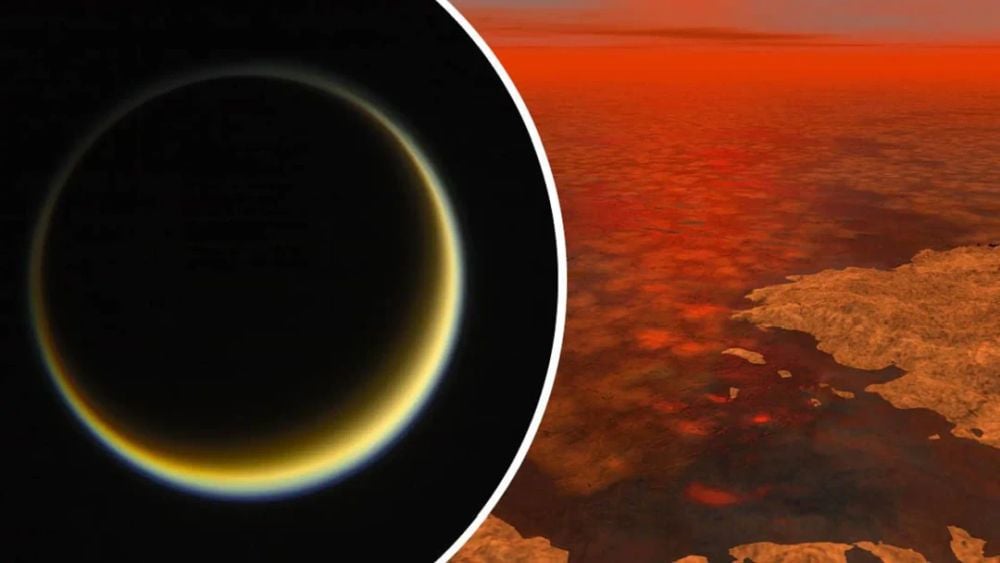
On the surface, Earth and Saturn’s moon Titan are very different from each other. Earth has a temperate climate and is warmed by the sun, liquid water flows across its surface, and life permeates its lush biosphere. Titan lies beyond the reach of the sun’s heat, is cold and lifeless, and orbits a gas giant that is also lifeless.
However, both are rocky worlds with dense atmospheres and are the only bodies in the solar system with liquid flowing over their surface. In the case of Titan, the surface fluids are cold hydrocarbons rather than water, although there may be an underground water-ammonia ocean. Some researchers have wondered whether a type of life could exist on Titan where liquid hydrocarbons take over the role of water in carrying out cellular functions.
This Cassini radar image shows liquid hydrocarbon lakes, seas and tributaries on Titan. It is the only other world besides Earth to have liquid flowing on its surface. Image source: From NASA / JPL-Caltech / Agenzia Spaziale Italiana / USGS – http://photojournal.jpl.nasa.gov/catalog/PIA17655, Public Domain.
Scientists are interested in cold Titan because of its chemistry. The chemistry of the Moon, with its dense nitrogen and methane atmosphere, is similar to Earth’s early atmosphere. This means it could serve as a kind of analogue for the early Earth, and studying it could shed light on what Earth looked like billions of years ago, and therefore clues as to how life arose.
New research in Proceedings of the National Academy of Sciences has discovered a new way certain substances can bond molecularly under Titan’s extreme conditions. The title is simply “Hydrogen cyanide and hydrocarbons mix on Titan.” The lead author is Martin Rahm, associate professor in the Department of Chemistry and Chemical Engineering at Chalmers University of Technology in Sweden.
“This work uncovers the unexpected solid-state molecular mixing of nonpolar hydrocarbons – such as methane and ethane – with hydrogen cyanide (HCN), a compound that is more polar than water,” the authors write in their research. According to the authors, this challenges chemical conventions and may shed new light on our understanding of solar system chemistry. “It suggests different ways of thinking about chemical interactions with HCN at lower temperatures and potentially changes our understanding of processes in different environments across the solar system,” they explain.
Polarity is a fundamental characteristic in chemistry. Polar compounds attract each other and bonds between polar and non-polar molecules are rare.
“These are very exciting findings that can help us understand something on a very large scale, a moon the size of the planet Mercury,” lead author Rahm said in a press release.
*This Cassini image of Titan has become iconic. The moon’s dense organic atmosphere blocks visible light and limits our attempts to understand the chemistry of its surface. Image Source: By NASA/JPL-Caltech/SSI/Kevin M. Gill – File:Titan – December 16, 2011 (40047599334).jpg by [1]CC BY 2.0, https://commons.wikimedia.org/w/index.php?curid=125680346*
The chemistry of titanium is determined by large amounts of the hydrocarbons ethane and methane as well as the extremely toxic chemical hydrogen cyanide (HCN). Research shows that these chemicals can interact with each other in ways scientists never thought possible. HCN is highly polar and the researchers found that it can form crystals with ethane and methane in the cold conditions on Titan.
“This work reveals a remarkable exception to the established rule in chemistry that polar and nonpolar compounds do not spontaneously mix: the insertion of methane, ethane and other small hydrocarbons into the crystal lattice of hydrogen cyanide (HCN), a highly polar molecule,” the authors explain in their paper. This insight could extend to the origin of life, as HCN plays a role in the formation of the building blocks of life. When interacting with ammonia and water, it can form amino acids.
“The discovery of the unexpected interaction between these substances could impact how we understand Titan’s geology and its strange landscapes of lakes, seas and sand dunes. In addition, hydrogen cyanide is likely to play an important role in the abiotic creation of several building blocks of life, for example amino acids used to build proteins and nucleobases needed for the genetic code. Ours “So work also contributes to understanding chemistry before the emergence of life and how it might have occurred in extreme, inhospitable environments,” said lead author Rahm.
The more we look into space and spy on other solar systems and exoplanets, the more we are confronted with extreme environments. For most of these worlds, life is almost certainly impossible. But others are less extreme. Is it possible that there are other ways to live on some of these clearly non-Earth-like worlds? Perhaps Titan’s chemistry and conditions can help us understand.
An unanswered question played a role in this discovery.
Scientists know that HCN is formed through photochemistry in Titan’s atmosphere. Methane (CH4) and nitrogen (N2) are the two most abundant chemicals in Titan’s atmosphere. When solar UV radiation and cosmic rays hit CH4 and N2, the molecules are broken apart. The fragments recombine to form HCN and other products.
But what happens to all the HCN? Does it collect on the planet’s surface? A group of researchers at NASA’s JPL conducted laboratory experiments in which they mixed HCN with methane and ethane at about -180°F. At this low temperature, HCN is a crystal and the hydrocarbons are liquids, just like on the surface of Titan. When they examined their results, the molecules were intact, but something had changed. Because Rahm’s research group at Chalmers University had done extensive research on HCN, they turned to Rahm for help.
“This led to an exciting theoretical and experimental collaboration between Chalmers and NASA,” Rahm said. “The question we asked ourselves was a bit crazy: Can the measurements be explained by a crystal structure in which methane or ethane is mixed with hydrogen cyanide? This contradicts a rule in chemistry, ‘like dissolves like,’ which basically means that it shouldn’t be possible to combine these polar and non-polar substances.”
Rahm and his colleagues turned to simulations to find some answers. They tested thousands of different ways methane, ethane and hydrogen cyanide might interact. They found that the hydrocarbon pair had penetrated the hydrogen cyanide crystal structure. This resulted in the formation of new, stable structures called cocrystals, which are an example of host-guest chemistry.
“This can happen at very low temperatures like on Titan. Our calculations predicted not only that the unexpected mixtures are stable under Titan’s conditions, but also light spectra that agree well with NASA’s measurements,” Rahm said.
The discovery does not negate our understanding of polar and non-polar substances. Instead, it expands it. “I see it as a nice example of when boundaries are pushed in chemistry and a generally accepted rule does not always apply,” said Rahm.
There are other recent examples of the discovery of new chemical pathways on other worlds. For example, scientists discovered phosphine in the clouds of Venus. There are no known pathways for the abiotic formation of phosphine. So unless life is hiding somewhere on the uninhabitable planet, there must be an abiotic pathway that we don’t know about.
The JWST discovered dimethyl sulfide (DMS) on the exoplanet K2-18b, a compound and potential biosignature produced by living things here on Earth. But in 2024 it was also found on the icy comet Comet 67P/Churyumov-Gerasimenko, showing that there must also be ways to its formation that we simply don’t know about yet. The realization is that our knowledge is incomplete.
Fortunately, our understanding of the fascinating Titan is poised to take a giant leap. NASA’s Dragonfly mission to Titan is scheduled to launch in 2028 and reach the cold moon in 2034. Titan’s dense atmosphere obscures much of the chemical signals from its surface, so the details of its surface chemistry are largely unknown. Dragonfly will measure the composition of materials on the lunar surface in detail and help us understand how advanced prebiotic chemistry may be.
“Prussic acid is found in many places in the universe, for example in large dust clouds, in planetary atmospheres and in comets. The results of our study could help us understand what happens in other cold environments in space,” said Rahm. “And we may be able to find out whether other non-polar molecules can also penetrate the hydrogen cyanide crystals and, if so, what this might mean for the chemistry before the emergence of life.”
“Given that methane, ethane and HCN are major components of the atmosphere and surface of Saturn’s moon Titan – where they play key roles in shaping chemistry, weather and landscape – our results could prove crucial in explaining Titan’s chemical and geological evolution,” the researchers conclude.

Comments are closed.