

Nature is full of examples of extreme life (also called extremophiles), so named because they can withstand extreme conditions. These include organisms that can survive in extremely dry conditions, extreme temperatures, acidity, pressure, and even the vacuum of space. Studying these organisms not only helps scientists learn more about the types of environments in which life can survive (and even thrive). It also helps astrobiologists speculate about possible life in the universe. Maybe the name “tardigrades” (also known as “water bears”) rings a bell, these little creatures that could survive in interstellar space?
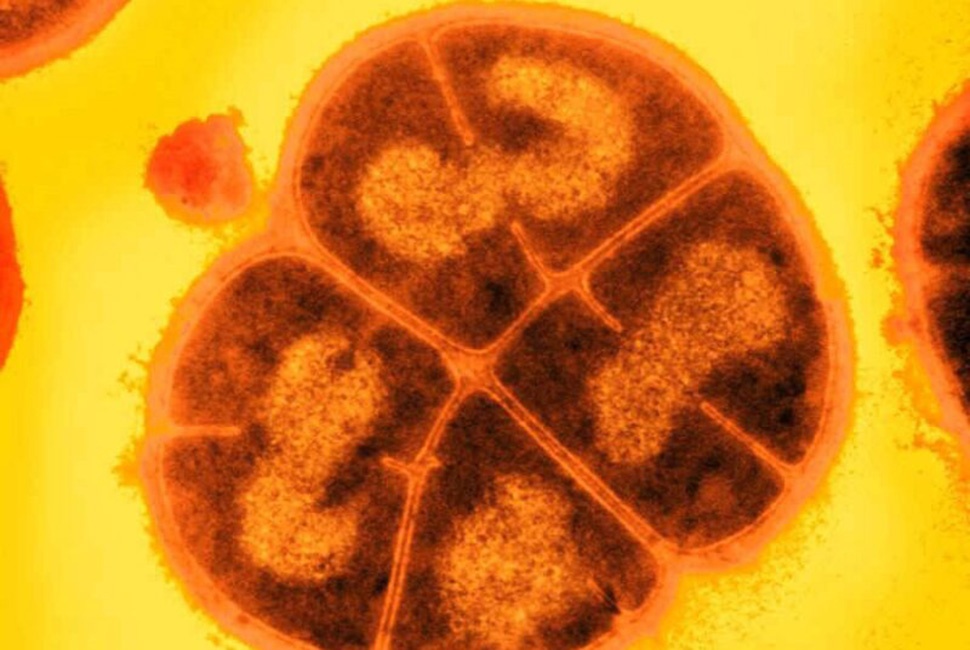
Then you have Deinococcus radiodurans (D. radiodurans), which microbiologists call “Conan the bacterium” because of its ability to tolerate the harshest conditions. These include doses of radiation thousands of times higher than those that would kill a human or any other organism on Earth. In a new study, a team of researchers from Northwestern University and the Uniformed Services University (USU) characterized a synthetic organism inspired by Deinococcus radiodurans that could enable humans to withstand increased radiation levels in space, the Moon and Mars.
The research was led by Hao Yang, a research assistant professor in the Department of Chemistry at Northwestern University. He was joined by Ajay Sharma, also a research assistant professor of chemistry at Northwestern; Michael J. Daly, professor of pathology at the Uniformed Services University (USU); and Brian M. Hoffman, Charles E. and Emma H. Morrison Professor of Chemistry and Molecular Biosciences at Northwestern. The paper detailing their findings appeared Nov. 8 in the Proceedings of the National Academy of Sciences (PNAS).
Image of the Martian atmosphere and surface taken by the Viking 1 orbiter in June 1976. (Source: NASA/Viking 1)
Hoffman is the Charles E. and Emma H. Morrison Professor of Chemistry and Professor of Molecular Biosciences, and a member of the Chemistry of Life Processes Institute and the Robert H. Lurie Comprehensive Cancer Center at Northwestern University. Daly, an expert on Deinococcus radiodurans, is also a member of the National Academies' Committee on Planetary Protection. In a previous study, Hoffman and Daly examined the ability of D. radiodurans to withstand radiation on Mars. Previous research has shown that the bacterium can survive 25,000 Grays, which is five times the lethal dose for a human.
However, Hoffman and Daly found that when dried or frozen, D. radiodurans could withstand 140,000 grays – 28,000 times the lethal dose for a human! That means frozen microbes beneath Mars' surface could survive the cosmic and solar radiation the planet is exposed to on a daily basis. They found that the key to its resistance is simple metabolites that combine with manganese to form a powerful antioxidant. They also found that the dose of radiation a microorganism can survive is directly related to the amount of manganese antioxidants it contains.
In this latest study, the research team describes a synthetic designer antioxidant (MDP) inspired by D. radiodurans that is much more effective against radiation. Building on their previous efforts, Hoffman and Daly's team investigated a designer decapeptide (DP1) that combines with phosphate and manganese to form the free radical scavenger MDP, which protects against radiation damage even better than D. radiodurans. As Hoffman explained in a Northwestern Now press release:
“It is this ternary complex that provides MDP's excellent shield against the effects of radiation. We have long known that manganese ions and phosphate together form a powerful antioxidant, but the discovery and understanding of the “magic” effect created by the addition of the third component is a breakthrough. This study has provided the key to understanding why this combination is such an effective – and promising – radiation protection agent.”
An artistic concept of Mars explorers and their habitat on the Red Planet. Courtesy of NASA
“This new understanding of MDP could lead to the development of even more potent manganese-based antioxidants for applications in healthcare, industry, defense and space exploration,” said Daly. Potential applications include synthetic antioxidants that could help protect astronauts from radiation during long-duration missions to space. In another study, Daly and his collaborators found that MDP was effective in producing irradiated polyvalent vaccines. This could also have applications in space medicine, ensuring that vaccines that are normally inactivated by radiation remain effective.
Further reading: Northwestern Now, PNAS
Like this:
Load…

Comments are closed.