

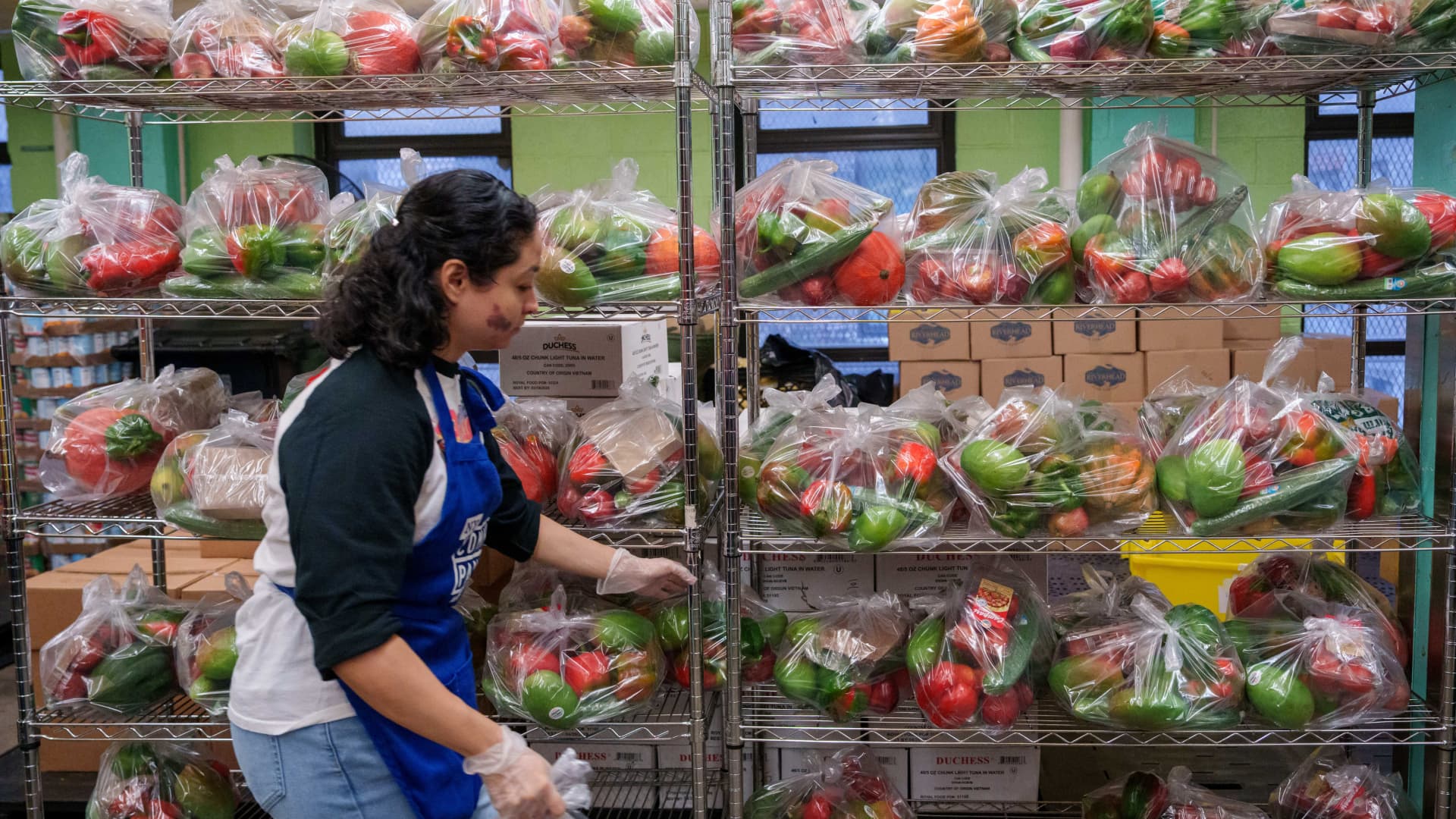
Millions of Americans live in fear that possible delays in payments for SNAP food assistance will leave them hungry, even after a federal judge ordered the Trump administration to make payments in November. This is in a country where almost $400 billion in food is wasted every year.
ReFED, a US-based non-profit organization focused on food waste, recently released its 2025 report showing that $382 billion worth of surplus food was produced in 2023, the latest statistics available.
“Globally, 40 percent of all food ends up in the trash,” said Chris MacAulay, head of the Too Good to Go food marketplace in North America, which has expanded to 70 cities. “Imagine what that means – it would be like standing in front of the fridge and throwing half of it away. That’s an incredible amount of waste,” MacAulay said.
Too Good to Go does not divert excess food that may end up in food banks, but rather provides an outlet for food that would normally be thrown away. It connects grocery stores and restaurants that have surplus food with customers looking for food at reasonable prices. For example, a local pizzeria might offer a few extra pies at the end of the evening. Instead of throwing them in the dumpster, they can at least get some back by offering them on Too Good to Go. Consumers receive a “surprise bag” containing food that would otherwise end up in landfill. Too Good to Go estimates that eight meals are saved every second through its marketplace.
“We know that many Americans are feeling greater strain on their grocery budgets, especially with the impending possible loss of SNAP benefits,” MacAulay said. “You don’t know what you’re going to get, but you can get great food at 50 to 60 percent off,” he added.
The current SNAP crisis comes amid broader cuts to the food assistance program included in the Trump administration’s tax cuts that will reduce payments across the United States
Donations, composting, pet food, and surplus food marketplaces are the main options for food waste.
“There’s not one solution, it’s a combination of solutions. We look at it as a food waste supply chain,” MacAulay said, adding that grocers in particular are finding their marketplace a good fit for their surplus.
His organization is not alone in recognizing the need for further solutions to the problem. More and more people, from major investors to mom-and-pop stores, are realizing that there is money to be saved and people to be fed in the food waste business.
“The level of transaction activity and the level of interest in this sector is quite impressive,” said Effram Kaplan, senior managing director at Brown Gibbons Lang & Company, who leads investment banking in environmental services, environmental infrastructure and energy transition.
Kaplan says that while waste management companies are nothing new, the consistency and predictability of returns are increasingly attracting investor attention. “I have been in this business for 25 years and I believe it has been undervalued for some time,” he said.
Savvy, high-net-worth infrastructure investors looking for stable returns are discovering that waste makes profits in the US. “While this type of capital has been widespread in Europe for some time, it has only just begun here,” Kaplan said.
The barriers to entry into the business are being lowered, but getting into the business still requires significant investment, often in equipment.
“I think it’s easier than ever because technology lowers the barrier to entry if you have a good idea,” MacAulay said.
Food waste from households to commercial kitchens
Some solutions come directly to the consumer. Mill, a startup founded by one of the inventors of the Nest smart thermostat, has $100 million in funding for its smart kitchen waste bin that dries, shrinks and stinks leftover food, preventing food waste.
Other approaches are used at the commercial point of waste disposal. Metafoodx, a startup that raised $9.4 million in Series A funding in May 2024, has developed a 3D AI scanner that tracks food in commercial kitchens – what is used, what is wasted, and where improvements can be made.
Buddy Bockweg, CEO of Vsimple, which works with industrial and environmental services companies (including waste management providers) to digitize and streamline operations, from field shipping to invoicing, says startups have a unique ability to use technology to compete with larger players.
“AI is able to streamline everything on the shipping side,” Bockweg said. “Those who invest in technology to power their operations are the ones who win and make more money.”
Tyler Frank, president and founder of Garbage to Garden based in Portland, Maine, started small and then grew. He started his business in 2012 with $300 and a truck after realizing while living in his apartment that there was no easy way to compost his waste. Garbage to Garden offers compost bins and subscription-based route pickup. The waste is composted and delivered to local farms, or subscribers can have the soil delivered back to them.
“I think the way I did it was a low barrier to entry, but it was a very long and difficult hill to climb. You have to achieve economies of scale,” Frank said. His motivation was partly the recognition that waste will be a business regardless of other economic factors. “This is a recession-resistant company and an idea whose time has come,” Frank said.
What started as an individual subscription is increasingly evolving into municipal contracts. Garbage to Garden now serves 50,000 subscribers and has pickup deals in cities like Boston and Medford, Massachusetts.
Lower-income households waste less
While Frank’s business model doesn’t address the problem of hunger – there may actually be less composted waste as people try to get what they can out of their food during the SNAP delays – he says the overall trend and flow of food waste is increasing.
Ben Scharadin, a professor of economics at Colby College, says the government plays a big role in innovation and growth in the sector because of federal mandates to reduce waste and companies’ desire for greater efficiency.
However, a cruel irony of the current situation is that SNAP recipients are more likely to waste less food than others.
“In lower-income households, food waste tends to be lower than in higher-income households. With tighter budget constraints, there isn’t much wiggle room in households,” said Sharadin. “Low-income and SNAP households are better able to plan their food intake because they have to be,” he said.
Sharadin says younger and wealthier households tend to waste the most and that subscription composting services are seen as a premium. The circular economy should prepare for some impact from the SNAP cuts, he said, and business models like Too Good to Go should benefit.
“As consumer budgets become more and more tight, there will be a quicker emergence of surprise bags and secondary markets that appear to be of slightly lower quality,” said Scharadin.
Although more companies are finding new ways to address the waste problem, “the first goal when it comes to food waste should be to reduce it,” Sharadin said.

Comments are closed.