

When NASA's DART mission intentionally collided with Dimorphos in September 2022, the moon's orbit was altered. Researchers have studied the photos and data DART took before the impact and learned more about the geology of the Didymos/Dimorphos system. They have now estimated the surface age of both the asteroid and its moon. The asteroid Didymos has a surface age of 12.5 million years, while the moon Dimorphos is only 300,000 years old.
In addition, the DART researchers concluded that both Didymos and Dimorphos are piles of rubble, with Dimorphos likely inheriting its boulders from Didymos.
“It's a bunch of gravel and rocks (and some sand/dust) held together by its own gravity, and nothing else,” Andy Rivkin, co-leader of the DART investigation team at the Johns Hopkins Applied Physics Lab (APL), said of Bluesky. “There's really no cohesion between the different pieces of gravel or rock on Dimorphos.”
This composition explains why the DART impact caused such a surprising change in Dimorphos' orbital period, shortening it by about 34 minutes. A collection of rocks is easier to move than a solid object.
Several DART researchers published five articles in Nature Communications examining the geology and geophysics of Didymos and Dimorphos from a DART perspective.
“These findings give us new insights into the way asteroids can change over time,” said Thomas Statler, senior scientist for solar system small bodies at NASA Headquarters in Washington, in a NASA press release. “This is important not only for understanding the near-Earth objects that are the focus of planetary defense, but also for our ability to read the history of our solar system from these remnants of planet formation. This is just part of the wealth of new knowledge we have gained through DART.”
In “The Geology and Evolution of the Near-Earth Binary Asteroid System (65803) Didymos,” Olivier Barnouin, Ronald-Louis Ballouz, also of APL, and their team were able to determine the different ages of Didymos and Dimorphos. They also found that both objects have weak surface features that most likely contributed to DART's significant influence on the Moon's orbit.
“The images and data DART collected in the Didymos system provided a unique opportunity to get a close-up geological look at a near-Earth binary asteroid system,” Barnouin said in an APL press release. “From these images alone, we were able to derive a lot of information about the geophysical properties of Didymos and Dimorphos and increase our understanding of how these two asteroids formed. We also better understand why DART was able to move Dimorphos so effectively.”
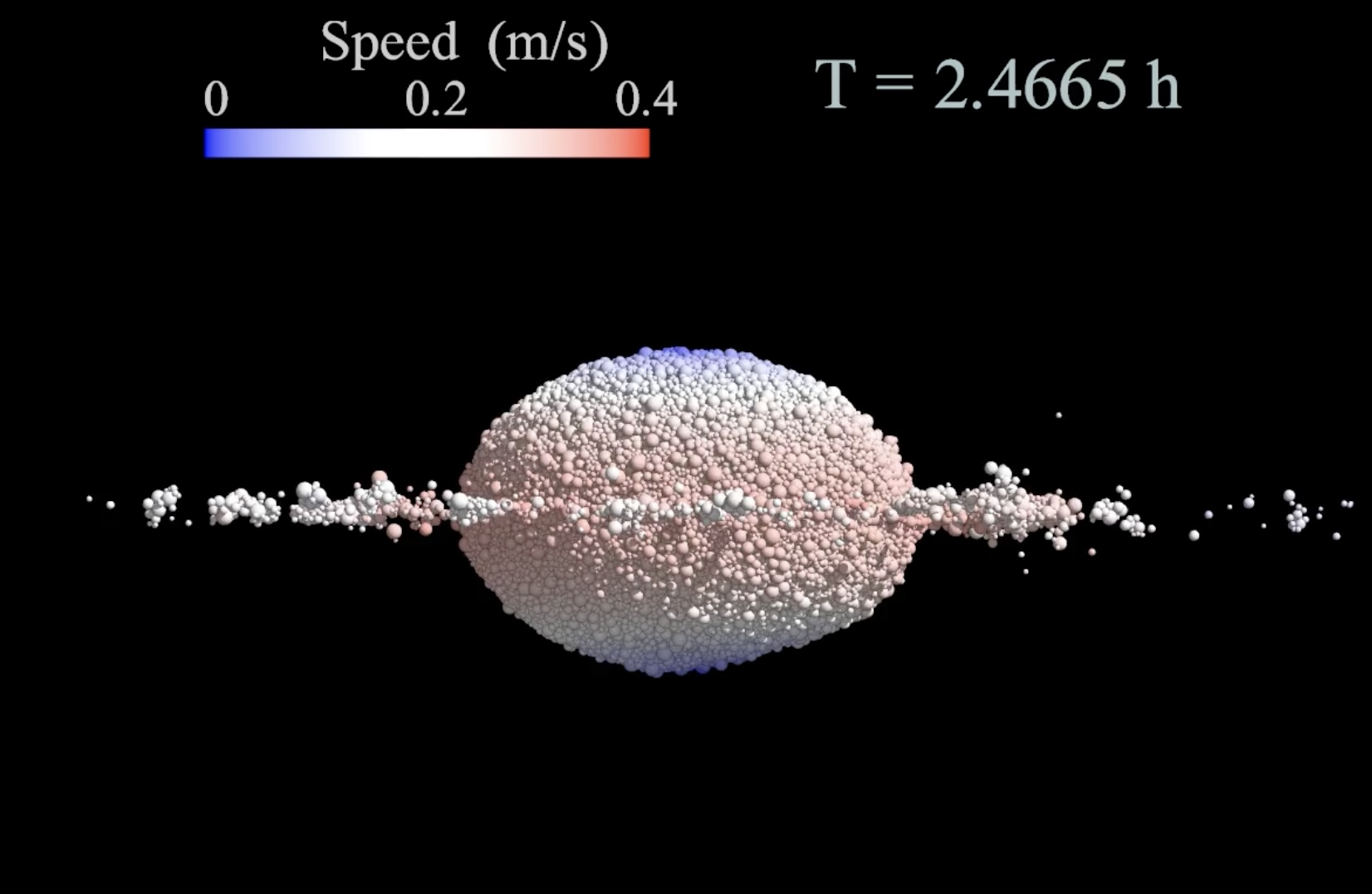
Based on the internal and surface properties described in Barnouin et al. (2024), this video shows how the rotation of the asteroid Didymos could have led to the growth of its equatorial ridge and the formation of the smaller asteroid Dimorphos, which is seen orbiting the former at the end of the clip. The particles are colored according to their speed, with the scale shown at the top, along with the ever-changing rotation period of Didymos. Image credit: University of Michigan/Yun Zhang and Johns Hopkins APL/Olivier Barnouin
Images taken by DART and its Cubesat companion LICIACube – contributed by the Italian Space Agency (ASI) – showed that Dimorphos' topography was covered with boulders of varying sizes, while the larger asteroid Didymos was smoother at lower altitudes but rockier at higher altitudes. It also had more craters than Dimorphos. The authors concluded that Dimorphos probably split off from Didymos in a large mass shedding event.
This was confirmed in another paper: “Evidence for multiple fragmentation and mass ejection of rocks on the rubble-heap binary asteroid system (65803) Didymos”. Maurizio Pajola of the National Institute of Astrophysics (INAF) in Rome and his team show that both Didymos and Dimorphos are composed mainly of a collection of rocks. This team concluded that Dimorphos probably formed when Didymos ejected material, creating a new asteroid moon.
“The size-frequency distribution of boulders larger than 5 meters on Dimorphos and 22.8 meters on Didymos confirms that both asteroids are piles of fragments created by the catastrophic destruction of their predecessors,” the team wrote. “This finding supports the hypothesis that some binary asteroid systems are formed by the acceleration and mass repulsion of part of the primary asteroid.”
In another paper, “Rapid boulder fragmentation due to thermal fatigue discovered on rocky asteroids,” Alice Lucchetti, also of INAF, and her colleagues found that the size and distribution of boulders on Dimorphos is consistent with thermal fatigue, the gradual weakening and cracking of a material due to heat. This could cause boulders on the surface of Dimorphos to break up rapidly, creating surface lines and changing the physical properties of this type of asteroid more quickly than previously thought. The DART mission was likely the first observation of such a phenomenon on this type of asteroid.
Thermal fatigue could also have implications for what would happen if this type of asteroid had to be diverted to defend the planet.
“The presence of debris fields caused by thermal fractures on near-Earth asteroid surfaces may contribute to increasing the ejected mass and momentum of kinetic impact bodies during asteroid deflection,” the authors write.
A. The approximate equator (dashed magenta line), example boulder tracks (magenta arrows) and probable boulders (white arrows) on the surface of Didymos. B. The 15 rock tracks identified on the surface of Didymos are marked by magenta lines. Image credit: Bigot, Lombardo et al.
Another paper, titled “The bearing capacity of asteroid (65803) Didymos estimated from boulder tracks,” led by students Jeanne Bigot and Pauline Lombardo of ISAE-SUPAERO in Toulouse, France, shows that the bearing capacity – the ability of the surface to withstand the loads acting on the surface of the asteroid Didymos – is only 0.1% of that of dry sand on Earth. According to NASA, this is considered an important parameter for understanding and predicting the response of a surface, including for the purpose of asteroid displacement.
Finally, in their paper “Mechanical Properties of Rubble Pile Asteroids Through Surface Boulder Morphological Analysis,” Colas Robin, also of ISAE-SUPAERO, and co-authors analyzed the surface boulders on Dimorphos and compared them to those on other rubble pile asteroids, including Itokawa, Ryugu, and Bennu. The researchers found “striking similarities” in the boulders on all four asteroids, suggesting that they all formed and evolved in similar ways and were also modified by impacts. This data will also serve as a basis for future planetary defense missions or attempted impact missions.
“Planetary protection measures rely on estimates of the mechanical properties of asteroids, which are difficult to determine accurately from Earth,” the team wrote. “The mechanical properties of the asteroid material are also important for interpreting the DART impact.”
The entire DART research team will continue to observe and study the DART impact. In addition, another spacecraft will be launched in 2024 to study Dimorphos in even greater detail. ESA's Hera mission is scheduled to reach Didymos and Dimorphos in December 2026. Hera will conduct a detailed study of Dimorphos to better understand how the impact affected the planet.
Like this:
Is loading…

Comments are closed.