

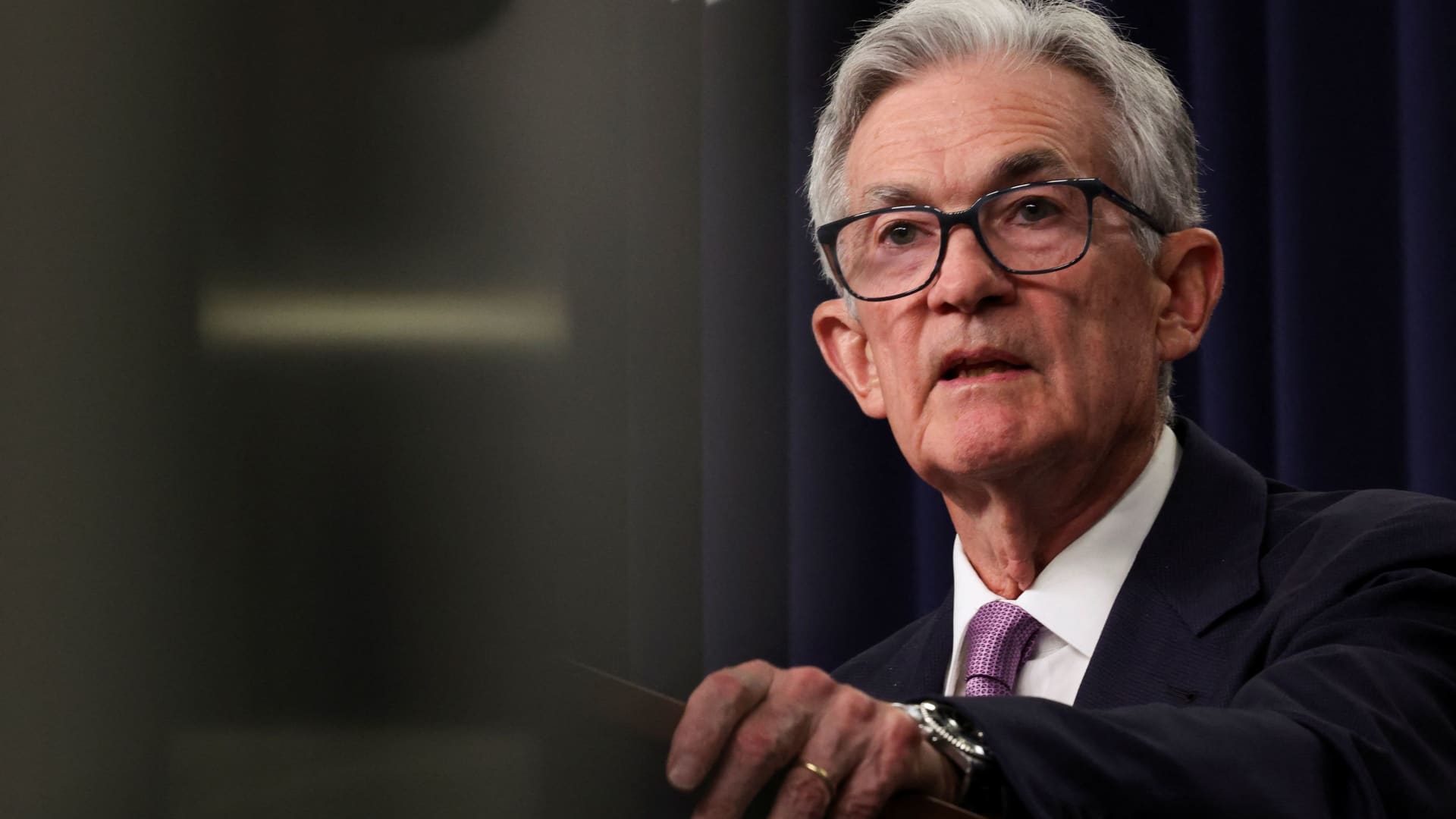
US Federal Reserve Chairman Jerome Powell has unveiled his latest buzzword to describe monetary policy: a “recalibration” of policy at a crucial moment for the central bank.
At his press conference following the Federal Open Market Committee meeting on Wednesday, Powell used variations of the word no fewer than eight times as he tried to explain why the Fed had taken the unusual step of cutting interest rates by half a percentage point without an obvious economic slowdown.
“This rebalancing of our policy stance will help maintain the strength of the economy and the labor market and will continue to enable further progress on inflation as we begin the process of moving toward a more neutral stance,” Powell said.
Immediately after the meeting, financial markets were not quite sure what to make of the chairman's messages.
Still, asset prices rose sharply on Thursday as investors took Powell at his word that the unusually large move was not a response to a significant economic slowdown, but rather an opportunity to “recalibrate” Fed policy away from a rigid focus on inflation and toward a broader approach to ensure the recent labor market slowdown does not spiral out of control.
The Dow Jones Industrial Average and the S&P 500 hit new highs in trading Thursday after experiencing wild swings on Wednesday.
“Policy was geared toward significantly higher inflation. With inflation now nearing target, the Fed may begin to reverse some of its aggressive tightening,” said Tom Porcelli, chief U.S. economist at PGIM Fixed Income.
“It really allows him to push the story that this easing cycle is not about us being in a recession, it's about extending the economic expansion,” he added. “I think that's a really powerful idea. It's something we were hoping he would do.”
Powell's keywords
Several of Powell's previous attempts to describe the Fed's policies or its views on the economy in a particularly explosive manner have not been particularly successful.
In 2018, his description of efforts to reduce bond holdings as running on “autopilot,” as well as his assessment that a series of rate hikes that same year had taken the Fed “far” from a neutral rate, sparked headwinds in markets.
More famously, however, his claim that a rise in inflation in 2021 would prove to be “transitory” ultimately led the Fed to be so hesitant in its policy that it had to implement a series of interest rate hikes of three-quarters of a percentage point each to bring inflation down.
But despite that track record and some signs of cracks in the economy, markets expressed confidence in Powell's latest assessment.
“In other contexts, a larger move might reflect greater concerns about growth, but Powell repeatedly stressed that this is essentially a happy cut as easing inflation allows the Fed to take action to maintain a strong labor market,” said Michael Feroli, chief U.S. economist at JPMorgan Chase, in a note to clients. “Moreover, if policy is optimally targeted, it should bring the economy back to a favorable position over time.”
Still, Feroli believes that following Wednesday's action, the Fed will have to take a similarly large step at its Nov. 6-7 meeting unless the labor market reverses the downturn that began in April.
There was some good news from the labor market on Thursday: The Labor Department reported that weekly applications for unemployment benefits fell to 219,000, the lowest level since May.
An unusual downward movement
The half-percentage point – or 50 basis points – cut was notable because it was the first time the Fed had gone beyond its traditional quarter-point steps without the threat of a recession or crisis.
Although Powell rejected the idea that this move was a catch-up measure for the lack of interest rate cuts at the July meeting, there was speculation on Wall Street that the central bank did indeed have to catch up to some extent.
“Maybe he felt they were getting a little behind,” said Dan North, senior North American economist at Allianz Trade. “A 50 basis point cut is pretty unusual. It's been a long time, and I think it was maybe the last jobs report that gave him pause.”
Indeed, Powell made no secret of his concerns about the labor market, saying on Wednesday that preparing for a possible slowdown was a key driver of the rebalancing.
“The Fed still sees the economy as healthy and the labor market as solid, but Powell noted that it is time to recalibrate policy,” wrote Seth Carpenter, chief economist at Morgan Stanley. “Powell emphasized, and demonstrated with this rate cut, that the FOMC is prepared to move incrementally or take larger steps depending on incoming data and how risks evolve.”
Carpenter is part of the group that expects the Fed to be able to reduce its easing to quarter percentage points for the rest of the year and into the first half of 2025.
However, traders in the futures markets are factoring in a more aggressive pace, which would mean a quarter-percentage-point cut in November but a half-percentage-point return in December, according to the CME Group's FedWatch indicator.
Aditya Bhave, an economist at Bank of America, noted a change in the Fed's post-meeting statement, which now refers to the pursuit of “maximum employment.” He interpreted this reference as a sign that the central bank is prepared to continue to act aggressively if the employment situation continues to deteriorate.
This also means that recalibration could be difficult.
“We believe the Fed will bring forward rate cuts more than it has announced,” Bhave said in a note. “The labor market is likely to remain subdued, and we believe markets will push for another, outsized cut in the fourth quarter.”

Comments are closed.