

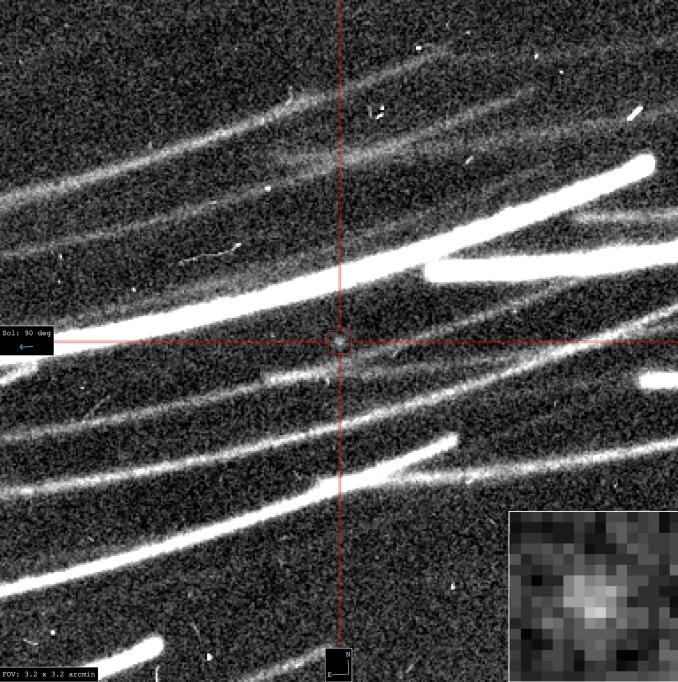
A new “mini moon” has been joining Earth for just over a month. The object is an asteroid that temporarily accompanies the Earth on its journey around the sun. It will have departed by November 25, but by then astronomers around the world have turned their telescopes to study it. New work from 2024 PT5 reveals its basaltic nature – similar to volcanic rocks on Earth – with a composition that makes it similar to lunar material. There have been many encounters with Earth that revealed many of its secrets.
The moon is perhaps one of the most famous astronomical objects. It is Earth's only permanent natural satellite and has been in orbit since the beginning of the planet's history. Located about 384,400 kilometers away, it has played a crucial role in stabilizing the axis tilt and regulating the climate and seasons. In addition to the Moon, we are occasionally joined by asteroids that briefly orbit the Earth before continuing their journey through the solar system.
The partial lunar eclipse of October 2023 from Oxfordshire, UK. Photo credit: Mary McIntyre FRAS.
2024 PT5 is a small asteroid that served as a temporary “mini-moon” for Earth and orbited near the planet for about six weeks. Analysis has shown that the asteroid rotates rapidly, completing a complete revolution in less than an hour and is no more than 15 meters in diameter. Although it will leave Earth's environment in just a few days, its brief presence has provided valuable insights and data about the properties of near-Earth objects.
Space agencies such as NASA and ESA are both exploring commercial space operations to support the growing global space economy. Asteroid exploration and mining is an activity well suited to this endeavor. Asteroids such as 2024 PT5, which are in close proximity to Earth, are well suited for this. The article was published in Astronomy & Astrophysics and was written by R. de la Fuente Marcos and a team of Spanish astronomers.
The asteroid Dimorphos was captured by NASA's DART mission just two seconds before the spacecraft hit its surface on September 26, 2022. Observations of the asteroid before and after impact suggest that it is a loosely packed “debris pile” object. Image credit: NASA/JHUAPL
The study focused on changes in short-term orbital properties and used N-body simulations (a technique for simulating a dynamical system under other physical forces such as gravity). They also studied the asteroid's spectral class through reflectivity spectral analysis with the OSIRIS spectrograph and assessing its rotational properties.
The team confirmed that 2024 PT5 is (fortunately) a natural object whose spectra consist of the so-called Sv-type asteroid, similar to the breccia found in the lunar mare. Study of its rotational properties showed that it completes one revolution in less than an hour. They couldn't rule out the possibility that the asteroid was tumbling erratically, and further analysis is needed. Finally, through astrometric observations, the team concluded that the orbits of 2024 PT5 and 2022 NX1 (another near-Earth asteroid just 10 meters in diameter) are very similar.
Both ESA and NASA now consider a cost-effective strategy for NEO missions essential, with a focus on small body science and planetary defense. The approach includes reuse and active missions, as well as identifying accessible objects such as 2022 NX1 and 2024 PT5 using ground-based observatories.
Source: Basaltic Minimoon: Characterization of 2024 PT5 with the 10.4 m Gran Telescopio Canarias and the two-meter twin telescope
Like this:
Load…

Comments are closed.