

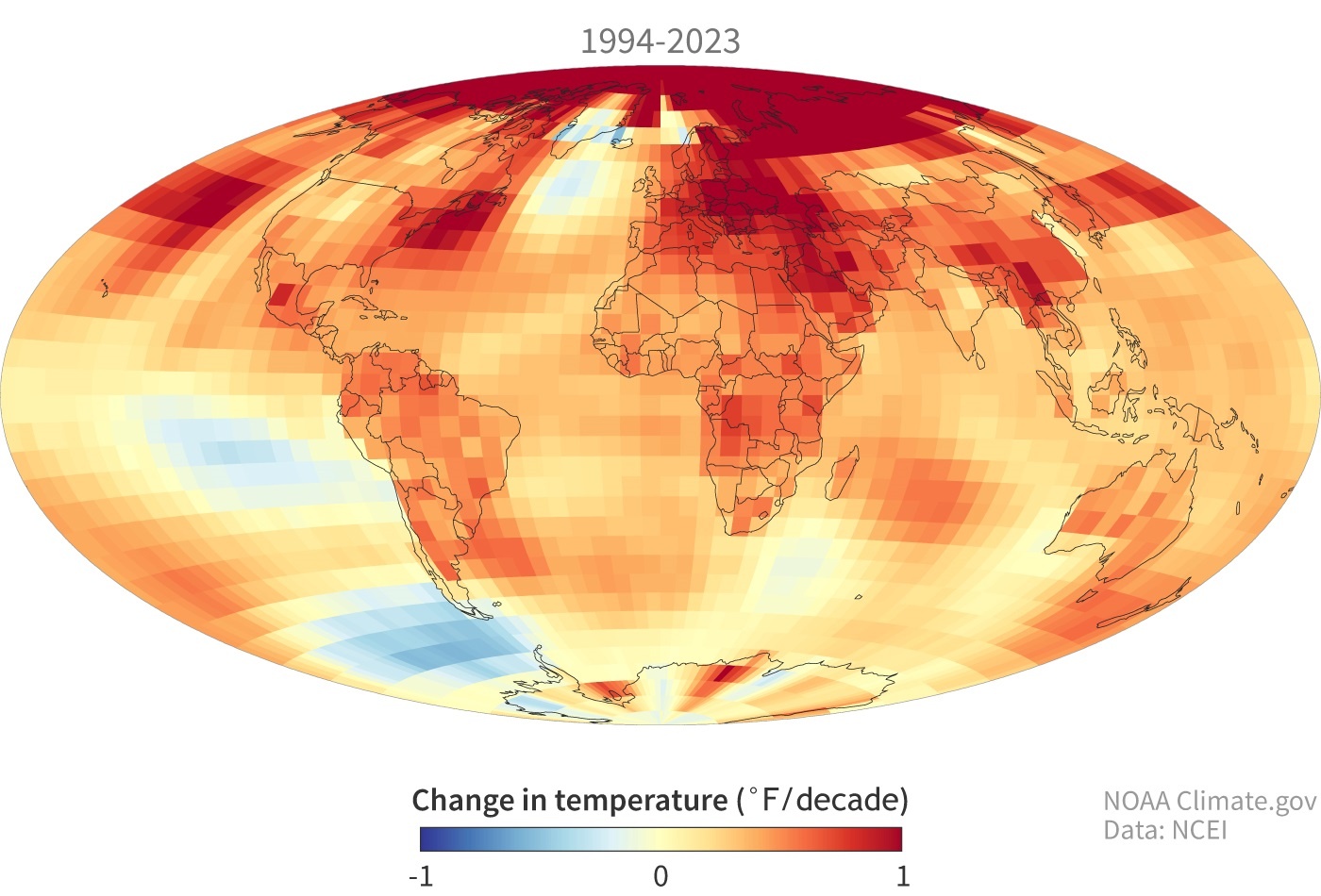
The Earth's average global temperatures have been rising steadily since the Industrial Revolution. According to the National Oceanic and Atmospheric Agency (NOAA), the Earth is warming at a rate of 0.06 °C (0.11 °F) per decade since 1850 – or about 1.11 °C (2 °F) in total. Since 1982, the average annual increase has been 0.20 °C (0.36 °F) per decade, more than three times as fast. Moreover, this trend is expected to increase by 1.5 to 2 °C (2.7 to 3.6 °F) by mid-century, possibly even more! This is a direct result of the burning of fossil fuels, which has increased exponentially since the mid-19th century.
Depending on the magnitude of the temperature rise, the impact on Earth's habitability could be catastrophic. In a recent study, a team of researchers investigated how temperature rise is a long-term problem for advanced civilizations and is not just a matter of fossil fuel consumption. They argue that rising temperatures on the planet could be an inevitable consequence of the exponential growth of energy consumption. Their findings could have serious implications for astrobiology and the search for extraterrestrial intelligence (SETI).
The study was conducted by Amedeo Balbi, an associate professor of astronomy and astrophysics at the Universita di Roma Tor Vergata, and Manasvi Lingam, an assistant professor in the School of Aeronautics, Astronautics and Space Sciences and the School of Chemistry and Chemical Engineering at the Florida Institute of Technology (Florida Tech). The paper containing their findings, “Waste heat and habitability: constraints imposed by technological energy use,” recently appeared online and is under review for publication in the journal Astrobiology.
This chart shows the meteorological temperature anomalies during summer (June, July, and August) each year since 1880. Image credit: NASA Earth Observatory/Lauren Dauphin
The idea that civilizations will eventually overheat their planet dates back to the work of Soviet scientist Mikhail I. Budyko. In 1969, he published a groundbreaking study entitled “The Effects of Fluctuations in Solar Radiation on the Climate of the Earth,” in which he argued: “All the energy consumed by man is converted into heat, the major part of this energy being an additional source of heat compared to the present supply of radiation. Simple calculations show that at the present rate of growth in energy consumption, the heat produced by man will be comparable to the energy coming from the sun in less than two hundred years.”
This is a simple consequence of the fact that all energy production and use inevitably generates waste heat. Although this waste heat is a small contributor to global warming compared to carbon emissions, long-term projections suggest this could change. Lingam told Universe Today via email:
“The current contribution of waste heat to global temperature rise is minimal. However, if waste heat production continues exponentially over the next century, a further temperature increase of 1 degree Celsius (1.8 F) can be caused by waste heat, independent of any enhanced greenhouse effect due to fossil fuels. If waste heat production maintains its exponential growth for centuries, our experience suggests it can ultimately lead to a complete loss of habitability and the demise of all life on Earth.”
The Dyson sphere is a fitting example of the waste heat resulting from the exponential growth of a highly advanced civilization. In his original proposal paper, “Search for Artificial Stellar Sources of Infrared Radiation,” Freeman Dyson argued that the need for more habitable space and energy could eventually lead a civilization to create an “artificial biosphere that completely surrounds its parent star.” As he described, these megastructures would be detectable by infrared instruments due to the “large-scale conversion of starlight to far-infrared radiation,” meaning they would radiate waste heat into space.
“The warming we study in our paper results from the conversion of any form of energy and is an inevitable consequence of the laws of thermodynamics,” added Balbi, the study's lead author. “For today's Earth, this warming represents only a negligible fraction of the warming caused by the anthropogenic greenhouse effect. However, if global energy consumption continues to grow at the current rate, this effect could become significant within a few centuries, potentially affecting the habitability of the Earth.”
To determine how long it would take for advanced civilizations to reach the point where they would render their home planet uninhabitable, Balbi and Lingam developed theoretical models based on the second law of thermodynamics (relating to energy production). They then applied this model to planetary habitability by looking at the circumsolar habitable zone (CHZ)—the orbits in which a planet receives enough solar radiation to sustain liquid water on its surface.
“We adapted the habitable zone calculation, a standard tool in exoplanet research. Essentially, we included an additional heat source – that coming from technological activity – in addition to stellar irradiation,” Balbi said. Another important factor they took into account is the exponential growth rates of civilizations and their energy consumption, as predicted by the Kardashev scale. Using humanity as a template, we see that global energy consumption rates increased from 5,653 terawatt hours (TWh) to 183,230 TWh between 1800 and 2023.
This trend was not only exponential, but accelerated over time, similar to population growth over the same period (1 billion in 1800 to 8 billion in 2023). Balbi and Lingam extrapolated this trend to measure the impact on habitability and determine the maximum lifespan of an advanced civilization once it has entered a phase of exponential growth. Ultimately, they concluded that the maximum lifespan of technospheres is about 1000 years, assuming they have an annual growth rate of about 1% throughout the study period.
Humanity's energy consumption has experienced accelerated and exponential growth over the past two centuries. Source: OurWorldInData.org/Energy Institute – Statistical Review of World Energy (2024)
These findings, according to Balbi, have implications for humanity and the search for extraterrestrial intelligence (SETI):
“Our results show that the impact of waste heat could become significant not only in the future of Earth, but also in the evolution of any hypothetical technological species inhabiting planets around other stars. Consequently, taking this constraint into account could affect our approach to the search for technologically advanced life in the universe and our interpretation of the results of such searches. For example, it could provide a partial explanation for the Fermi paradox.”
Balbi and Lingam also stress that these results provide some possible recommendations for how we might prevent our planet from becoming uninhabitable. Again, there are implications for SETI, as any solution we can think of has probably already been implemented by another highly advanced species. Balbi said:
“Although our paper focuses on physics rather than solutions to societal challenges, we envision some scenarios that could help a technologically oriented species mitigate the limitations of waste heat and delay its onset. A sufficiently advanced civilization could deploy technologies to counteract warming, for example by deploying stellar shields.”
“Alternatively, they could move much of their technological infrastructure into space. Such mega-engineering projects would have significant implications for our search for technosignatures. A less ambitious but perhaps more feasible approach would be to reduce energy consumption by slowing growth. Of course, we cannot predict which of these options is the most plausible.”
Further reading: arXiv
Like this:
Load…

Comments are closed.