

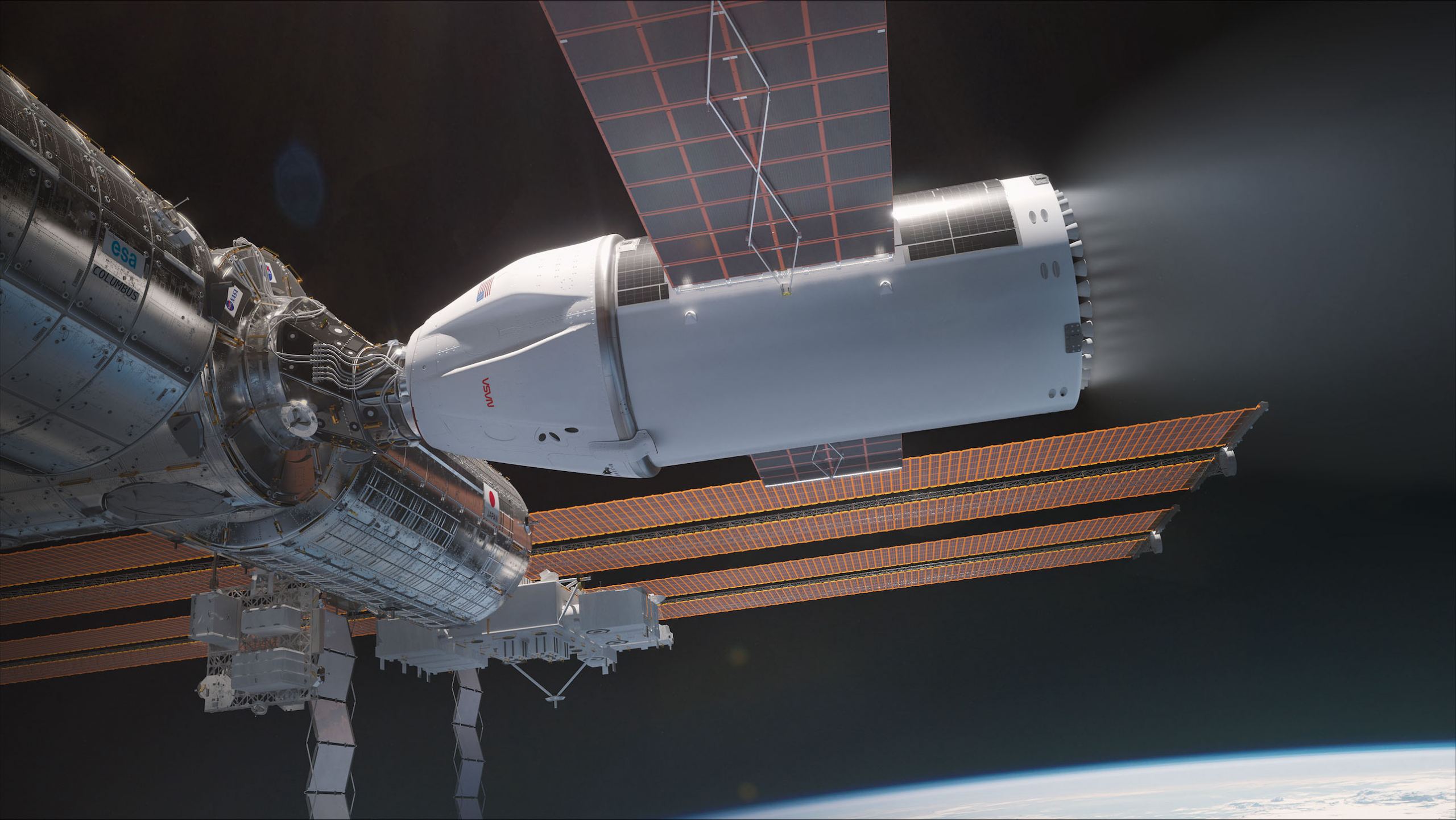
The International Space Station (ISS) has been orbiting Earth continuously for more than 25 years and has been visited by over 270 astronauts, cosmonauts and commercial astronauts. In January 2031, a special spacecraft developed by SpaceX – also known as the U.S. Deorbit Vehicle – will lower the station's orbit until it enters our atmosphere and lands in the South Pacific. On July 17, NASA held a live press conference where it announced details of the process, including a first look at the modified SpaceX Dragon responsible for deorbiting the ISS.
As usual, the company shared details of the press conference and a picture of the special Dragon via its official X account (formerly Twitter). As they stated, SpaceX will use a modified spacecraft that has six times the fuel and four times the power of “their current Dragon spacecraft.” The image shows that the US deorbit vehicle will have a rugged service module instead of the fuselage used by the standard Crew Dragon vehicle. This module is larger and has additional pop-up solar arrays in addition to the solar panels mounted on the fuselage.
It also appears to have more Draco engines than the standard Crew Dragon vehicle – which has 18 engines capable of generating 400 newtons (90 lbf) each – giving a total of 7,200 N (360 lbf) of thrust. This presumably means the US deorbit vehicle will have 72 Draco engines (arranged concentrically) and will be capable of generating nearly 30,000 newtons (1,440 lbf) of thrust. The image also shows the spacecraft docking with the Kibo module operated by the Japan Aerospace Exploration Agency (JAXA).
NASA announced in late June that SpaceX had been selected to develop the vehicle. The contract will be awarded as part of a single contract with a potential total value of $843 million. SpaceX will be responsible for developing the spacecraft, and NASA will own it after it is completed and operate it throughout the mission. Both the spacecraft and the ISS are expected to break up during reentry, and the remains will land in the “spacecraft graveyard” in the South Pacific. The contract for launch services has not yet been awarded, but will be announced soon.
SpaceX is also responsible for developing the Human Landing System (HLS) – Starship HLS – which will transport astronauts to the lunar surface as part of the Artemis III and IV missions. SpaceX has also been contracted to launch the core elements of the Lunar Gateway – the Power and Propulsion Element (PPE) and the Habitation and Logistics Outpost (HALO) – into lunar orbit on a Falcon Heavy rocket in November 2025.
The International Space Station (ISS) in orbit. Photo credit: NASA
Since 1998, the ISS has served as a unique scientific platform hosting crew members from five space agencies, including NASA, the Canadian Space Agency, the European Space Agency (ESA), JAXA and the Russian State Space Corporation (Roscosmos). During its operational life, crew members have conducted experiments examining the effects of microgravity and space radiation on the physiology of humans, animals and plants. This research will play a critical role as NASA and its international partners conduct long-duration missions to the Moon and Mars in the coming decades.
The station has also enabled extensive research in space science, biology and physics, as well as technology demonstrations not possible on Earth. Most importantly, the ISS has served as a symbol of international cooperation, in line with the Outer Space Treaty and its core philosophy that “space is for everyone.” NASA, CSA, ESA and JAXA have all committed to operating the station until 2030, while Roscomos has committed to continuing operations until at least 2028. Safely deorbiting the ISS is the responsibility of all five space agencies.
Further reading: NASA
Like this:
Is loading…

Comments are closed.