

Computers are truly wonderful and powerful things, but only when programmed by a clever mind. Check this out… there's an algorithm that mimics the growth of mold, but a team of researchers has adapted it to model the large-scale structure of the universe. Since the Big Bang, the universe has been expanding as gravity concentrates matter into galaxies and galaxy clusters. In between are vast areas of empty space called voids. The structure is often referred to as the cosmic web.
The cosmic web is the largest structure in the universe, consisting of filaments of galaxies and dark matter that stretch across the abyss of space. The filaments connect clusters of galaxies with vast voids between them. The web-like structure has been formed because gravity has been pulling matter together since the beginning of time. Studying the cosmic web helps us understand the evolution of the universe, the distribution of matter, and the relationship to dark matter.
Image of a galaxy cluster that may contain dark matter (blue shaded area) from NASA's Hubble Space Telescope. (Credit: NASA, ESA, MJ Jee and H. Ford et al. (Johns Hopkins Univ.))
Since the early 1980s, it has been known that the nature of a galaxy and its environmental conditions affect how it grows and evolves. The exact nature and how this happens is still the subject of much debate. A team of researchers believe they have proven how galaxies evolve using a slime algorithm!
The team, led by Farhanul Hasan, Professor Joe Burchett and eight co-authors, published their findings, “Filaments of the cosmic slime mold web and how they influence galaxy evolution,” in the August issue of the Astrophysical Journal. In the paper, they report how the slime mold algorithm helped unlock the secrets of the cosmos.
Burchett recommended using the slime mold algorithm for an astrophysics application. Hasan worked with Burchett and modified the algorithm to help them visualize the cosmic web. The team worked with graphics rendering expert Oskar Elek to use the slime mold algorithm. The mold algorithm was designed to mimic slime molds, which can find their own food by transforming themselves into a structure very similar to the cosmic web. It took the team several years to complete their work.
In shaping the universe, gravity builds a vast spider-web-like structure of filaments that connect galaxies and galaxy clusters along invisible bridges hundreds of millions of light-years long. A galaxy can move in and out of the densest parts of this web throughout its lifetime. Image credit: Volker Springel (Max Planck Institute for Astrophysics) et al.
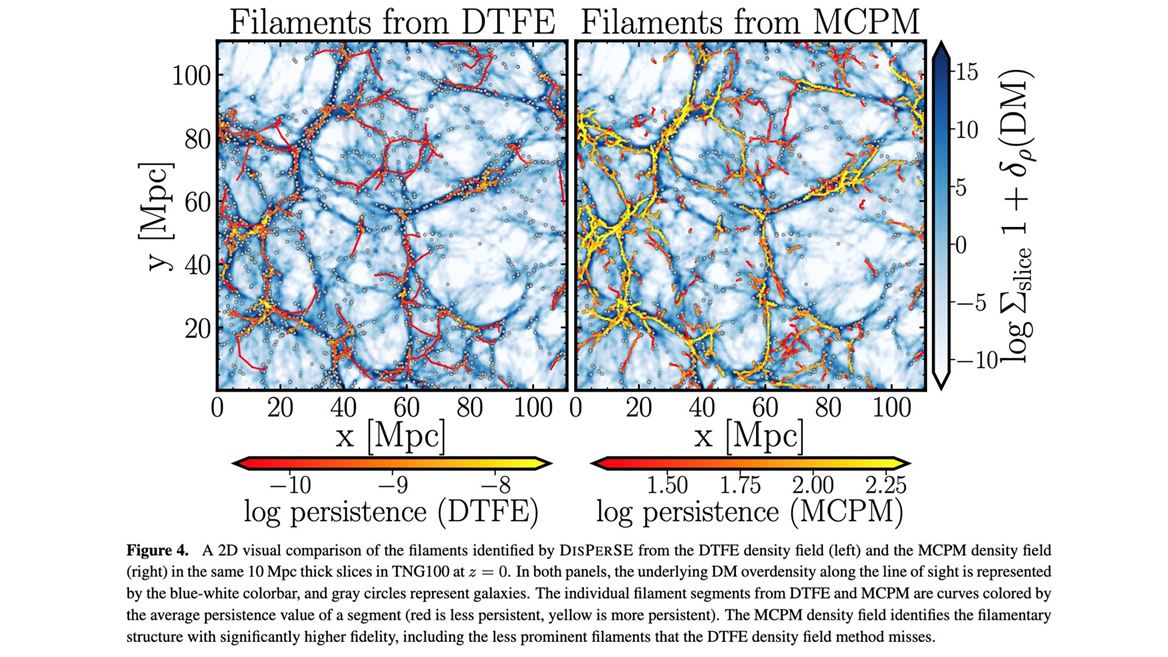
The result, according to Hasan, revealed far more detailed discrete structures than the old method. He added: “I didn't know how well it would work or not, but I had a feeling that the slime mold method could give us much more detailed information about how density is structured in the universe, so I decided to give it a try.”
Finally, Hasan and his team found that the impact on galaxies seems to have taken a proverbial U-turn. In earlier epochs, a galaxy's growth was stimulated by its proximity to larger structures. In the nearby universe, and thus in cosmologically more recent times, we see that galaxy growth is limited by its proximity to larger structures. This would not have been possible without the modified slime mold algorithm. Using the algorithm, we can now map the gas around the real universe over many different times to understand how the web changed and the universe evolved.
Source: NMSU astronomy research uses slime molds to model galaxies
Like this:
Load…

Comments are closed.