

UNIVERSITY OF BERN
Research news
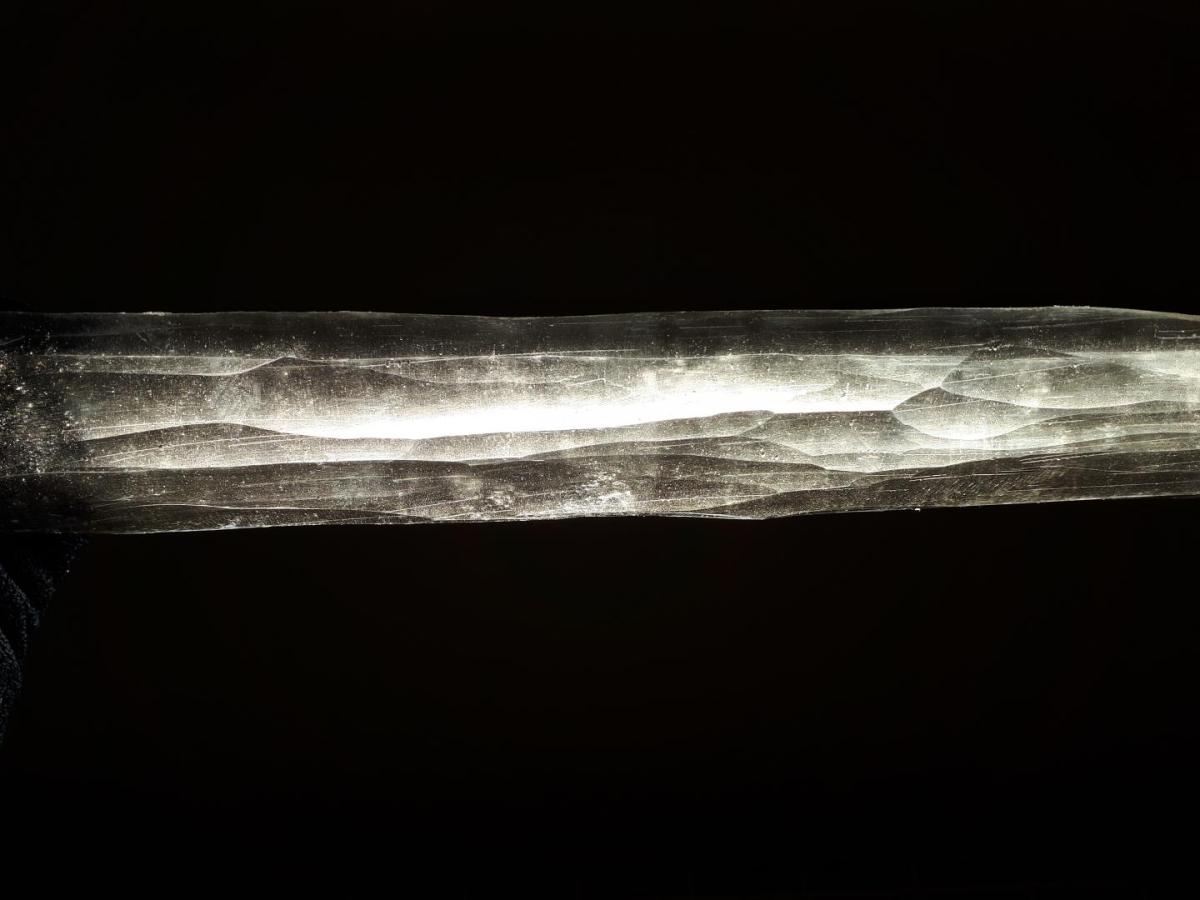
PICTURE: ICE SAMPLE FROM AN ANTARCTIC ICE CORE. Show more CREDIT: DANIEL BAGGENSTOS
Bern’s ice core researchers were able to demonstrate in 2008 how the CO2 concentration in the atmosphere has changed over the past 800,000 years. Using the same ice core from the Antarctic, the group led by climate researcher Hubertus Fischer from Bern is now showing the maximum and minimum values between which the mean sea temperature has fluctuated over the past 700,000 years. The results of the reconstruction have just been published in the journal Climate of the Past.
The most important results of the study: The mean sea temperatures in the last seven ice ages were very similar and were on average 3.3 ° C colder than in the pre-industrial reference period, as already suggested by the synthesis of deep water temperatures from marine sediments. However, sea temperatures in the warm periods 450,000 years ago were much colder and CO2 concentrations were lower than in our current warm period despite similar solar radiation. The new measurements show that sea temperature is also influenced by changes in ocean circulation. The so-called global circulation of deep waters has a significant impact on heat storage in the ocean.
“In order to understand how the heat balance of the climate system is changing,” says Hubertus Fischer, “we first and foremost have to understand the ocean.” For example, 93 percent of the additional heat that people accumulate due to the increase in greenhouse gases is currently more likely to be in the ocean than stored in the atmosphere. This means that without the heat absorption of the ocean, the temperature rise measured on land would be considerably greater due to man-made climate change. Since the oceans have a large mass compared to the atmosphere, the temperature changes measured in the ocean today are very small. Measurements on some ice samples are sufficient
The relevance of marine data for climate research is shown by the international ARGO project, a mobile observation system for the world’s oceans, with which, for example, continuous temperature measurements down to a depth of 2,000 meters have been carried out since 2000. Around 4,000 drifts. Buoys distributed over all oceans are used for this. The approach taken by the Bernese researchers is all the more astonishing in comparison: “We only need a single polar ice sample for our mean sea temperature measurement,” explains Hubertus Fischer, “of course we are nowhere near as accurate as ARGO, but the other way around, we can go far look back at the past. “What is being investigated is not frozen seawater, but air bubbles trapped in the Antarctic glacier ice. In particular: the noble gases argon, krypton, xenon and molecular nitrogen. Most of these gases are in the atmosphere, only a small part is dissolved in the ocean. How well each gas is dissolved in seawater depends on the sea temperature. Therefore, the changing ratio of these gases in the ice samples can be used to reconstruct past mean sea temperatures.High-precision gas measurements by Bern researchers
“The prerequisite for this method are high-precision measurements with a dynamic mass spectrometer,” emphasizes Hubertus Fischer, “which was made possible by the great efforts of several doctoral students and postdocs involved in the publication.” Processing and measurement methods developed in Bern as part of the MATRIC project funded by the European Research Council (ERC) are also decisive. Past sea temperatures are determined to an accuracy of 0.4 ° C in Bern. This precision makes it possible to follow the climatic ups and downs of the past, as the difference in mean sea temperature between the Ice Age and the warm phases was around 3 ° C over the past 700,000 years. In addition to the laboratory in Bern, only the Scripps Institute of Oceanography in San Diego, USA, with which Bern’s researchers work closely, has carried out such measurements worldwide.
###
From EurekAlert!
3.2
5
voices
Item rating
Like this:
Loading…

Comments are closed.