

Since it began scientific operations in mid-2022, the James Webb Space Telescope has made significant progress in detecting atmospheres around exoplanets. This included the first clear detection of carbon dioxide in the atmosphere of an exoplanet (WASP-39b), atmospheric water vapor (WASP-96 b), and even heavier elements such as oxygen and carbon (HD149026b). According to the latest press release, researchers announced that they have discovered the strongest evidence yet of an atmosphere around a rocky planet.
The planet is the ultra-hot super-Earth TOI-561 b, a rocky planet with 1.4 times Earth’s radius that orbits a Sun-like star located about 275 light-years from Earth. With an orbital period of less than 11 hours, this planet belongs to a rare class of objects known as ultra-short period exoplanets (USP). Observations with Webb’s Near Infrared Spectrometer (NIRSpec) suggest that this planet is covered by a global magma ocean with a thick blanket of gas above it. According to the team, these results challenge the prevailing theory that small planets orbiting close to their stars cannot maintain an atmosphere.
The research was led by Johanna Teske and her colleagues from the Earth and Planets Laboratory at the Carnegie Institution for Science. They were joined by researchers from the Waterloo Center for Astrophysics and the Department of Physics and Astronomy, the Trottier Institute of Exoplanet Science, the Kapteyn Astronomical Institute, the Atmospheric, Oceanic, and Planetary Physics Research Group in Oxford and several universities. Their results were published Dec. 11 in The Astrophysical Journal Letters.
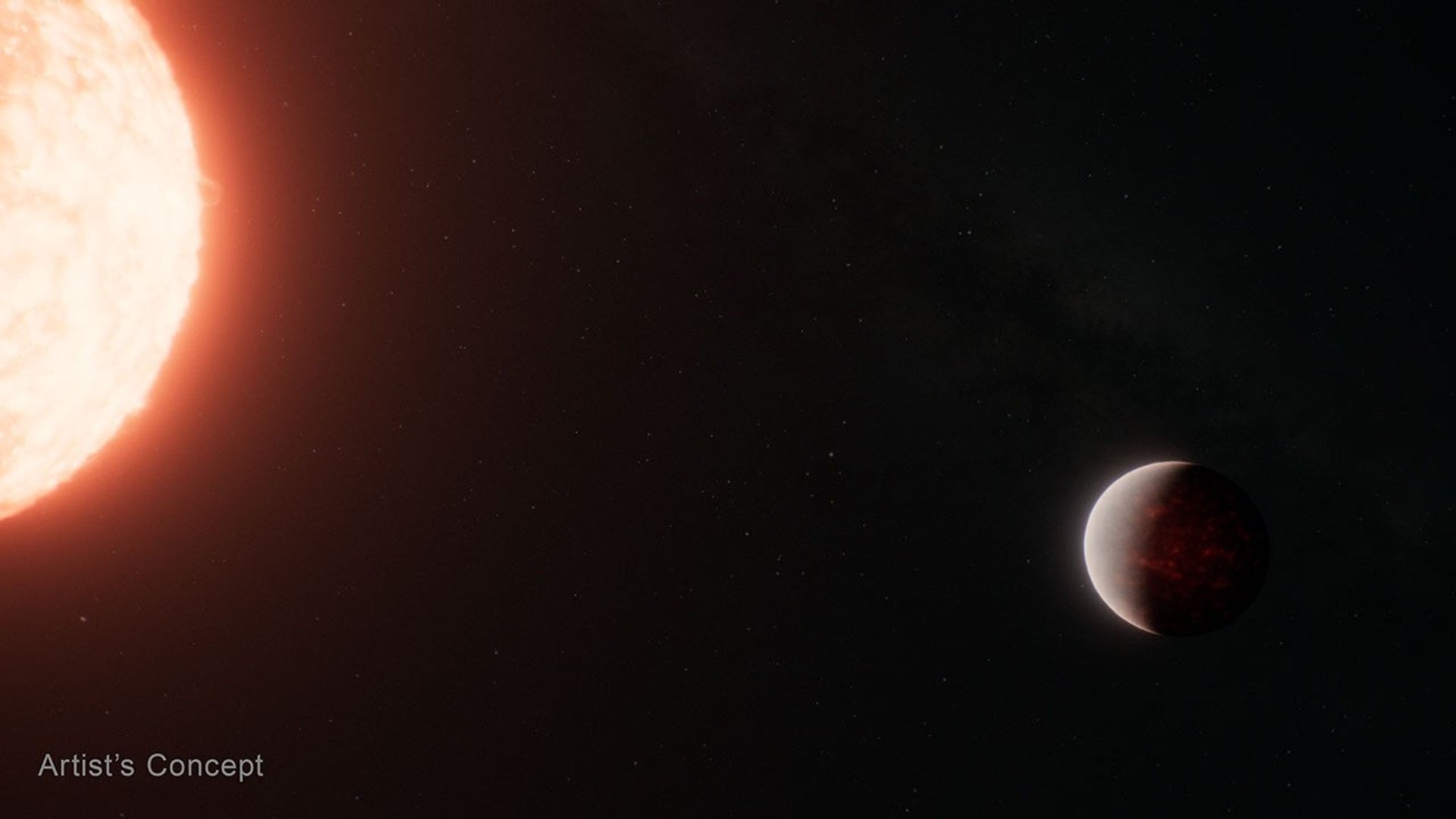
An artist’s concept shows what a dense atmosphere over a vast magma ocean on the exoplanet TOI-561 b might look like. Photo credit: NASA, ESA, CSA, Ralf Crawford (STScI)
Because TOI-561 b orbits so closely to its star, less than a fortieth of the distance between Mercury and the Sun, the research team concludes that it must be tidally locked, with one side constantly facing its Sun. This means that daytime temperatures exceed the melting temperature of the rock and a magma surface is formed. In addition, measurements of the planet’s size and mass revealed a surprisingly low density. One possible explanation for this is that the planet may have a relatively small iron core and a mantle of rock that is less dense than Earth’s. As Teske explained in a NASA press release:
TOI-561 b differs from ultrashort-period planets in that it orbits a very old (twice the age of the Sun), iron-poor star in a region of the Milky Way known as the thick disk. It must have formed in a very different chemical environment than the planets in our own solar system.” The planet’s composition could be representative of planets that formed when the universe was relatively young.
Given its theoretical composition and the age of its host star, which is about 10.5 billion years old, TOI-561 b could be representative of planets that formed when the universe was relatively young. Another possibility is that TOI-561 b has an atmosphere that makes it appear larger than it is, similar to what has been observed with “super-puff” gas giants orbiting close to their stars. To test this theory, the team used Webb’s NIRSpec to measure the planet’s daily temperature. This required observing the system for more than 37 hours as TOI-561 b completed almost four full orbits around the star.
During these orbits, the team measured the decrease in the system’s brightness as the planet passed behind its parent star. This is essentially the opposite of what exoplanet researchers do with the transit method, which uses dips in a star’s luminosity to detect potential exoplanets and measure their orbital period. This technique is also similar to that used to search for atmospheres on rocky planets orbiting red dwarf stars (like TRAPPIST-1). If there were no atmosphere, the planet would have no way to transfer heat between the day and night sides. In this case, the research team expected a daytime temperature of about 2,700 °C (4,900 °F).
An emission spectrum captured by NASA’s James Webb Space Telescope in May 2024 shows the brightness of various wavelengths of near-infrared light emitted by the exoplanet TOI-561 b. Image credit: NASA/ESA/CSA/STScI/Teske et al. (2025).
However, NIRSpec observations showed a daytime temperature closer to 1,800 °C (3,200 °F). Co-author Dr. Anjali Piette from the University of Birmingham said:
We really need a thick, volatile atmosphere to explain all the observations. Strong winds would cool the dayside by transporting heat to the nightside. Gases like water vapor would absorb a few wavelengths of near-infrared light emitted from the surface before traveling all the way up through the atmosphere. The planet would look colder because the telescope sees less light, but it is also possible that there are bright silicate clouds that cool the atmosphere by reflecting starlight.
The question remains: How could a small, tidally dependent planet exposed to so much radiation retain its atmosphere, especially one as dense as TOI-561 b’s? “We think there is a balance between the magma ocean and the atmosphere. As gases escape from the planet to feed the atmosphere, the magma ocean sucks them back in,” said co-author Tim Lichtenberg from the University of Groningen. “This planet has to be much, much more volatile than Earth to explain the observations. It’s really like a wet lava ball.”
These results are the first to come from Webb’s General Observers (GO) Program 3860, part of its Cycle 2 programs. The team is currently analyzing the entire data set to determine temperatures on both sides of the planet and learn more about the composition of the atmosphere.
Further reading: NASA

Comments are closed.