

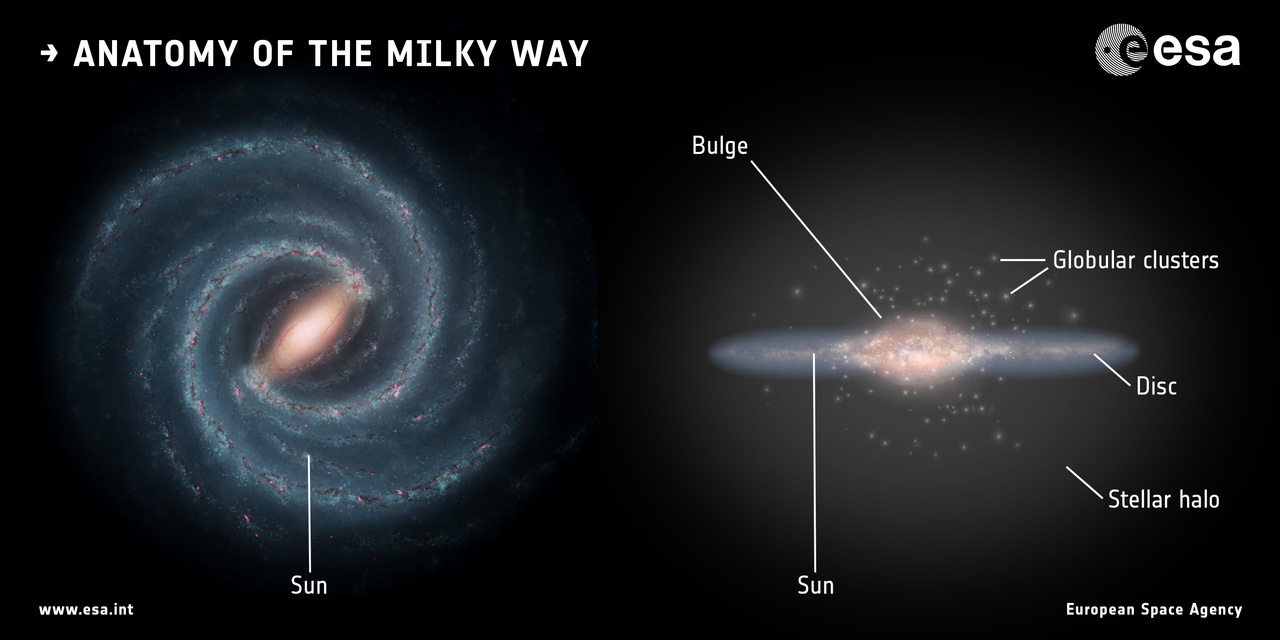
Astronomers have spent decades trying to understand how galaxies get so big. Part of the puzzle are spheroids, also called galactic bulges. Spiral galaxies and elliptical galaxies have different morphologies, but both have spheroids. This is where most of their stars are located and, in fact, this is where most of the stars in the universe are located. Since most stars are found in spheroids, understanding them is crucial to understanding how galaxies grow and evolve.
New research focusing on spheroids has brought them closer than ever to understanding how galaxies become so massive.
Elliptical galaxies do not have a flat disk component. They are smooth and shapeless and contain comparatively little gas and dust compared to spirals. Without gas and dust, new stars rarely form, so elliptical stars are populated with older stars.
Astronomers don't know how these ancient, bulging galaxies formed and evolved. However, a new research letter in Nature may finally find the answer. The title is “In situ spheroid formation in distant submillimeter-bright galaxies.” The lead author is Qing-Hua Tan from the Purple Mountain Observatory, Chinese Academy of Sciences, China. Dr. Annagrazia Puglisi from the University of Southampton co-authored the study.
“Our findings bring us closer to solving a long-standing mystery in astronomy that will redefine our understanding of how galaxies formed in the early universe.”
Dr. AS Annagrazia Puglisi, University of Southampton
The international research team used the Atacama Large Millimeter/sub-millimeter Array (ALMA) to study bright starburst galaxies in the distant universe. Submillimeter means that electromagnetic energy is observed between far infrared and microwave. Astronomers have long suspected that these galaxies are associated with spheroids, but observing them is challenging.
“Infrared/submillimeter-bright galaxies with high redshifts have long been suspected of being associated with spheroid formation,” the authors write. “Demonstrating this connection has so far been hampered by severe dust obscuration when focusing on their star emission or by methods and limited signal-to-noise ratios when considering submillimeter wavelengths.”
This image shows two of the 12-meter antennas of the Atacama Large Millimeter/submillimeter Array (ALMA). ALMA has 66 antennas that work together as interferometers. (Source: Iztok Bonina/ESO)
The researchers used ALMA to analyze more than 100 of these ancient galaxies using a new technique that measures their light distribution. These brightness profiles show that most galaxies have a triaxial shape rather than flat disks, suggesting that they have been deformed by something in their history.
The team's results are based on two important concepts: the Sersic index and the Spergel index.
The Sersic index is a fundamental concept for describing the brightness profiles of galaxies. It characterizes the radial distribution of light coming from galaxies and essentially describes how light is concentrated in a galaxy.
The Spergel index is less commonly used. It is based on the distribution of dark matter in galaxies. Instead of light, it helps astronomers understand how matter is concentrated. Together, both indices help astronomers characterize the complex structure of galaxies.
These indices, along with the new ALMA observations, led to new insights into how spheroids formed through mergers and the resulting influx of cold, star-forming gas.
It all starts with a galaxy collision or merger, sending large streams of cold gas into the galactic center.
This is a JWST image (not from this research) of an ancient galaxy merger 13 billion years ago. The galaxy, named Gz9p3, has a binary nucleus, suggesting the merger is underway. While astronomers know that mergers are a crucial part of galaxy growth and evolution, the role of spheroids has been elusive until now. Image source: NASA/Boyett et al
“The collision of two disk galaxies caused gas – the fuel from which stars are formed – to sink towards their center, creating trillions of new stars,” said co-author Puglisi. “These cosmic collisions occurred about eight to 12 billion years ago, when the universe was in a much more active phase of its evolution.”
“This is the first real evidence that spheroids form directly from intense episodes of star formation in the cores of distant galaxies,” Puglisi said. “These galaxies form quickly – gas is sucked in to feed black holes, triggering eruptions of stars that form 10 to 100 times faster than our Milky Way.”
The researchers compared their observations with hydrosimulations of galaxy mergers. The results show that the spheroids can maintain their shape for up to about 50 million years after the merger. “This is compatible with the observationally derived timescales for the submillimeter-bright bursts,” the authors write. After this intensive phase of star formation in the spheroid, the gas is used up and it comes to rest. No more energy is fed into the system and the residual gas flattens into a disk.
This research illustration shows how the spheroids lose their shape following the intense star formation phase following a merger. (a) shows maps (2×2 kpc) of the central gas in three different
Mergers showing the flattest projection for these systems observed 12 million years after the merger; This means that these systems are 3D spherical structures and not front-facing disks. (b) shows that the rate of star formation peaks and then declines over time. (c) shows C/A, which quantifies the relative system thickness encompassing all galactic components, including disks, bars, and bulges. It is a ratio between C, the shortest axis, and A, the longest axis in a three-axis ellipsoid. Image source: Tan et al. 2024.
These types of galaxies were more common in the early universe than they are today. The researchers' results show that these galaxies quickly used up their fuel, forming the spheroids now populated by ancient stars.
This is not the first time that astronomers have examined the possible connection between spheroids and distant submillimeter-bright galaxies. Previous research that found evidence of triaxiality also found strong ellipticity and other evidence that submillimeter-bright galaxies are discs with submillimeter bars. However, this new research relied on observations with a higher signal-to-noise ratio than previous research.
“Astrophysicists have been trying to understand this process for decades,” Puglisi said. “Our findings bring us closer to solving a long-standing mystery in astronomy that will redefine our understanding of how galaxies formed in the early universe.”
“This will give us a more complete picture of early galaxy formation and deepen our understanding of how the universe has evolved since the beginning of time.”
Like this:
Load…

Comments are closed.