

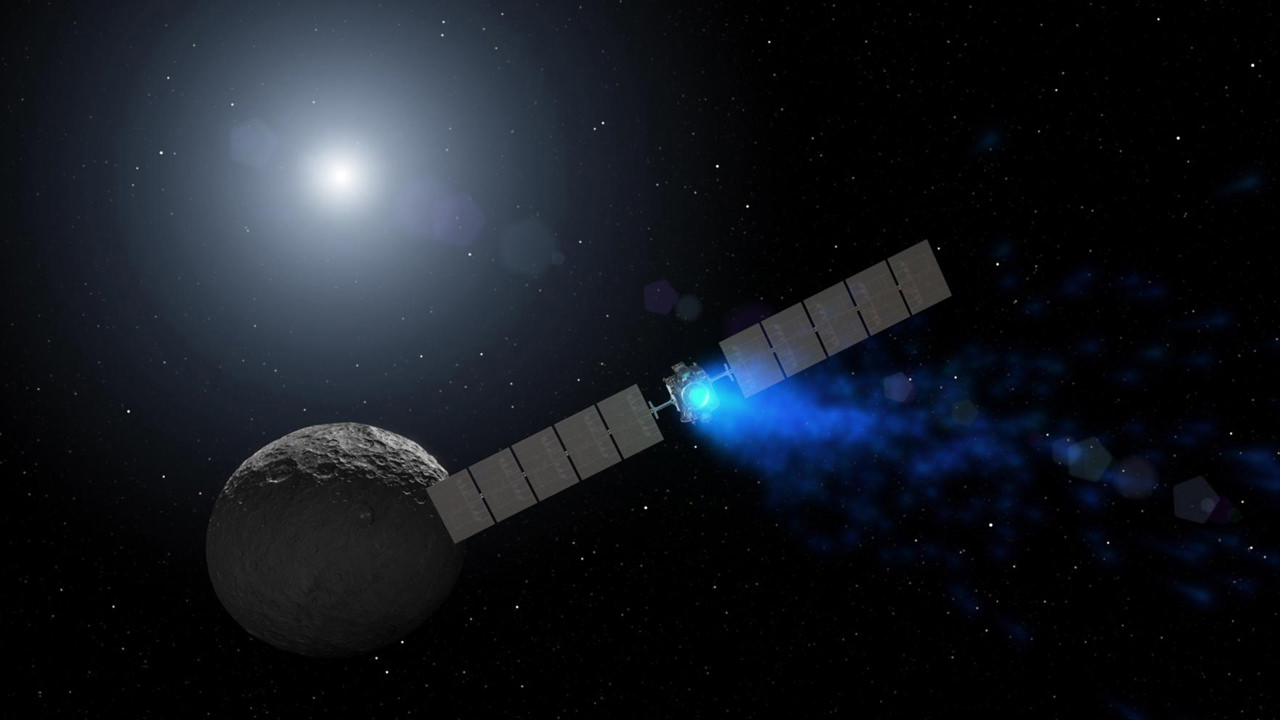
Between 2011 and 2018, NASA's Dawn mission conducted extensive observations of Ceres and Vesta, the largest bodies in the main asteroid belt. The purpose of the mission was to clarify questions about the formation of the solar system, as asteroids are residual material from the process that began about 4.5 billion years ago. Ceres and Vesta were chosen because Ceres is mostly ice, while Vesta is mostly rock. Over the years that Dawn orbited these bodies, she discovered several interesting features on their surfaces.
These included mysterious flow features similar to those observed in other airless bodies such as Jupiter's moon Europa. In a recent study, Michael J. Poston, a researcher from the Southwest Research Institute (SWRI), recently worked with a team at NASA's Jet Propulsion Laboratory to explain the presence of these features. In the paper detailing their findings, they explained how post-impact conditions could temporarily produce liquid brines that flow along the surface, creating curved channels and depositing debris fans along the walls of impact craters.
Michael J. Poston, the study's lead author, is a group leader for laboratory studies (space sciences) at SwRI. He was joined by a team of researchers from NASA JPL at the California Institute of Technology (Caltech) and the Airborne Snow Observatories, including Jennifer Scully – a NASA JPL planetary geologist and Dawn science mission team member. The paper describing their findings, “Experimental Examination of Brine and Water Lifetimes after Impact on Airless Worlds,” was published Oct. 21 in the Planetary Science Journal.
The planetoid Vesta, studied by the Dawn spacecraft between July 2011 and September 2012. Photo credit: NASA
Airless bodies are often struck by asteroids, meteorites, and other debris, forming impact craters and causing temporary atmospheres to form above them. For icy bodies or those with sufficient volatile elements (perhaps beneath the surface), this results in temporary outflows of liquid water. However, water and other volatile substances (such as ammonia, carbon dioxide, methane, etc.) lose stability under strong vacuum conditions. For their study, the team wanted to investigate how long liquid might be able to flow on the surfaces of airless bodies (like Ceres and Vesta) before it freezes again.
To do this, they simulated the pressure that the ice on Vesta would be exposed to after a meteorite impact and how long it would take for the liquid released from the subsurface to freeze again. “We wanted to explore our previously proposed idea that ice beneath the surface of an airless world could be excavated and melted by an impact, and then flow along the walls of the impact crater to form distinct surface features,” Scully said in a recent SwRI Release press.
To do this, the team placed liquid-filled sample containers in a modified test chamber at NASA's JPL to simulate the rapid pressure drops that occur after impacts with airless bodies. This allowed them to simulate how fluid behaves when the temporary atmosphere created by an impact dissipates. According to their results, the pressure drop was so rapid that the test fluids immediately and dramatically expanded, ejecting material from the sample containers. As Poston explained:
“Through our simulated impacts, we found that the pure water in a vacuum froze too quickly to cause any meaningful change, but salt and water mixtures or brines remained liquid and flowing for at least an hour. This is enough for the brine to destabilize slopes on crater walls on rock bodies, causing erosion and landslides, and potentially forming other unique geological features found on icy moons.”
This image of Cornelia Crater on Vesta shows lobe-shaped deposits (right) and curvilinear canyons (indicated by white arrows, left). Image credit: SwRI/NASA JPL-Caltech/Poston et al. (2024)
These results could help explain the origin of similar structures on other airless bodies, such as the smooth plains of Europa and the spider-like structure in the Manannán impact crater (which is due to “dirty ice” alongside “pure” water ice). They could also shed light on post-impact processes on bodies with very thin atmospheres, such as Mars. These include the gullies with their dark structures that run downhill and the fan-shaped debris deposits that form when water flows. Ultimately, the study could prove the existence of subsurface water in other inhospitable environments throughout the solar system.
“If the results are consistent for these dry and airless bodies or bodies with thin atmospheres, it shows that water existed on these worlds in the recent past, suggesting that impacts may still be ejecting water,” Poston said . “There may still be water out there.” This could have profound implications for future missions to these celestial bodies, including NASA's Europa Clipper mission. This mission launched on October 14, 2024 and will reach orbit around Europe by April 2030.
Further reading: SwRI, The Planetary Science Journal
Like this:
Load…

Comments are closed.