

People are quite familiar with the concept of “Ice Ages”. Not only does their abundant physical evidence suggest that ice ages occurred during the Pleistocene, which lasted approximately 2.58 million to 11,700 years ago, there are even indigenous oral traditions that speak of the formation of lakes and dramatic climate changes in the distant past. Far from being mere myths, these traditions are considered received accounts supported by scientific evidence. However, the glacial and interglacial cycles that characterize the Pleistocene were merely the latest in a long series of historical changes in Earth’s climate.
According to the geological record, Earth has experienced multiple ice ages over the past 2.5 billion years, peaking about 20,000 years ago, with average temperatures 8°C (14.5°F) cooler than today. Today, scientists are making similar discoveries on Mars, which also bears the marks of repeated ice ages that shaped the landscape. As on Earth, these climate changes were the result of long-term fluctuations in Mars’ axial tilt (obliquity), resulting in fluctuating temperatures that caused ice streams to advance and retreat across the planet.
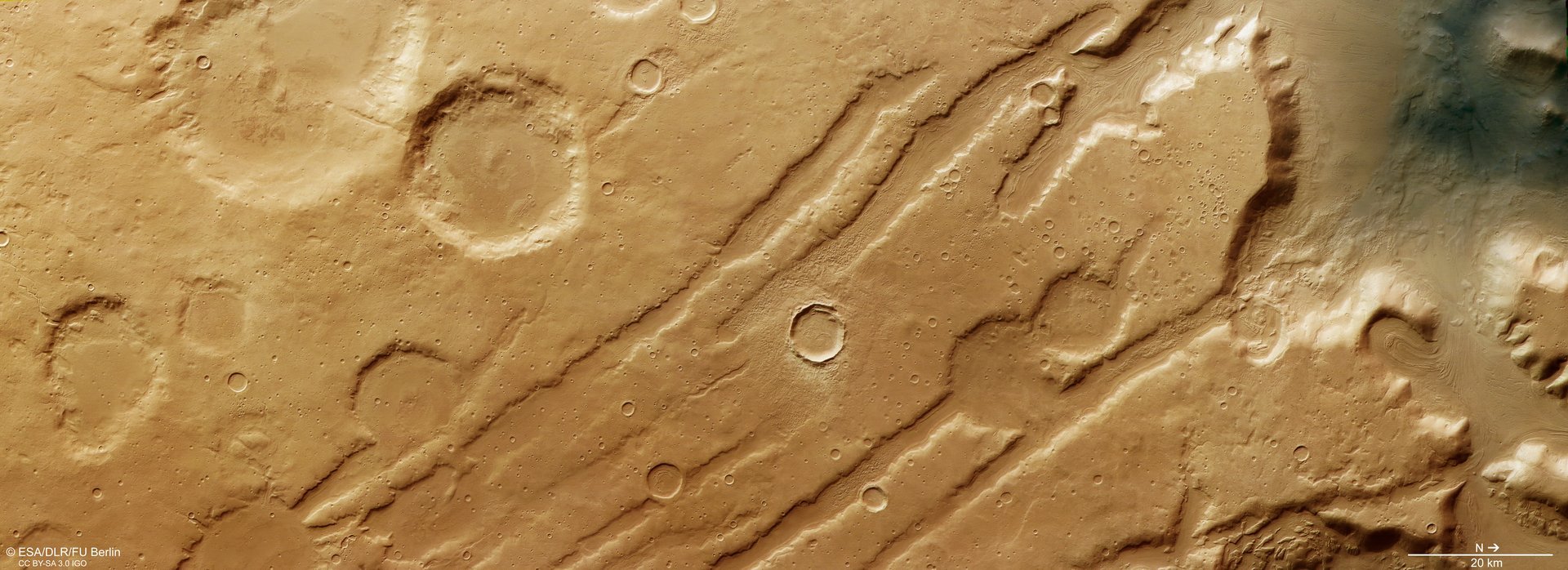
Evidence of these currents has been captured in a new series of images taken by the high-resolution stereo camera on ESA’s Mars Express orbit. The images show a distinctive feature known as the Coloe Fossae, a system of intersecting canyons in the Ismenius Lacus quadrangle between the northern lowlands and the southern highlands. Patterns of swirling lines are visible on the floor of these canyons (and the many craters that mark the region), indicating where material flowed during an earlier ice age.
*View generated from the digital terrain model and the nadir and color channels of the high-resolution stereo camera on ESA’s Mars Express. Photo credit: ESA/DLR/FU Berlin*
The technical term for these patterns is Lineated Valley Fill (LVF) or Concentric Crater Fill (CCF), which consists of rocky material deposited by ice flows as they move or retreat from an area. Scientists see these patterns on Earth in glaciers that left behind what is known as “till” (a combination of clay, silt, sand and gravel) that forms ridges and elongated hills. However, these features are located in a region far from the ice cap in Mars’ northern polar region, suggesting that this region was once covered by glaciers.
Similar to ice ages on Earth, these glaciers are thought to have advanced from the Martian poles into the mid-latitudes before retreating again during the interglacial period. Additionally, scientists have observed LVF and CCF features throughout Mars’ mid-latitudes, suggesting that the entire planet experienced glacial activity in the past. Finally, there is the fundamental insight from these and other observations, which have shown that Mars experienced multiple ice ages as its atmosphere was slowly eroded away, causing most of the water on its surface to disappear.
Tracking the flow of ice across the Red Planet is key to reconstructing the geological and ecological history of Mars. From this, scientists can deduce how and when it made the transition from a warmer, wetter planet to the extremely cold and dry world we see today.
Click here to view the annotated version of the image above and click on the circled areas for a closer look at the LVF features.
Further reading: ESA

Comments are closed.