

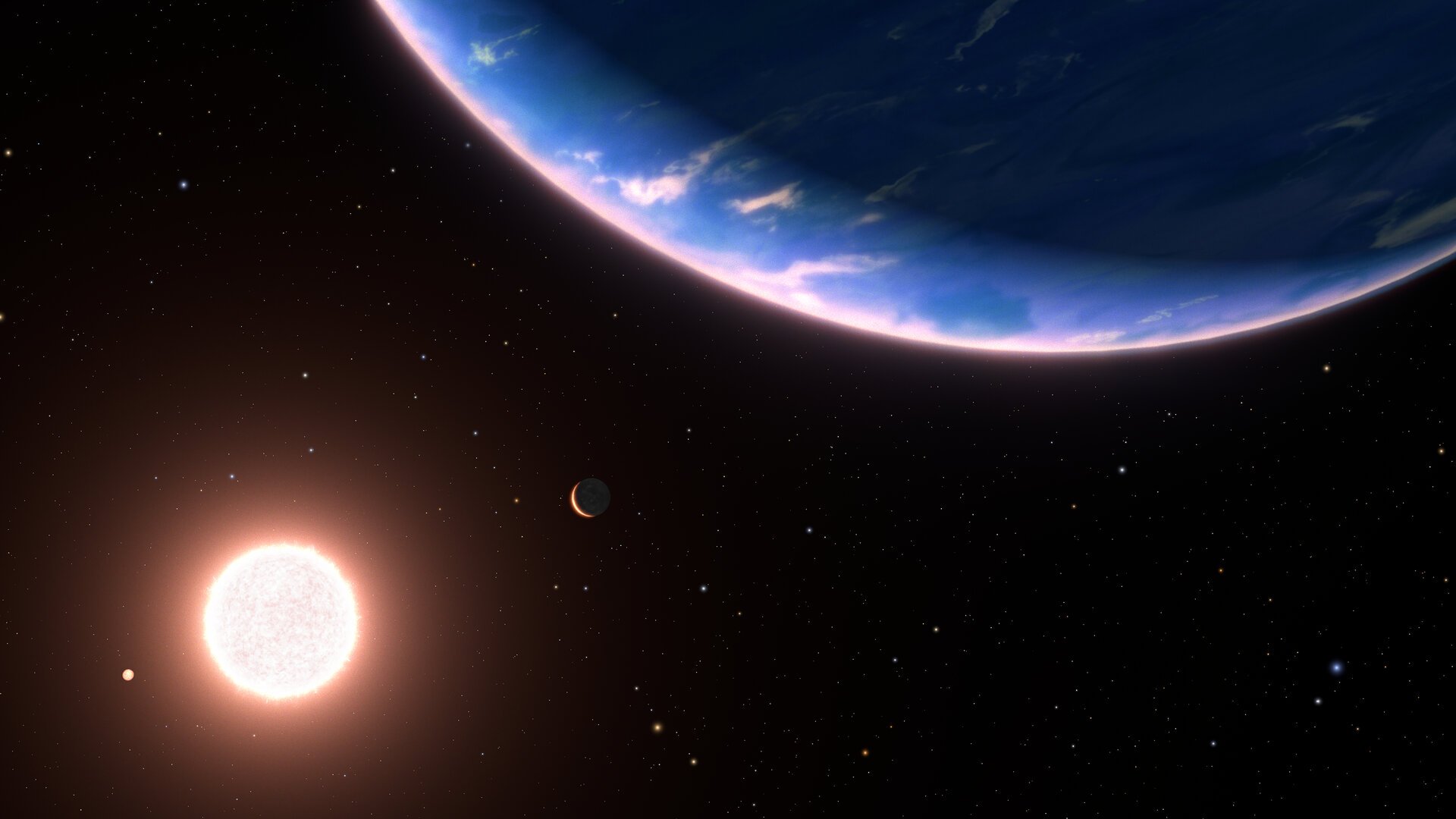
In the 1970s, Carl Sagan, along with co-author Edwin Salpeter, published a paper on the possibility of finding life in the Jupiter cloud. In particular, they described “sinkers, floaters and hunters” that could live floating and moving in the atmosphere of our solar system’s largest planet. He also famously spoke about how clouds on another planet in our solar system – Venus – obscured what was on the surface, leading to wild speculation about a lush, Jurassic Park-like world full of life obscured only by clouds. It turns out that Venus was the exact opposite, but both works show the impact clouds can have on life on Earth. A new paper from authors including the Carl Sagan Institute, led by Cornell’s Ligia Coelho, argues that we should consider clouds as potential habitats for life—we just need to know how to look for them.
The search for life on exoplanets has so far focused on two methods. One is to look for certain types of atmospheric gases, such as oxygen or methane, in their atmosphere. Another is to look at the spectra of their surface signatures – particularly a “red edge” that appears despite its traditional “green” color when the vegetation is observed spectrographically. Clouds have been just one obstacle in the search for any of these methods, which is why astrobiologists have typically ignored them.
It turns out that there are actually microorganisms that live in the Earth’s upper atmosphere. These microbes, which include species such as Modestobacter, Roseomonas and Micrococcus, float in the atmosphere between 21 and 29 km. In order to survive at this altitude, they have to endure a lot of UV radiation and produce very bright pigments, especially in the form of carotenoids. These organic molecules are visible as pigments in the microbe’s body – particularly in very bright colors such as pink and yellow.
Carl Sagan talks about possible life on Jupiter during an episode of Cosmos. Photo credit: Brian Emerson / Carl Sagan YouTube channel
Bright colors are one thing that can be easily seen with spectroscopy, which is why the authors chose it. They cultured samples of these microbes isolated from the atmosphere and created spectra of the pigments they produced. Essentially, they collected data that would be visible to a space-based telescope observing an exoplanet from a distance – like JWST or the upcoming Habitable Worlds Observatory (HWO). And they did this in two different states – “wet” and “dry” – to ensure that they represented all possible pigmentation states of the microbes themselves.
With this data, the authors turned to Exo-Prime II – a model for simulating spectra of exoplanets. They created a model of several types of Earth-like planets, including a “snowball world” that would be very dry but still have a lot of water, and an “ocean world” that would be saturated with water but have little land. They then introduced a cloud layer and also colonies of different microbes into this cloud layer and examined the different spectral results for each scenario.
There was a clear difference between “wet” and “dry” microbes. Wet specimens had very distinct features with distinct spectral lines. Dry had higher reflectivity overall. But both were significantly different from a baseline without any microbes in the clouds. However, the extent of microbial colonization makes a big difference, but the thickness of the cloud cover does not. In the model, the microbes had to have colonized at least 50% of the cloud cover – even if this cloud cover only covered 50% of the planet itself.
Video describing how some of the microbes enter the atmosphere. Credit – bioGraphicMagazine YouTube channel
That’s a pretty significant level of colonization – and nowhere near the level we have on Earth. So while the work proves that we would, at least theoretically, be able to directly detect the spectral signatures of these microbes in the clouds of an exoplanet, the population level of these clouds would have to be extremely high for us to succeed.
Perhaps most importantly, the paper provides a database of spectral signatures that can be searched for when missions like HWO finally launch in the coming decades. Although the population level could be relatively high, there is a real possibility that we will find at least one such exoplanet out there among the stars. If we can do that, it’s safe to say Carl Sagan would be proud.
Learn more:
Cornell – How to detect life in the clouds on other worlds
LF Coelho et al – Colors of life in the clouds: Biopigments of atmospheric microorganisms as a new signature for detecting life on planets like Earth
UT – Do Venus’ clouds really harbor life?
UT – Clouds could improve the search for life on exoplanets

Comments are closed.