

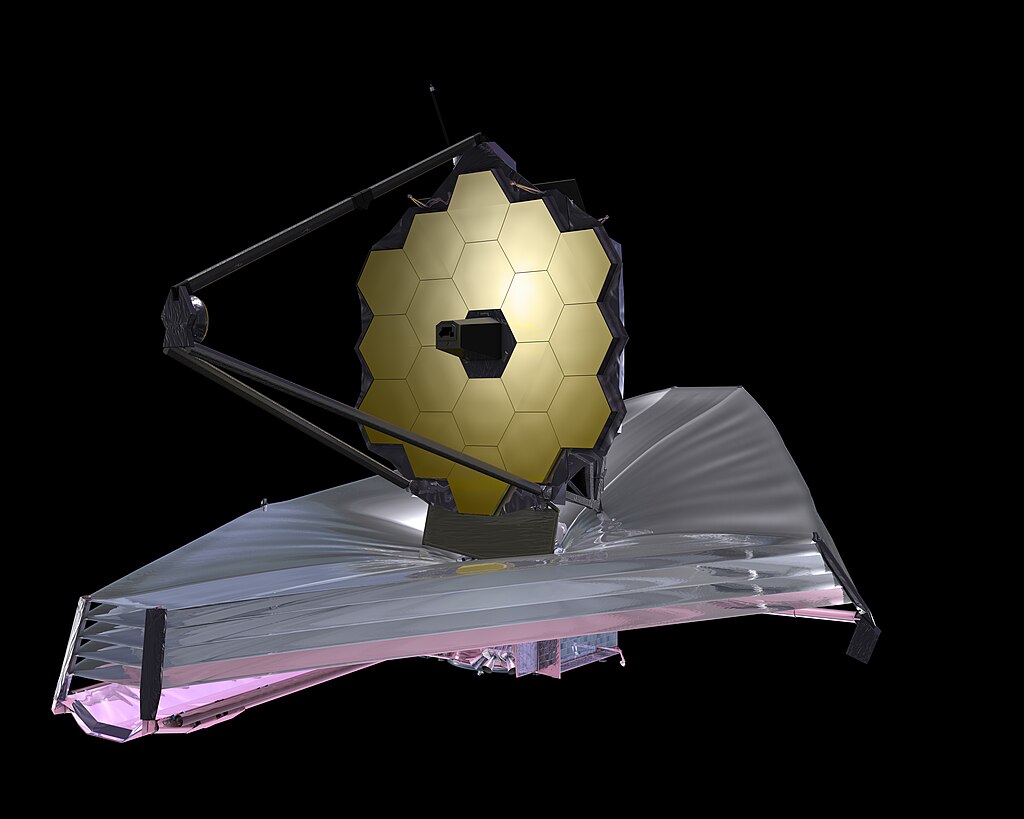
In recent years we have been treated to first the Hubble Space Telescope (HST) and then the James Webb Space Telescope (JWST). Both opened our eyes to the universe and made amazing discoveries. One topic that has received attention from both sides is the derivation of the Hubble constant – a constant that relates the speeds of distant galaxies to their distances. A recent article announces that the JWST has just validated the results of previous Hubble Space Telescope studies to accurately measure its value.
The Hubble constant (H0) is a fundamental parameter in cosmology that defines the expansion rate of the universe. It defines the relationship between Earth and distant galaxies based on the speed at which they are moving away from us. It was first discussed by Edwin Hubble in 1929 when he observed the spectra of distant galaxies. It is measured in kilometers per second per megaparsec and shows how quickly galaxies are moving away from us per unit distance. The exact value of the constant has been the subject of much scientific debate and more recently HST and JWST have attempted to refine its value. Obtaining an accurate value is key to determining the age, size and fate of the universe.
Edwin Hubble
A recent paper published by a team of researchers led by Adam G. Riess of John Hopkins University confirms the results of an earlier HST study. They use JWST to examine previous Cepheid/Supernova distance ladder results. This has been used to determine distances in the cosmos using Cepheid variable stars and Type 1a supernovae. Both objects can be compared to “standard candles” whose actual brightness is very well known. By measuring their apparent brightness from Earth, their distances can be calculated by comparing them with their actual brightness, their intrinsic luminosity.
NASA's James Webb Space Telescope has discovered a multi-imaged supernova in a distant galaxy called MRG-M0138. Image credits: NASA, ESA, CSA, STScI, Justin Pierel (STScI) and Andrew Newman (Carnegie Institution for Science).
Over the past few decades, numerous attempts have been made to accurately determine H0 using a variety of different instruments and observations. The cosmic microwave background was used along with the above studies using Cepheid variables and supernovae events. The results produce a series of results that have become known as “Hubble tension.” The current study with JWST hopes to refine and validate previous work.
In order to determine H0 with any degree of accuracy using the Cepheid/supernova ladder, a sufficiently large sample of Cepheids and supernovae must be observed. This was challenging, especially given the sample size of supernovae in the Cepheid variable star region. The team also explored other techniques for determining H0, such as using HST data to study the luminosity of the brightest red giant branch stars in a galaxy – which can also function as a standard candle. Or the luminosity of certain carbon-rich stars, which is another technique.
This figure shows three steps that astronomers used to measure the universe's expansion rate (Hubble constant) with unprecedented accuracy, reducing the overall uncertainty to 2.3 percent. The measurements streamline and strengthen the design of the cosmic distance ladder, which is used to measure precise distances to galaxies near and far from Earth. The latest Hubble study expands the number of Cepheid variable stars analyzed to distances up to ten times further into our galaxy than previous Hubble results. Image credits: NASA, ESA, A. Feild (STScI) and A. Riess (STScI/JHU)
The team concludes that when all JWST measurements are combined, including a correction for the small sample of supernovae data, H0 is 72.6 ± 2.0 km s?1 Mpc?1. This compares to the combined HST data, which determines H0 to be 72.8 km s?1 Mpc?1 It will take more years and further study before JWST's supernova sample size matches that of HST, but cross-checking has so far shown that we finally find an exact value for the Hubble constant.
Source: JWST validates HST distance measurements: Supernova subsample selection explains differences in JWST estimates of local H0
Like this:
Load…

Comments are closed.