

When using new space telescopes, several critical steps must be completed. The start is probably most often thought of, another is the “first light” of all the telescope’s instruments. Ultimately, they are responsible for the data the telescope is supposed to collect – if it doesn’t work properly, the mission itself is a failure. Fortunately, the Interstellar Mapping and Acceleration Probe (IMAP) recently collected first light on its ten primary instruments and everything appears to be in order, according to a press release from the Southwest Research Institute, which was responsible for ensuring that the delivery of all ten instruments went smoothly.
It is not uncommon for instruments not to work even if they start up correctly. Hubble famously had to undergo a series of corrective surgeries on its main lens, which involved people making physical spacewalks to the telescope to repair and repair things. The result was some of the most famous astronomy images ever captured. However, IMAP will not have this luxury – it is intended for the L1 Lagrange point directly between the Earth and the Sun – well beyond the range of currently operational manned spacecraft.
Fortunately, this doesn’t seem to be necessary, and IMAP can begin its primary task once it researches its target and goes through some startup procedures. But operators at Johns Hopkins University figured it would be easy enough to try out the telescope’s instruments along the way.
NASA video showing the IMAP mission. Photo credit: NASA Goddard YouTube channel
This instrumentation is intended to study how our “heliosphere” – the area around our star where the Sun has the main influence – interacts with the wider interstellar neighborhood. A particular instrument that stands out for this mission is the Compact Dual Ion Composition Experiment (CoDICE).
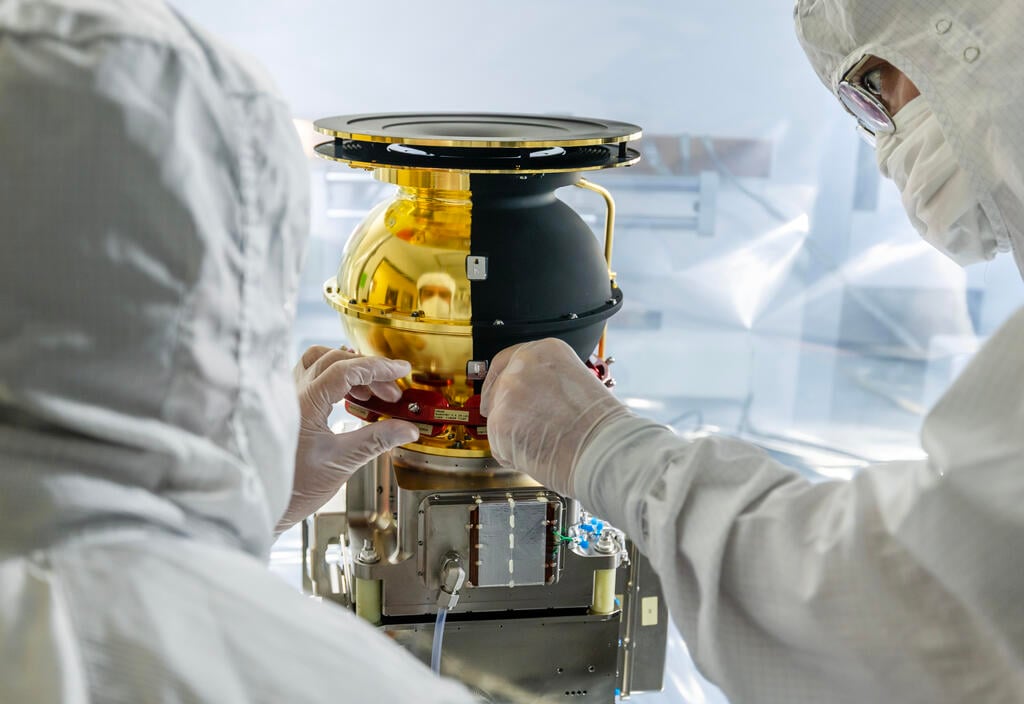
It is a 22-pound instrument, about the size of a 5-gallon bucket, designed to measure interstellar ions, including relatively rare ions such as oxygen and iron, which are ejected from the Sun past the heliosphere in the solar wind. In particular, CoDICE will measure the mass and charge of the ions flowing past. Visually, it looks stunning, with a shiny “golden” surface facing the sun to reflect its heat and a matte black surface designed to absorb as much heat as possible from the cold of the cosmic vacuum.
But it is just one of 10 instruments scheduled to go live with IMAP, and just one of four charged particle detectors, which include the Princeton-built SWAPI, which will also measure solar wind ions as well as “pickup” ions that enter the heliosphere from interstellar space. The Solar Wind Electron instrument is designed to measure the three-dimensional distribution of solar wind electrons to provide context for measurements by other instruments. And the High Energy Ion Telescope (HIT) was developed by NASA to monitor “high energy” particles accelerated by solar flares and other solar shocks.
Video from Johns Hopkins showing some of the telescope’s instruments. Photo credit: Johns Hopkins Applied Physics Laboratory
The other sensors can be divided into two further categories: Energetic Neutral Atom (ENA) detectors and coordinated measurements. There are 3 separate ENA sensors, each measuring different energy levels of charge-neutral atoms. The coordinator measurement sensors provide both backup data, such as magnetic field strength, as well as new types of sensors, such as an interstellar dust collector.
Although IMAP is still a few weeks away from its goal and full scientific operations are expected to begin by February, it seems like everything is going well so far. As more of its systems come online, we’ll be able to use IMAP to get a more complete picture of our position in the galaxy for at least the next two years of the telescope’s main mission – and if we’re lucky, there will be more to come.
Learn more:
SwRI – The novel IMAP instrument developed by SwRI provides first-light data
UT – Can IMAP solve the mystery of the bubble in space?
UT – NASA’s interstellar mapping probe is preparing for launch in 2025
UT – The heliosphere looks much stranger than we originally thought

Comments are closed.