

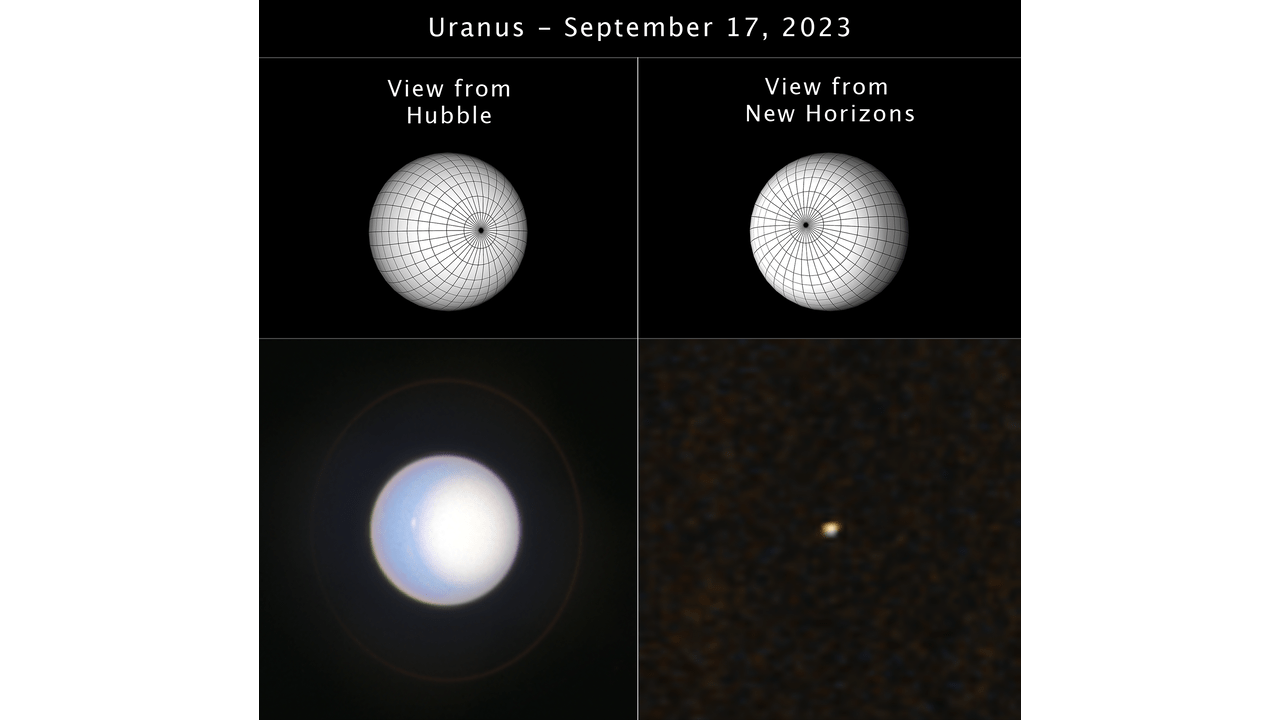
Since space exploration began, we have seen some amazing images of the planets. New technologies often bring a new perspective, and we were recently reminded of this again by images from the Hubble Space Telescope (HST) and the New Horizons spacecraft. The two objects simultaneously imaged Uranus from different perspectives to predict what astronomers would see when looking at exoplanets orbiting other stars.
Uranus is the seventh planet from the Sun and can be recognized by its wonderful blue-green color. It was discovered by William Herschel in 1781 and we have been exploring its secrets with telescopes and space probes ever since. Like the other outermost planets, Uranus is a giant ball of gas, and the presence of methane in its atmosphere gives it its striking color. It is unusual among the other planets in that it appears to revolve around the Sun at an axial tilt of 98 degrees, so it does have quite extreme seasons.
This magnified image of Uranus, taken by Webb's Near Infrared Camera (NIRCam) on February 6, 2023, shows breathtaking views of the planet's rings. Image credits: NASA, ESA, CSA, STScI. IMAGE PROCESSING: Joseph DePasquale (STScI).
HST and New Horizons recently set their sights on Uranus, but for a somewhat unusual project: supporting the development of imaging techniques for exoplanets. Direct images of distant extraterrestrial worlds are difficult simply because of their distance and often also because of their proximity to the host star. It is of great importance to be able to study them directly to learn more about their nature and their possible habitability. Direct imaging of exoplanets often shows only points of light, so researchers have used Uranus as a “proxy” exoplanet to explore new imaging methods.
The payload of the New Horizons instrument, which is currently conducting planetary science, heliospheric measurements and astrophysical observations. Image credit: NASA/Johns Hopkins University Applied Physics Laboratory/Southwest Research Institute
Uranus was chosen because most exoplanets are gas giants and similar in nature. The choice also fell on the fact that New Horizons was on the other side of Uranus at the time of observation and was therefore 10.5 billion kilometers away. From its vantage point, New Horizons would see a crescent-shaped Uranus, a phase often seen on exoplanets when they are furthest from their star. They used the Multispectral Visible Imaging Camera to capture the images, with Uranus only covering a few pixels, similar to an exoplanet when viewed from Earth.
While New Horizons was taking its images, HST, just 1.7 billion miles away, was able to capture an incredible amount of detail in the atmosphere with its high-quality cameras. By comparing the two images, researchers were able to see how atmospheric features appear in the New Horizon data to learn more about exoplanet observations. The team noted that both HST and New Horizons found that brightness did not change as the planet rotated, showing that cloud features did not change with the planet's rotation.
This image from NASA's Hubble Space Telescope was taken on May 19, 2009, after deployment during Servicing Mission 4. NASA
They also found that exoplanets in New Horizons likely appear fainter than predicted at partial and high phase angles. This means that a gas planet like Uranus reflects light differently in some phases than others. The results are a testament to the wonderfully insightful approach to addressing an existing challenge in modern astronomy; The direct study of exoplanets. In the coming years, telescopes like the Nancy Grace Roman Space Telescope, scheduled to launch in 2027, will have the ability to block out light to enable direct observations of exoplanets. This latest study will help interpret data obtained in future studies.
Source: NASA's Hubble and New Horizons team up for a simultaneous look at Uranus
Like this:
Load…

Comments are closed.