

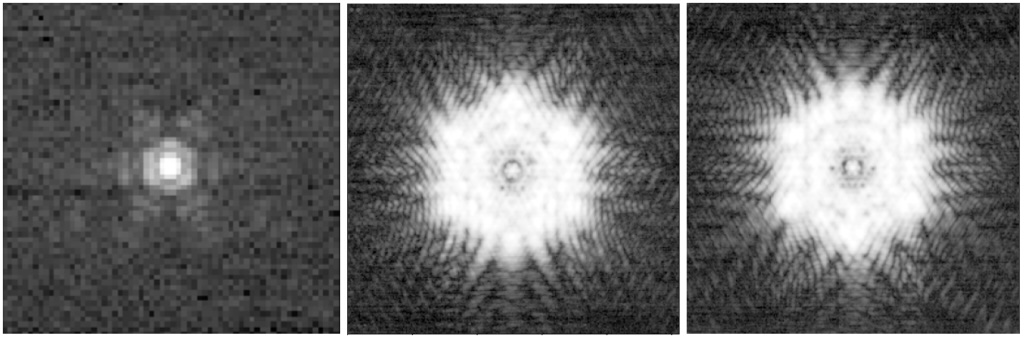
One of the most difficult challenges in assembling a telescope is aligning it for optical precision. If you don't do it right, all your pictures will be blurry. This presents a particular challenge when assembling your telescope in space, as demonstrated by the James Webb Space Telescope (JWST).
Unlike the Hubble Space Telescope, the JWST does not have a single primary mirror. To fit into the launch rocket, it had to be folded and reassembled after launch. For this and other reasons, JWST's primary reflector consists of a set of 18 hexagonal mirror segments. Each segment is only 1.3 meters wide, but when properly aligned they effectively act as a single 6.5 meter mirror. This is an effective way to build a larger space telescope, but it means the mirror array must be focused in space.
To achieve this, each mirror segment has a series of actuators that can translate the segment along six alignment axes. They are focused using a wavefront phase technique. Because light behaves like a wave, when two beams of light overlap, the waves create an interference pattern. When the mirrors are aligned correctly, the light waves from the individual mirror segments also align, creating a sharp focus.
The primary mirrors of Hubble and JWST in comparison. Photo credit: Wikipedia user Bobarino
For JWST, its near-infrared camera (NIRCam) is equipped with a wavefront camera. To align the mirrors, the JWST team points the NIRCam at a star and then intentionally moves the mirrors out of alignment. This gives the star a blurry diffraction pattern. The team then positions the mirrors to focus on the star, thereby aligning them.
This was done to align the mirrors shortly after JWST was launched. However, due to vibrations and temperature fluctuations, the mirror segments slowly become out of alignment. Not a lot, but enough that they need to be re-aligned occasionally. To maintain order, the team typically conducts wavefront error checks every two days. Additionally, a small camera is pointed at the mirror assembly so the team can take a “selfie” to monitor the condition of the mirrors.
The JWST was designed to maintain a wavefront error of 150 nanometers, but the team was able to maintain an error of 65 nanometers. It's an amazingly close alignment for a space telescope, allowing JWST to capture amazing images of the most distant galaxies in the observable universe.
You can find out more about this technology on the NASA blog.
Like this:
Load…

Comments are closed.