

Mars exploration vehicles are usually equipped with wheels so they can navigate the Red Planet's challenging terrain. Eventually, however, their systems wear out and one of the wheels gets stuck. The “Free Spirit” campaign in 2009 is the most famous case. Unfortunately, that campaign was also unsuccessful, and today, 15 years later, Spirit is still stuck at its final resting place. Things might have turned out differently if NASA had adopted a new robotic paradigm developed by Guangming Chen and his colleagues at the Lab of Locomotion Bioinspiration and Intelligent Robots at Nanjing University of Aeronautics & Astronautics. They developed a robot based on a desert lizard with adaptable feet and a flexible “spine” that they calculated would be well suited to traversing Mars' regolith.
Planning for traversing difficult terrain isn't limited to stuck rovers. Curiosity and Perseverance, the two most prominent rovers on Mars, currently spend a lot of time avoiding areas where they could get stuck. This limits their ability to collect data from those areas, and they may miss cool rocks, like the pure sulfur that Curiosity recently found on Mars for the first time.
A lizard-inspired robot, on the other hand, would have no problem traversing such terrain. It also has some advantages over traversing other types of terrain, such as rocks. Most rovers don't have enough leg strength to get over medium-sized rocks, whereas a legged robot would be able to do so, particularly one with adjustable “toes” that would allow it to grip a rock more tightly than typical legged robots could otherwise.
Lizard-inspired robots can not only walk — they can also jump like their biological relatives, as this video from UC Berkeley's robotics lab shows.
Source: UC Berkeley YouTube channel
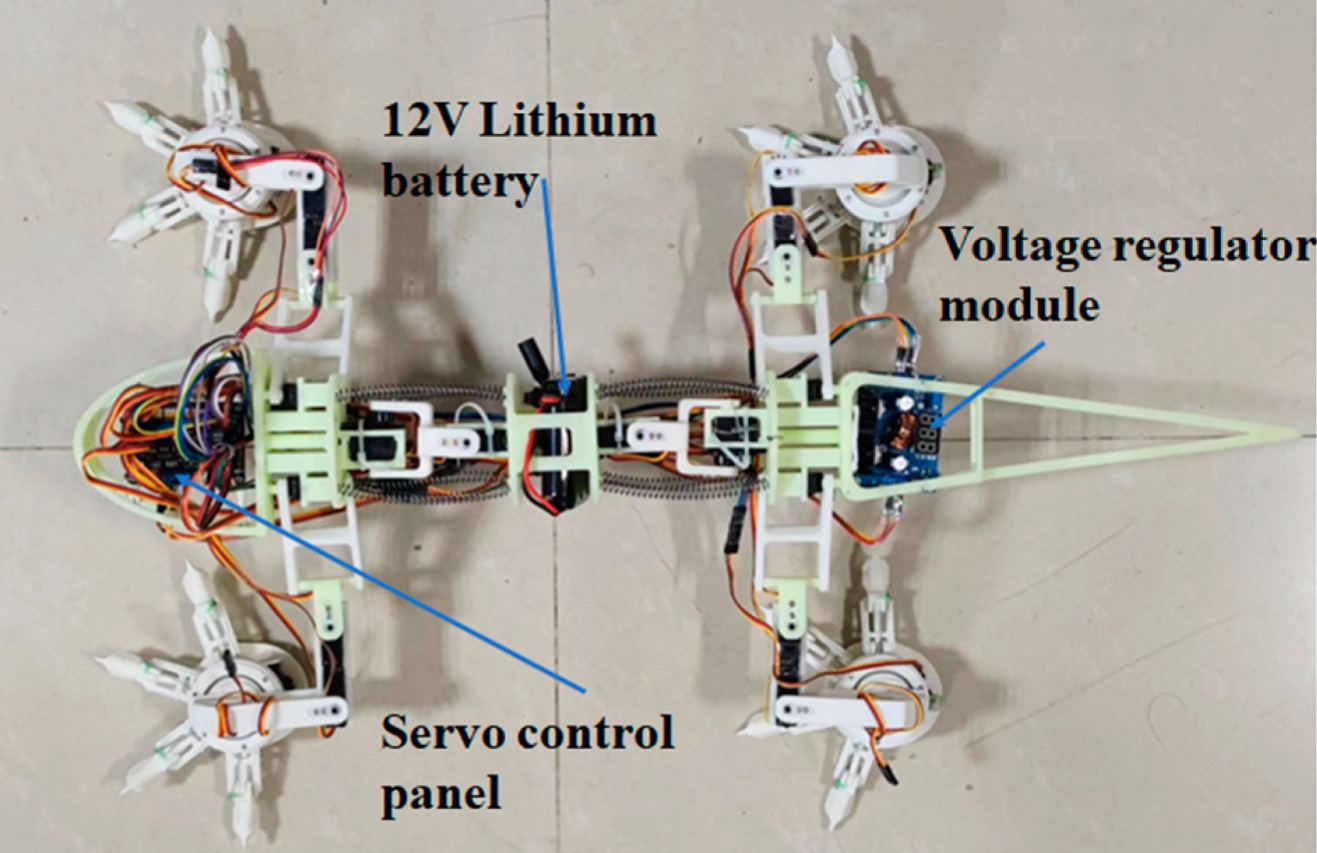
The design of the robot itself is relatively simple – it has four “feet” spaced apart by a chassis that essentially looks like a desert lizard. It even has a tail for balance. Each foot has a set of three “toes” powered by springs. They also have a servo for ankle articulation and a bearing for rotation control. This combination allows the lizard robot to effectively walk on all fours, adjusting each leg to best suit the surface it is “walking” over.
The authors performed a series of kinematic calculations for different types of terrain to understand how the robot would interact with each of these surfaces. Kinematic calculations are typically used in robotics when designers try to find the best way to move a particular robot part. Given the number of variable parts, the calculations in this case are relatively detailed. However, a control algorithm is possible using only onboard calculations, enabling basic autonomous terrain navigation if the architecture is ever adopted for use in space.
Building a real prototype would be a great way to work on this navigation algorithm, and that's exactly what the researchers did. They 3D printed many parts for the chassis and foot, built some batteries and controllers into the head and tail sections, and started testing the prototype on a simulated Mars test site.
Not only Mars could benefit from walking robots – they could also work on the moon, as Fraser explains.
They tested everything from grasping loose regolith to climbing over small rocks, and their algorithm seemed to work effectively for the relatively easy terrain in the test area. However, the robot's actual movement speed was slower than originally simulated, largely due to technical difficulties in balancing the movements of the springs and spine.
Despite any issues encountered during physical testing, this new robot iteration is a step in the right direction, as this lab has been developing similar systems for years. They also plan to develop another version, including mounting a continuous power supply and fully implementing an autonomous navigation algorithm. Their research is funded by both Jiangsu Province and China's Ministry of Science and Technology, so it looks like it will continue to receive support, at least for the foreseeable future.
Learn more:
Chen et al. – Development of a lizard-like robot to explore the surface of Mars
UT – Spirit Extrication, Day 1: Drive stopped after 1 second
UT – Biomimetics and Space Research
UT – Robots could jump around to explore the moon
Cover image:
Image of the biomimetic lizard robot prototype.
Credit – Chen et al.
Like this:
Is loading…

Comments are closed.