

From NASA
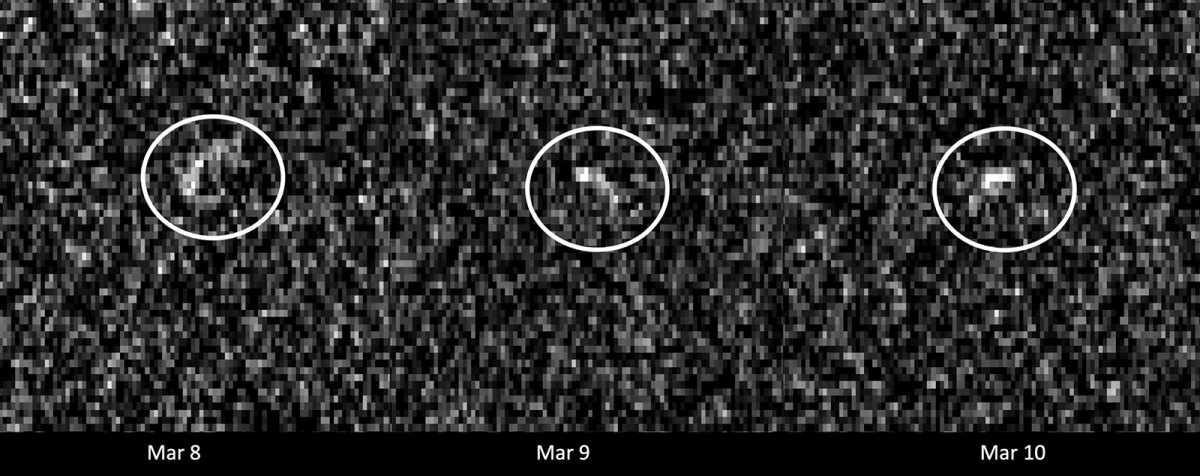
These images of the asteroid Apophis were taken with radio antennas in the Goldstone Complex of the Deep Space Network in California and the Green Bank Telescope in West Virginia. The asteroid was 17 million kilometers away and each pixel has a resolution of 38.75 meters.
Credits: NASA / JPL-Caltech and NSF / AUI / GBO
The near-Earth object was thought to pose a small risk of impacting Earth in 2068, but now radar observations have ruled that out.
After its discovery in 2004, the asteroid 99942 Apophis was identified as one of the most dangerous asteroids that could hit Earth. However, that impact assessment changed as astronomers tracked Apophis and its orbit was better determined.
The results of a new radar observation campaign combined with precise orbit analysis have now led astronomers to conclude that there has been no risk of Apophis affecting our planet for at least a century.
Apophis was estimated to be 340 meters in diameter and quickly gained notoriety as an asteroid that could pose a serious threat to Earth when astronomers predicted it would get uncomfortably close in 2029. Thanks to additional observations of the Near-Earth Object (NEO), the risk of an impact in 2029 was ruled out later, as was the potential impact risk resulting from another narrow approach in 2036. However, until that month there remained a small chance of an impact in 2068.
When Apophis made a distant flyby of Earth around March 5, astronomers took the opportunity to use powerful radar observations to refine the estimate of their orbit around the Sun with extreme precision, safely eliminating the risk of impact in 2068 and long after.
This animation shows the orbit of the asteroid 99942 Apophis, which will safely zoom past Earth on April 13, 2029. Earth’s gravity deflects the trajectory slightly as the 340-meter-wide near-Earth object is within 20,000 miles (32,000 kilometers) of the surface of our planet. The movement was accelerated 2,000 times. Credits: NASA / JPL-Caltech
“An impact from 2068 is no longer possible, and our calculations show no impact risk for at least the next 100 years,” said Davide Farnocchia of the NASA Center for Near-Earth Object Studies (CNEOS) administered by NASA’s Jet Propulsion Laboratory in Southern California. “With the support of recent optical observations and additional radar observations, the uncertainty in Apophis’ orbit has collapsed from hundreds of kilometers to just a handful of kilometers as it was projected into 2029 future movement so we can now remove Apophis from the risk list. “
Farnocchia was referring to the Sentry Impact Risk Table. The table maintained by CNEOS monitors the few asteroids whose orbits bring them so close to the earth that an impact cannot be ruled out. With the latest findings, the risk table no longer includes Apophis.
CNEOS relies on optical telescopes and ground-based radar to characterize the orbit of any known near-earth object to improve long-term hazard assessments, and calculates high-precision orbits in support of NASA’s planetary defense coordination office.
Scientific opportunity
For the latest Apophis calculations, astronomers turned to the 70-meter radio antenna at the Deep Space Network’s Goldstone Deep Space Communications Complex near Barstow, California to closely track Apophis’ movement. “Although Apophis recently made a close approach to Earth, it was still nearly 10.6 million miles [17 million kilometers] Path. Even so, we were able to get incredibly accurate information about the distance with an accuracy of about 150 meters [490 feet]”Said JPL scientist Marina Brozovic, who led the radar campaign.” This campaign not only helped us eliminate an impact risk, it also prepared us for a wonderful scientific opportunity. “
Goldstone also worked with the 100-meter Green Bank Telescope in West Virginia to enable the imaging of Apophis. Goldstone sent while receiving the Green Bank – a “bistatic” experiment that doubled the strength of the received signal.
Although Apophis’ radar images appear pixelated, the images have a resolution of 38.75 meters per pixel. This is a remarkable resolution considering the asteroid was 17 million kilometers away, or about 44 times the Earth-Moon distance. Brozovic added. “If we had binoculars as powerful as this radar, we could be sitting in Los Angeles reading a dinner menu in a New York restaurant.”
As the radar team continues to analyze its data, they also hope to learn more about the shape of the asteroid. Previous radar observations have shown that Apophis has a “bilobed” or peanut-like appearance. This is a relatively common form in near-Earth asteroids that are more than 200 meters in diameter. At least every sixth person has two lobes.
Astronomers are also working to better understand the asteroid’s rate of rotation and the axis around which it rotates (better known as its spin state). This knowledge will enable them to determine the orientation of the asteroid on Earth when it hits our planet’s gravitational field in 2029, which could change this spin state and even cause “asteroid quakes”.
On April 13, 2029, the asteroid Apophis will be less than 20,000 miles from the surface of our planet – closer than the distance of geosynchronous satellites. During this approximation of 2029, Apophis will be visible to observers at the bottom of the Eastern Hemisphere without the aid of a telescope or binoculars. It is also an unprecedented opportunity for astronomers to get up close and personal with a relic of the solar system that is now just a scientific curiosity and not an imminent threat to our planet.
“When I started working with asteroids after college, Apophis was the poster child for dangerous asteroids,” said Farnocchia. “There is some sense of satisfaction with being taken off the risk list, and we look forward to the science we could discover in their narrow approach in 2029.”
Like this:
Loading…

Comments are closed.