

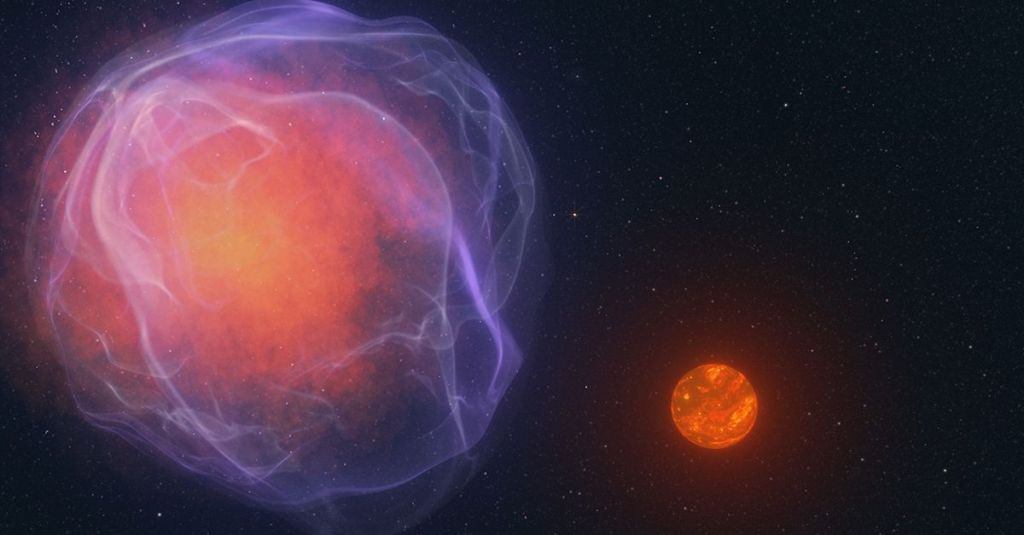
Citizen science is a great concept. Using the combined processing power of a plethora (exaggeration) of desktop and laptop computers to crunch data is a great and efficient way to analyze large amounts of data. This was proven again when a star was identified hurtling into intergalactic space! Most stars in the Milky Way do not move fast enough to escape their immense gravity, but the suspected brown dwarf is moving at 1.5 million km/h, fast enough to escape.
The concept of using the public to support scientific endeavors goes back further than you might think. One of the earliest examples can be found in the 19th century, when the Audubon Society launched the Christmas Bird Count in 1900, encouraging citizens to track bird populations. When it comes to space exploration, projects like SETI@Home come to mind, among others.
A home PC running SETI at Home helps with the evaluation of observation data. Image credit: SETI@home
Another citizen science project called “Planet 9” was started by Backyard Worlds and has so far involved 82,690 volunteers. The goal is to search for possible distant planets in our solar system or previously unidentified brown dwarfs in our solar neighborhood. The project takes images from NASA's Wide-field Infrared Survey Explorer (WISE) and makes them available to its volunteers, who then examine them for moving objects.
While searching for objects worthy of study, a team of volunteers – Martin Kabatnik, Thomas P. Bickle and Dan Caselden – discovered a fast-moving object that became known by the catchy name CWISE J124909.08+362116.0. After its detection by several ground-based instruments, observations were scheduled that showed it was moving so fast that it will eventually escape the gravitational pull of the Milky Way and break off into intergalactic space. It is the first object with a mass less than or similar to that of a star to travel at such a breathtaking speed – 1.5 million km/h! To honor the contribution of the citizen scientists, they are named as co-authors of the study, which was recently published in the Astrophysical Journal Letters.
Artist's impression of the Wide-field Infrared Survey Explorer in orbit around the Earth. Image credit: NASA/JPL
What exactly CWISE J1249 is remains a bit of a mystery at the moment. Its small mass suggests it is either a low-mass star or possibly a gas giant, or perhaps something in between known as a brown dwarf. Its core has also been found to contain less iron and other metals than other stars and brown dwarfs. Its composition suggests it is quite old and perhaps one of the Milky Way's first generation of stars. If it is a brown dwarf, it is not particularly rare per se. Planet 9 has discovered more than 4,000 of them alone, but none are moving at a speed high enough to leave the galaxy.
It is not just the nature of the object that puzzles astronomers, its high speed has also been the subject of much debate. One theory is that it may have been part of a binary star system with a white dwarf. The white dwarf would slowly accrete material from its companion, leading to an explosion when the material reached a critical point. This event may have provided the energy to accelerate the object out of the system and beyond. Alternatively, it may have been part of a cluster ejected by gravitational interactions.
Source: NASA citizen scientists discover object moving at 1.6 million kilometers per hour
Like this:
Load…

Comments are closed.