

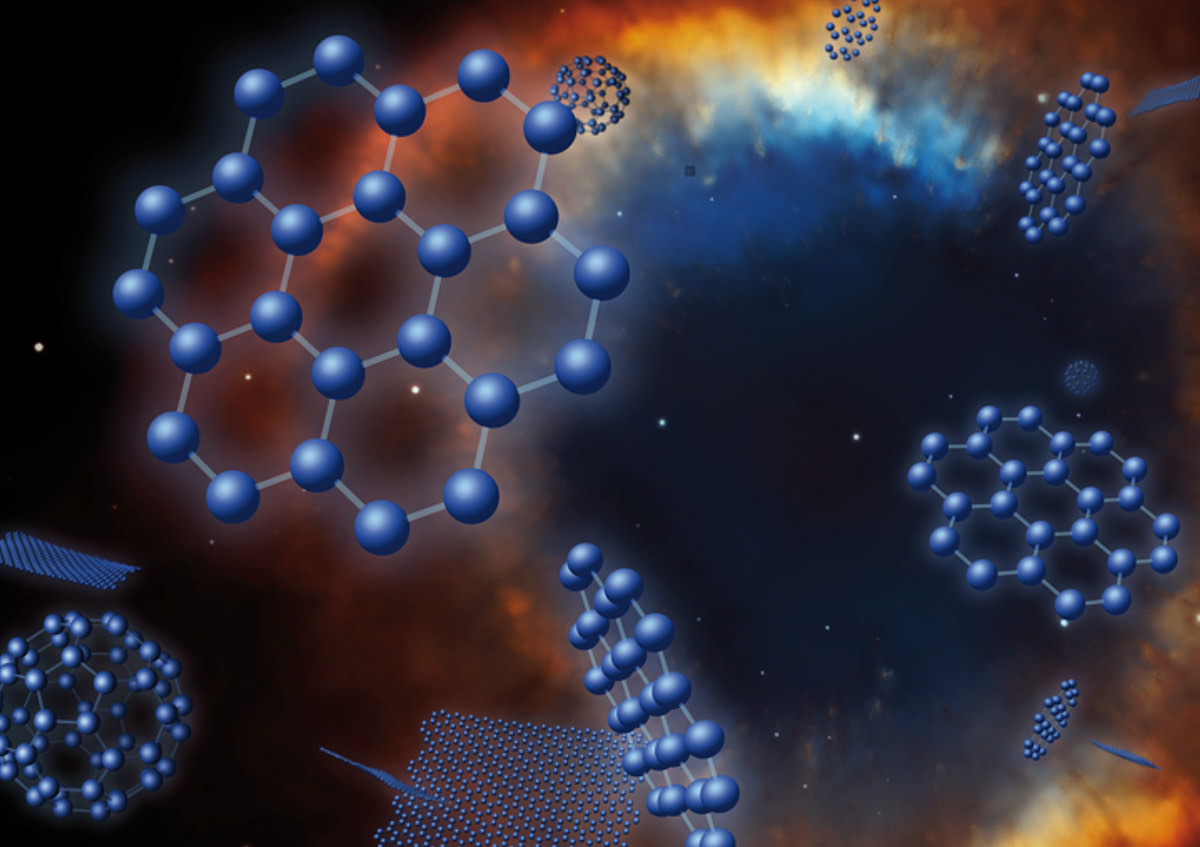
In 2004, scientists at the University of Manchester first isolated and studied graphene, the supermaterial made of single-layer carbon atoms arranged in a hexagonal honeycomb lattice. Since then, it has been a marvel whose properties make it extremely useful for numerous applications. It is widely believed among scientists that about 1.9% of the carbon in the interstellar medium (ISM) is in the form of graphene, with its shape and structure determined by the process of its formation.
In fact, there could be plenty of this supermaterial on the lunar surface. In a recent study, researchers from the Chinese Academy of Sciences (CAS) discovered naturally occurring graphene arranged in a special thin-film structure on the moon. These findings could have dramatic implications for our understanding of the moon's formation and lead to new methods for producing graphene, with applications in electronics, energy storage, construction and supermaterials. They could also prove useful for future missions that create permanent infrastructure on the lunar surface.
The team was led by Professors Wei Zhang and Meng Zou of the Key Laboratory of Bionic Engineering and the Jilin Provincial International Cooperation Key Laboratory of High-Efficiency Clean Energy Materials at Jilin University, Xiujuan Li, senior engineer at Jilin University, and Wencai Ren of the Institute of Metal Research (CAS-ISM) of CAS. They were joined by colleagues from several key laboratories at Jilin University, the CAS-ISM, the Deep Space Exploration Lab, and the Lunar Exploration and Space Engineering Center. The article describing their findings appeared in the National Science Review.
For decades, scientists have speculated that the Earth-Moon system was formed by a massive collision – the Giant Impact Hypothesis – between a Mars-sized body (Theia) and Earth about 4.4 billion years ago. This theory is supported by analyses of lunar rocks brought back by the Apollo astronauts, which led to the assumption of a carbon-poor system. However, recent evidence challenges this consensus, as global carbon ion fluxes have been observed on the Moon, suggesting the presence of native carbon.
These observations are consistent with the analysis of one of the Apollo 17 samples, which showed the presence of graphite. For their study, the team performed a spectroscopic analysis of an olive-shaped sample of lunar soil (about 2.9 mm x 1.6 mm) recovered by the Chang'e-5 mission in 2020. This was China's third robotic mission to reach the lunar surface and its first sample return from the Moon. Based on the spectra they obtained, they found an iron compound closely related to the formation of graphene in a carbon-rich section of the sample.
Upon further analysis using advanced microscope and mapping technologies, they confirmed that the carbon in the sample was composed of graphene flakes that were two to seven layers thick. As for how it got there, the team suggested that the graphene may have been formed during a period of volcanic activity early in the Moon's history, when it was still geologically active. They further suspect that the graphene was catalyzed by solar winds that stirred up the lunar regolith and its iron-containing minerals, which may have helped transform the carbon's atomic structure.
They also consider the possibility of meteorite impacts, which are known to create high-temperature, high-pressure environments similar to volcanic activity. In their article, they write:
“Graphene is embedded in the form of individual flakes or formed as part of a carbon shell that encloses the mineral particles. Our result shows a typical structure of native carbon on the Moon and its formation mechanism has been proposed. This discovery could reinvent the understanding of the chemical constituents, geography and history of the Moon.”
Artist's impression of the interior of the moon. Image credit: Hernán Cañellas/Benjamin Weiss
These findings could also have huge implications for research here on Earth, where graphene is being studied for applications ranging from electronics and mechanics to materials science. As they state in their study, this study could lead to new methods for producing the material inexpensively and provide additional opportunities for lunar research:
“The identification of graphene in the core-shell structure suggests a bottom-up synthesis process rather than exfoliation, which generally involves a catalytic reaction at high temperatures. Therefore, a formation mechanism of few-layer graphene and graphitic carbon is proposed here…
“The mineral-catalyzed formation of natural graphene, in turn, sheds light on the development of low-cost, scalable synthesis techniques for high-quality graphene. Therefore, a new lunar research program could be promoted and some breakthroughs are expected soon.”
These findings could also prove useful for future missions that lead to the development of permanent infrastructure on the lunar surface. These include NASA's Artemis program, which aims to create a “sustainable lunar exploration and development program.” There is also ESA's Moon Village initiative and China and Russia's plan for an International Lunar Research Station (ILRS). In addition to exploration and scientific research, these programs could conduct experiments on the properties and uses of graphene, which could include the creation of lunar habitats!
Further reading: EurekAlert!, National Science Review
Like this:
Is loading…

Comments are closed.