

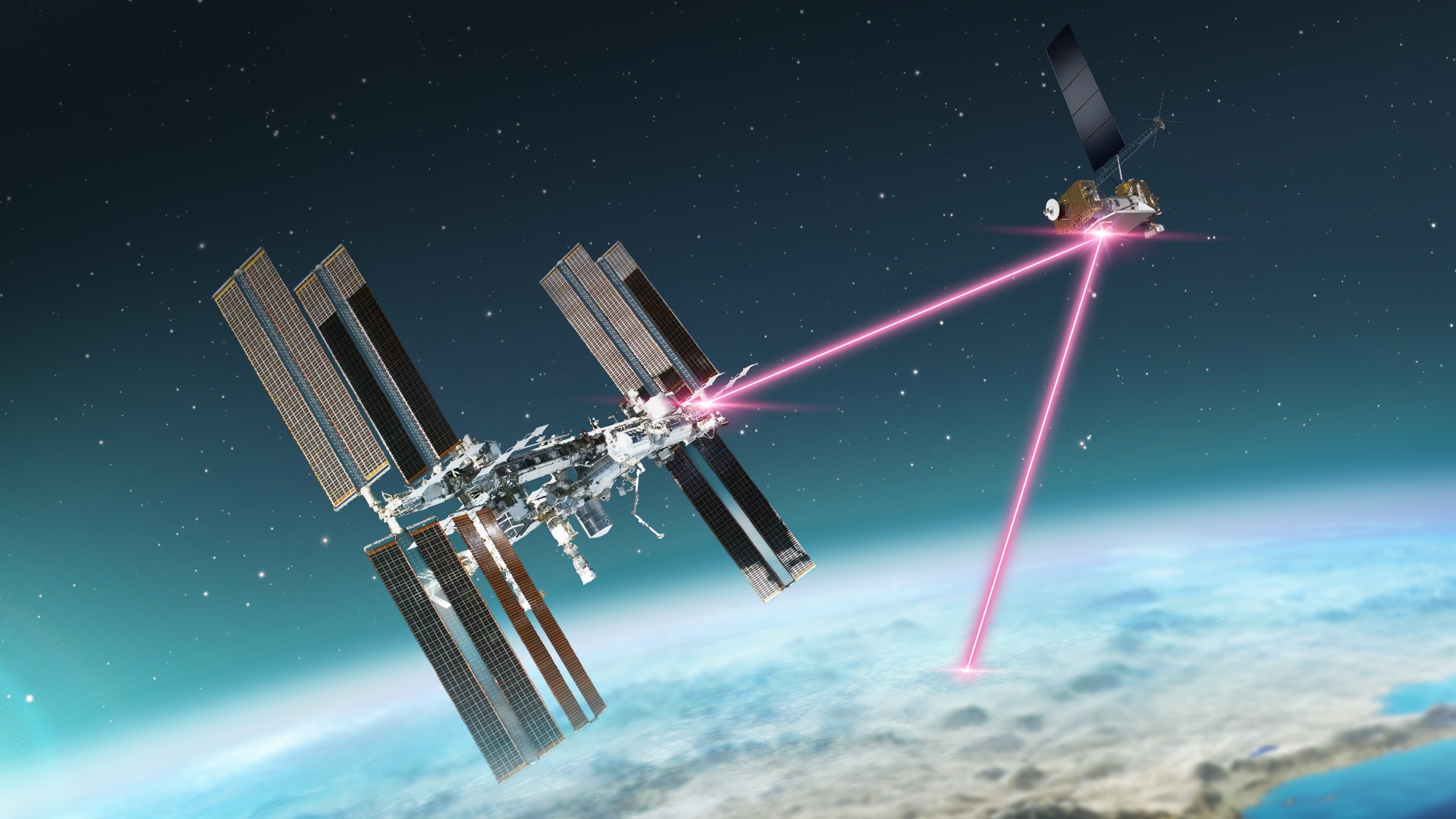
In many parts of the world, we take high-definition streaming for granted. Even now, as I write this article, I have high-definition streaming from Mars, but astronauts aboard the space station have had to make do with low-definition streaming until now. A team of researchers at NASA has developed and used a new system that uses an aircraft as a relay. A laser terminal was installed on a research aircraft and data was beamed to a ground station. The signals were sent around the Earth and sent to a relay satellite, which then relayed the signal to the space station. As for what the astronauts will actually use it for, streaming HD movies is less likely, but they will certainly be able to use the high bandwidth for scientific data and communications.
Over the years, astronauts from all countries have had to rely on radio waves to transmit data and information to and from space. While this meant reliable communications, video quality was poor. Alternative technologies have existed, but these are generally limited to activities on Earth. One obvious alternative is laser, which uses infrared light to transmit 10 to 100 times more data than radio-based systems.
A team of researchers at the Glenn Research Center, part of NASA's Cleveland office, has succeeded in establishing sufficient bandwidth to stream 4K video to the ISS using laser communications. The study was part of a series of tests of new technologies that could enable high-quality live video coverage of the Artemis lunar landing missions.
The International Space Station (ISS) in orbit. Photo credit: NASA
The team worked closely with the Air Force Research Laboratory and NASA's Small Business Innovation Research program. Together, they installed a temporary laser terminal on the underside of a Pilatus PC-12 aircraft. The pressurized, single-engine aircraft then flew over Lake Erie in Cleveland and sent data to a nearby ground station. The next step was to send the data via ground-based infrastructure to White Sands, NASA's test facility in New Mexico, where it was converted into an infrared signal.
Orbiting Earth at an altitude of 35,000 kilometers, NASA's experimental Laser Communications Relay Demonstration satellite received the infrared signal and then relayed it to the ISS via Illuma-T, the integrated LCRD LEO user modem and repeater terminal. A new system called High-Rate Delay Tolerant Networking was integrated into the transmission to help better deal with cloud intrusion.
The Pilatus aircraft completed several flights and after each test the functionality was improved. During flight tests it is much easier to identify problems and subsequent improvements than during ground tests.
NASA's Space Launch System rocket carrying the Orion spacecraft launches for the Artemis I flight test from Launch Complex 39B at NASA's Kennedy Space Center in Florida on Wednesday, November 16, 2022. Image credit: NASA/Joel Kowsky.
The upcoming Artemis missions to the Moon and beyond are a real driver for the development of high-bandwidth data transmissions, not only for video streaming, but also to provide astronauts with comprehensive video conferencing capabilities. This will not only improve mission efficiency, but also help maintain astronaut morale and well-being. The pursuit of capturing high-quality video data along with massive amounts of scientific data will also benefit this high-bandwidth technology, as NASA sees laser communications as a core part of its future projects.
Source: NASA transmits first 4K video from aircraft to space station, back
Like this:
Is loading…

Comments are closed.