

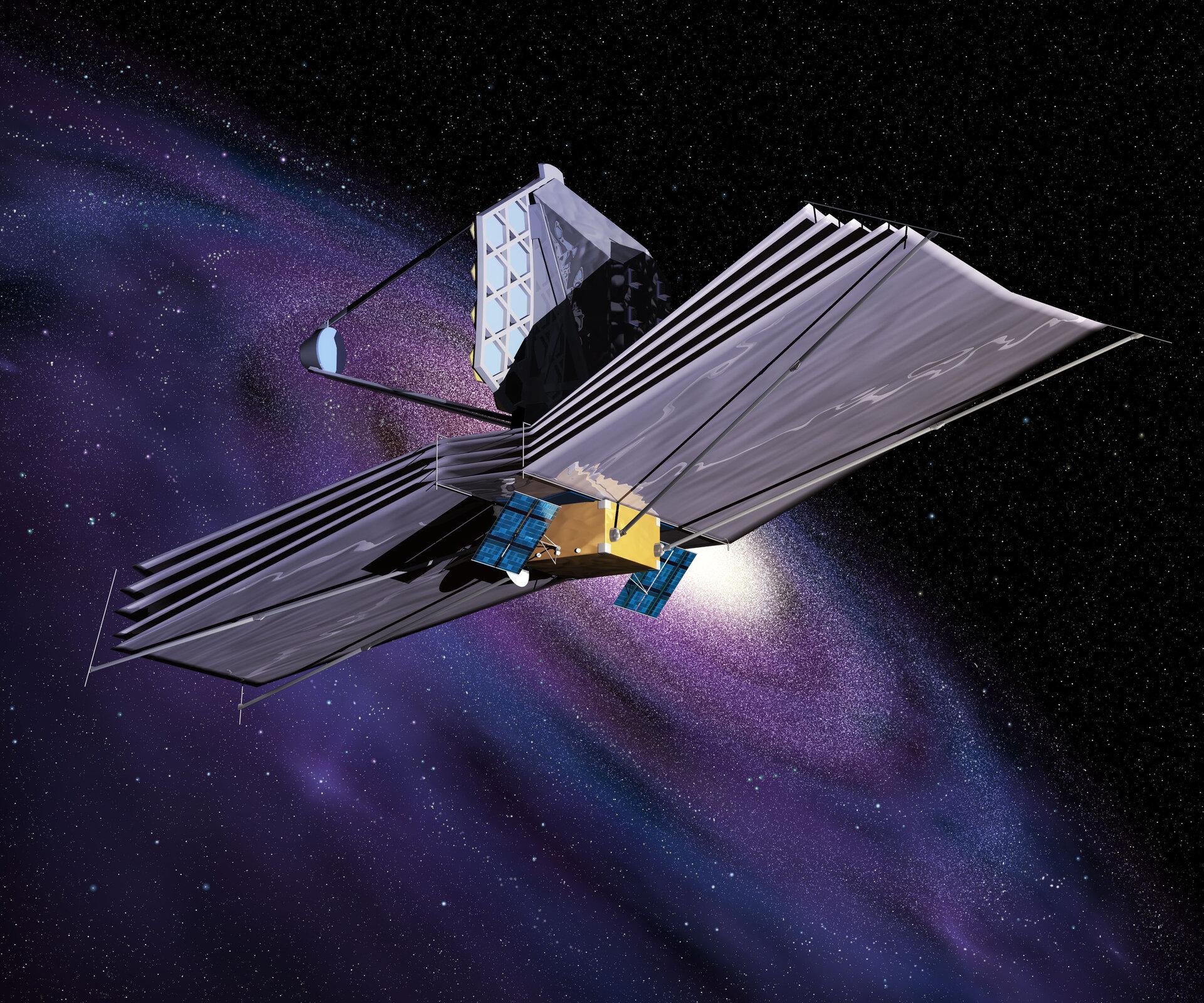
The Hubble Space Telescope was launched into space on the space shuttle Discovery and then released into low Earth orbit. The James Webb Space Telescope was squeezed into the nose cone of an Ariane 5 rocket and then launched. It unfolded its mirror and shadow as it made its way to its home at the Sun-Earth L2 Lagrange point.
However, the ISS was assembled in space, with components launched at different times. Could it be a model for building future space telescopes and other space facilities?
The universe has many dark corners that need to be explored. That's why we strive to build more powerful telescopes, i.e. larger mirrors. However, it is becoming increasingly difficult to transport them into space within the nose of the rocket. Since we no longer have space shuttles, this leads us to a natural conclusion: we assemble our space telescopes in space using powerful robots.
New research in the journal Acta Astronautica examines the feasibility of using walking robots to build space telescopes.
The research is “The new era of walking manipulators in space: Feasibility and operational evaluation of building a 25m large aperture space telescope in orbit.” The lead author is Manu Nair from the Lincoln Center for Autonomous Systems in the UK.
“This research is timely given the ongoing call for high-resolution astronomy and Earth observation in the space community and will serve as a foundation for future missions using much larger aperture telescopes, missions requiring the construction of space stations, and solar power generation satellites,” to just to name a few,” the authors write.
Although the Canadarm and the European robotic arm on the ISS have proven to be powerful and effective, they have limitations. They are remotely controlled by astronauts and have limited walking abilities.
Recognizing the need for more powerful space telescopes, space stations and other infrastructure, Nair and his co-authors developed a concept for an improved walking robot. “To address the limitations of traditional walking manipulators, this paper introduces a novel, dexterous end-over-end walking robot (E-Walker) with seven degrees of freedom for future In-Space Assembly and Manufacturing (ISAM) missions,” they write .
An illustration of the E-Walker. The robot has seven degrees of freedom, which means it has seven independent movements. Image source: Mini Rai, University of Lincoln.
Robotics, automation and autonomous systems (RAAS) will play a large role in the future of space telescopes and other infrastructure. These systems require skill, a high degree of autonomy, redundancy and modularity. Much work remains to develop RAAS that can operate in the harsh environment of space. The E-Walker is a concept that aims to meet some of these requirements.
The authors point out how robots are used in unique industrial environments here on Earth. The Joint European Torus will be decommissioned and a four-legged robot from Boston Dynamics Spot will be deployed to test its effectiveness. During a 35-day test period, it moved autonomously around the JET, mapping the facility and taking sensor readings while avoiding obstacles and personnel.
The Boston Dynamics Spot robot worked autonomously on the Joint European Torus for 35 days. Here Spot inspects wires and pipes at the Culham facility near Oxford (Image credit: UKAEA)
The use of Spot during an industrial shutdown shows the potential of autonomous robots. However, robots still have a long way to go before they can build a space telescope. The authors' case study could be an important first step.
Their case study is the hypothetical LAST, a large-aperture space telescope with a 25-meter wide-field primary mirror operating in visible light. LAST is the backdrop for the researchers' feasibility study.
LAST's primary mirror would be modular and its part would have connection ports and interfaces for construction as well as data, power and heat transfer. This type of modularity would make it easier for autonomous systems to assemble the telescope.
LAST would build its mirror using Primary Mirror Units (PMUs). Nineteen PMUs form a primary mirror segment (PMS), and 18 PMS would form LAST's 25-meter primary mirror. A total of 342 PMUs would be required to complete the telescope.
This illustration shows how LAST would be structured. 342 primary mirror units form the 18 primary mirror segments and together result in a 25 meter primary mirror. (b) shows how to find the center of each PMU, and (c) shows a PMU and its connections. Image source: Nair et al. 2024.
The E-Walker concept would also include two spacecraft: a base spacecraft (BSC) and a storage spacecraft (SSC). The BSC would act as a sort of mothership, sending necessary commands to the E-Walker, monitoring its operational status and ensuring that everything runs smoothly. The SSC would hold all the PMUs in a stacked arrangement and the E-Walker would retrieve one at a time.
For the LAST mission, the researchers developed eleven different Concept of Operations (ConOps). At some ConOps, several e-walkers worked together. The goals are to optimize task sharing, prioritize ground lifting mass, and simplify control and motion planning. “The above eleven mission scenarios will be further studied to select the most feasible ConOps for assembling the 25m LAST,” they explain.
This figure summarizes the 11 missions ConOps developed for LAST. (a) shows assembly with a single E-Walker, (b) shows partially shared responsibilities among E-Walkers, (c) shows equally shared responsibilities between E-Walkers, and (d) shows assembly in two separate units, Das is the safer installation option. Image source: Nair et al. 2024.
Advanced tools such as robotics and AI will be the cornerstone of the future of space exploration. It is almost impossible to imagine a future in which they are not critically important, especially as our goals become increasingly complex. “The ability to assemble complex systems in orbit using one or more robots will be an absolute prerequisite for supporting a resilient future orbital ecosystem,” the authors write. “In the coming decades, newer orbital infrastructure, much more advanced than the International Space Station, will be needed for maintenance, manufacturing, recycling, orbital storage, space-based solar power (SBSP), and on-orbit astronomical purposes and Earth observation stations.”
The authors point out that their work is based on some assumptions and theoretical models. The E-Walker concept still requires a lot of work, but a prototype is in development.
It's likely that the E-Walker or a similar system will eventually be used to build telescopes, space stations and other infrastructure.
Like this:
Load…

Comments are closed.