

In 2012, astronomers discovered a gas giant passing in front of WASP-49A, a G star located about 635 light-years from Earth. Data obtained from the WASP survey suggests that this exoplanet (WASP-49 b) is a gas giant, approximately the same size as Jupiter and 37% as massive. In 2017, WASP-49 b was found to have an extensive sodium cloud, which posed a mystery to scientists. Further observations in 2019 with the Hubble Space Telescope revealed the presence of other minerals, including magnesium and iron, which appeared to be magnetically bound to the gas giant.
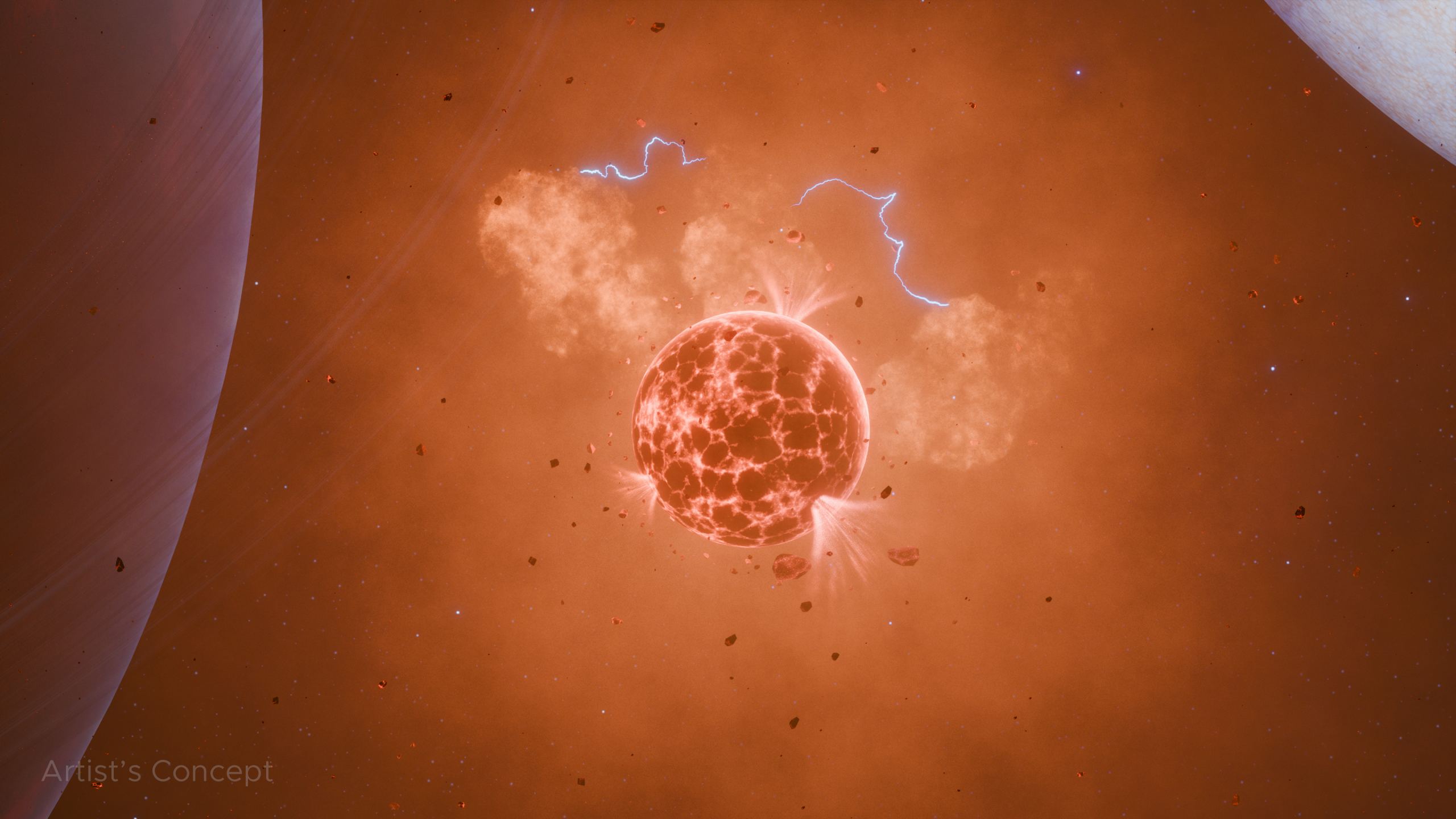
WASP-49 b and its star are mostly hydrogen and helium and contain only trace amounts of sodium – not enough to explain this cloud. Furthermore, there was no indication of how this sodium cloud was ejected into space. In our solar system, gas emissions from Jupiter's volcanic moon Io cause a similar phenomenon. In a recent study, an international team led by scientists at NASA's Jet Propulsion Laboratory found potential evidence of a rocky volcanic moon orbiting WASP-49 b. Although not yet confirmed, the presence of a volcanic exomoon around this gas giant could explain the presence of this sodium cloud.
The study was led by Apurva Oza, a former postdoctoral fellow at NASA's Jet Propulsion Laboratory and now a research associate at Caltech. He was joined by colleagues from NASA JPL and researchers from the European Southern Observatory (ESO), the Indian Institute of Astrophysics, the Caltech/IPAC-NASA Exoplanet Science Institute, the Institute of Science and Technology Austria (ISTA) and the Birla Institute of Technology and science as well as several universities. The paper detailing their findings was recently published in The Astrophysical Letters.
Io is the most volcanic body in our solar system, with hundreds of active volcanoes and extensive lava formations. This activity is the result of tidal interaction with Jupiter's strong magnetic field, causing Io's interior to bend and contract, creating dense lava flows that breach the surface. These volcanoes spew lava up to 300 km (186 miles) into space, along with sulfur dioxide, sodium, potassium and other gases, creating a huge cloud around Jupiter that reaches up to 1,000 times the planet's radius.
While the team's observations did not detect any exomoons directly around WASP-49 b, a massive sodium cloud could be indirect evidence of a volcanic moon that is simply too small and dark to be detected. Oza has been studying for years how exomoons could be recognized based on their volcanic activity. To determine whether this was the case with WASP-49 b, he and the team observed WASP-49 b over time using the Echelle SPectrograph for Rocky Exoplanets and Stable Spectroscopic Observations (ESPRESSO) on ESO's Very Large Telescope (VLT). .
This proved quite difficult due to the distance and the way the star, planet and cloud often overlap, making it very difficult to tell them apart. Still, their observations revealed several clues that a separate body is responsible for the sodium cloud. For example, their observations indicated that the cloud suddenly grew larger during two observations, suggesting that it was being refilled. In fact, they estimate that the cloud is renewing itself at a rate of 100,000 kg (220,000 lbs) per second.
They also observed that the cloud was moving faster than the planet, suggesting that it was created by another body orbiting faster than the planet. “We think this is really crucial evidence,” Oza said. “The cloud is moving in the opposite direction that physics would tell us if it were part of the planet's atmosphere.” Their observations also revealed something interesting, as WASP-49 b orbited its host star every 2.8 days. During this time, the cloud appeared and disappeared irregularly behind the star or planet.
This artist's concept shows a potential volcanic moon between the exoplanet WASP-49 b (left) and its parent star. Image credit: NASA/JPL-Caltech
To address this issue, the team also used a computer model to simulate the presence of an exomoon and compare it with their observations. Their results showed that an exomoon with an orbital period of eight hours could explain the cloud's movement and activity, including the way it appeared to pass in front of the planet and disappear and reappear at intervals. Another takeaway from this study was what it says about the future of this possible exomoon.
If WASP-49 b is a similar size to Earth's moon, Oza and his colleagues estimate that the interaction of the tides with the planet's gravity and its rapid loss of mass will eventually cause it to disintegrate. “If there really is a moon there, it will have a very destructive end,” Oza said. Although these observations are fascinating, the team emphasizes that follow-up observations are needed to learn more about the cloud's orbit and structure.
Further reading: NASA, The Astrophysical Letters
Like this:
Load…

Comments are closed.