

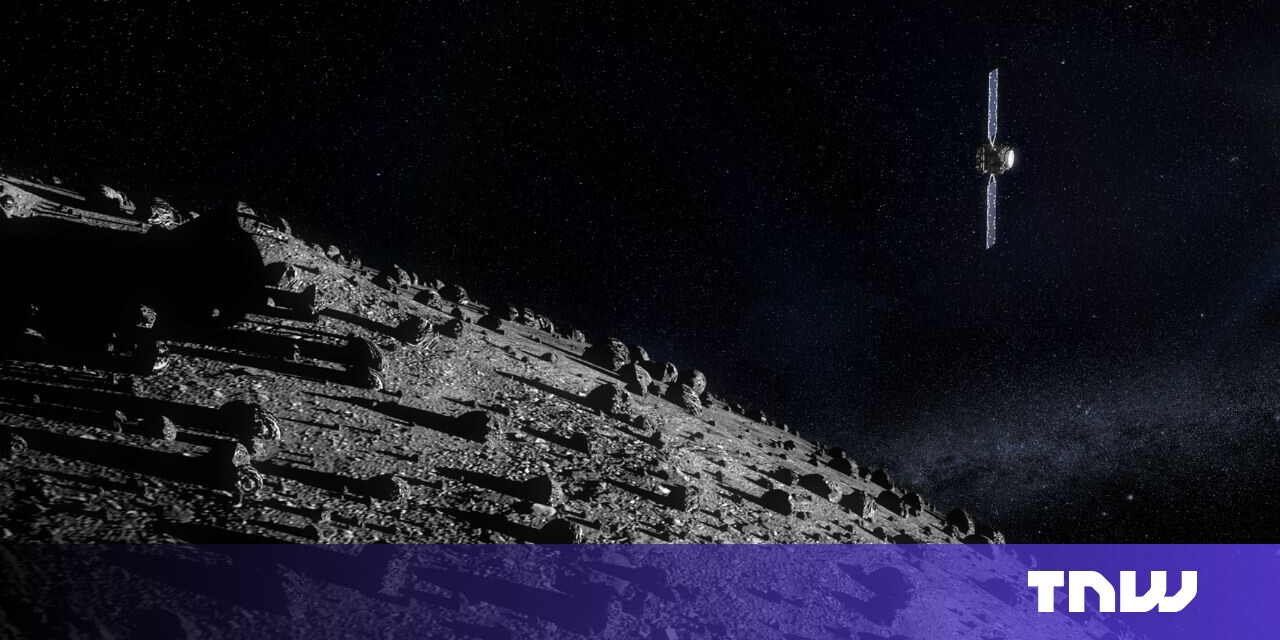
Europe's space engineering elite are making their final preparations for a groundbreaking encounter with an asteroid.
A spaceship called Hera – named after the Greek goddess of marriage – will conduct the rendezvous. The launch of the probe is scheduled for October 7th.
If all goes well, Hera will then complete a detailed inspection of Dimorphos – a binary asteroid that has also caught the attention of NASA.
In 2022, the agency's DART spacecraft intentionally crashed into Dimorphos. The collision contributed to a test of humanity's planetary defenses.
NASA wants to prove we can redirect a giant space rock hurtling toward Earth — and avoid the same fate as the dinosaurs.

The
The latest rumors from the EU tech scene, a story from our wise old founder Boris and questionable AI art. It's free in your inbox every week. Register now!
Hera will measure the impact of the DART attack. The probe will analyze shifts in the asteroid's momentum and changes in its composition.
The European Space Agency (ESA) is leading the mission. But much of the technology on board the probe was developed by startups.
A public-private mission
An outstanding group of 28 startups and SMEs worked on Hera. Among them is Finland's Kuva Space, which uses a technique called hyperspectral imaging to analyze wavelengths of light. By collecting this data, the company can gain new insights about scanned objects.
For the Hera mission, Kuva worked on the spacecraft's life support interface board, which connects the probe and its two CubeSats. Hera will use the CubeSats to collect data about Dimorphos.
Kuva also contributed to the probe's hyperspectral camera, which ESA will use to scan the asteroid.
“They want to see if they can detect the mineral composition of the asteroid without creating an impact crater on the asteroid,” says Tuomas Tikka, founder and CTO of Kuva.
The mission offers the opportunity for fine-tuning Kuva's hyperspectral business plan. The company wants to station a constellation of 100 satellites by 2030. Jarkko Antila, the startup’s CEO, wants them to create “the Bloomberg of planetary insights.”
Tikka also wants to explore another business idea: asteroid mining.
The business case for asteroid mining
Asteroids contain a variety of valuable materials. Hyperspectral images could help find and extract them.
“Maybe it’s a bit in the future,” says Tikka with a smile. “But if we make hundreds of millions from Earth-based applications, then we have the money for asteroid mining.”
ESA can play a key role in making such dreams come true. The agency's programs provide funding for space companies and unique tests in the cosmos.
“The Continuous support of startups working in new areas is important because not everything can be commercialized immediately,” says Tikka.
Kuva will now travel from Hera to Cape Canaveral, Florida for the launch. The probe is scheduled to launch this Monday on a SpaceX Falcon 9 rocket, but there is a risk of delay.
Falcon 9 has been grounded since an anomaly in the upper stage during launch on September 28th. However, if the rocket flies as planned, humanity will be one step closer to defending against asteroids – and possibly mining them.

Comments are closed.