

The European Space Agency has given the green light to initial work on a mission to visit an asteroid called (99942) Apophis. If approved at a key meeting next year, the robotic spacecraft, known as the Rapid Apophis Mission for Space Safety (Ramses), will rendezvous with the asteroid in February 2029.
Apophis is 340 meters wide, about as tall as the Empire State Building. If it were to impact Earth, it would cause widespread destruction hundreds of kilometers from the impact site. The energy released would be equivalent to that of dozens or hundreds of nuclear weapons, depending on the capabilities of the device.
Fortunately, Apophis will not hit Earth in 2029. Instead, it will fly safely past Earth at a distance of 19,794 miles (31,860 kilometers), which is about one-twelfth the distance from Earth to the Moon. Still, it is a very close flyby of such a large object, and Apophis will be visible to the naked eye.
NASA and the European Space Agency have seized this rare opportunity to send separate robotic spacecraft to rendezvous with Apophis and learn more about it. Their missions could help advance efforts to deflect an Earth-threatening asteroid should we need it in the future.
The threat of asteroids
About 66 million years ago, an asteroid the size of a small town hit Earth. The impact of this asteroid triggered a global extinction of dinosaurs.
Earth is constantly at risk of being hit by asteroids, the remnants of the formation of the solar system 4.5 billion years ago. Asteroids are found in the asteroid belt between Mars and Jupiter and come in many shapes and sizes. Most are small, just 10 meters wide, but the largest are hundreds of kilometers in diameter and larger than the asteroid that killed the dinosaurs.
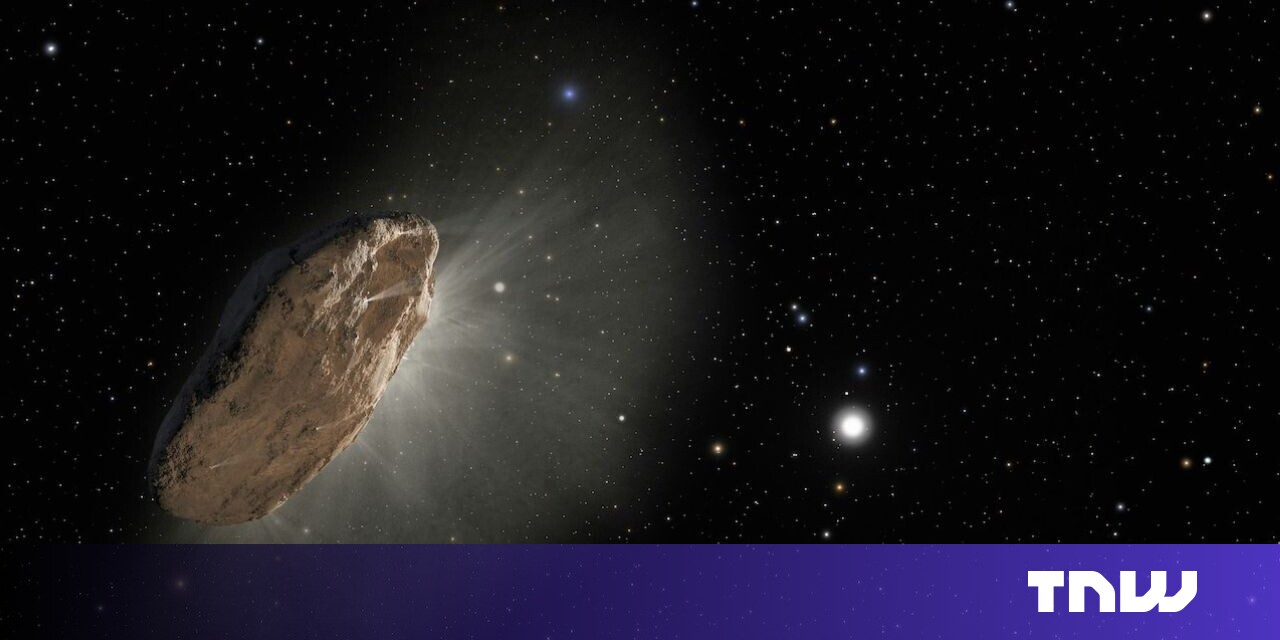
Artist's impression of Apophis.
NASA
The asteroid belt contains 1–2 million asteroids larger than a kilometer in diameter and millions of smaller bodies. These space rocks feel the pull of each other as well as the pull of Jupiter on one side and the inner planets on the other.
Because of this gravitational tug-of-war, every now and then an asteroid is thrown out of its orbit and hurtles toward the inner solar system. There are 35,000 such “near-Earth objects” (Neos). Of these, 2,300 “Potentially Hazardous Objects” (PHOs) have orbits that cross Earth’s and are large enough to pose a real threat to our survival.
Don't go gently into that good night
In the 20th century, astronomers set up several surveys like Atlas to detect and study dangerous asteroids. But detection is not enough; We must find a way to defend Earth against an incoming asteroid.
Blowing up an asteroid, as depicted in the movie Armageddon, serves no purpose. The asteroid would break up into smaller fragments that would move largely in the same direction. Instead of being hit by a large asteroid, Earth would be hit by a swarm of smaller objects.
The preferred solution is to deflect the incoming asteroid away from Earth so that it passes harmlessly. To do this we would need to apply an external force to the asteroid to push it away. A popular idea is to fire a projectile at the asteroid. NASA did this in 2022 when a space probe called Dart collided with an asteroid. Before we do this out of necessity, we need to understand how different types of asteroids would react to such an impact.
Apophis, Ramses and Osiris Apex
Apophis was discovered in 2004. The asteroid passed Earth on December 21, 2004 at a distance of 14 million kilometers. It returned in 2021 and will fly past Earth again in 2029, 2036 and 2068.
Until recently, there was a small chance that Apophis could collide with Earth in 2068. However, during Apophis' approach in 2021, astronomers used radar observations to refine their knowledge of the asteroid's orbit. These showed that Apophis would not hit our planet for another 100 years.
The Ramses mission will rendezvous with Apophis in February 2029, two months before its closest approach to Earth on Friday, April 13. It will then accompany the asteroid as it approaches Earth. The goal is to learn how Apophis' orbit, rotation and shape change as it gets so close to Earth's gravitational field.
In 2016, NASA launched the Origins, Spectral Interpretation, Resource Identification, and Security – Regolith Explorer (Osiris-Rex) mission to study the near-Earth asteroid Bennu. It intercepted Bennu in 2020 to collect rock and soil samples from its surface. It shipped the stones in a capsule that arrived on Earth in 2023.
The spacecraft is still out there, so NASA renamed it Origins, Spectral Interpretation, Resource Identification and Security – Apophis Explorer (Osiris-Apex) and tasked it with exploring Apophis. Osiris Apex will reach the asteroid shortly after its close encounter in 2029. It then flies low over Apophis' surface and fires its engines, stirring up the rock and dust covering the asteroid and revealing the layer beneath.
A close flyby of an asteroid as large as Apophis only occurs once every 5,000 to 10,000 years. The arrival of Apophis in 2029 provides a rare opportunity to study such an asteroid up close and see how it is affected by Earth's gravitational pull. The information collected will influence the way we protect Earth from a real killer asteroid in the future.
Ancient Egyptian mythology
When Ramses and Osiris-Apex encounter Apophis in 2029, they will inadvertently recreate a core part of ancient Egyptian cosmology. For the ancient Egyptians, the sun was personified by several powerful gods, most notably Re. The setting of the sun in the evening was interpreted as dying again and entering the underworld.
During his nightly journey through the underworld, Re was threatened by the great serpent Apophis, who embodied the forces of darkness and dissolution. Only after Apophis was defeated could Re be revived by Osiris, the king of the underworld. Then Re could be reborn in the East and ascend to heaven again.
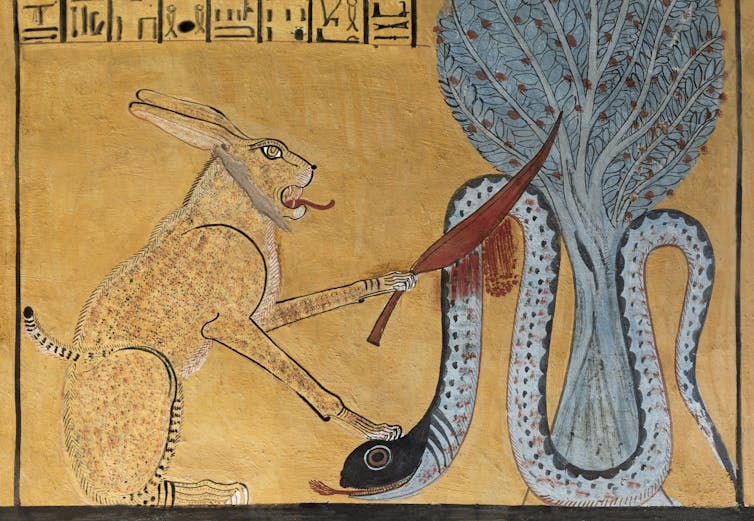 Detail from an Egyptian tomb showing the great cat of Re killing the giant snake Apep (Apophis).
Hemro/Shutterstock
Funeral murals, coffins, and funerary papyri depict Apophis as a large, coiled serpent threatening Re as he sails in his solar barque (sailing ship). But Apophis is always defeated, his body pierced by a spear or torn by knives.
Although the asteroid Apophis poses no threat in the near future, Ramses (named after the pharaohs of the same name, meaning “born of Re”) and Osiris-Apex will study it so that one day we will know how to defeat him – or one of his distant brothers.
Or Graur, Associate Professor of Astrophysics, University of Portsmouth
This article is republished from The Conversation under a Creative Commons license. Read the original article.

Comments are closed.