

The moons of Mars are attracting increasing attention not only because they could offer a glimpse into the solar system's past, but also because they could provide invaluable bases for future human settlements on Mars itself. However, missions designed specifically to visit Phobos, the larger of the two moons, have failed in varying stages of failure. So why not tackle a low-cost mission – one that could launch multiple copies of itself if necessary? That's the idea behind a CubeSat-based mission to Phobos, known as Perseus, which was first described in 2020.
Phobos is interesting for several reasons, but so far we've only gotten relatively grainy images of this small moon, whose overall diameter is the size of a medium-sized city. Most of these images come from Mars orbiters like MRO, which occasionally point their instruments at the other bodies in the system. Several planned missions intended to visit directly, such as Phobos 1 and 2 and more recently Phobos Grunt, failed in space, limiting our understanding of this potentially helpful moon to secondary fragments of larger missions.
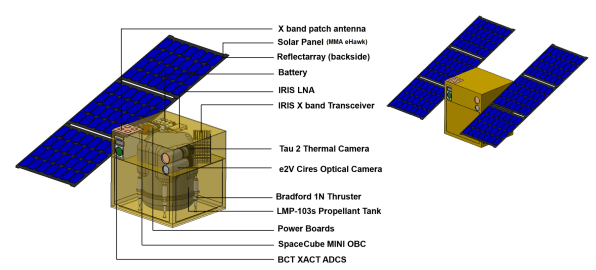
Enter a new mission concept – Perseus (which, surprisingly, doesn't seem to be an acronym for anything) is designed as a 27U CubeSat that adopts several commercial off-the-shelf (COTS) systems used in other interplanetary CubeSat missions, including its own propulsion system and remote sensing equipment . Depending on the funding the mission receives, it could branch into one of two different potential interaction styles with Phobos.
MMX is another mission to collect actual samples from Phobos, but its launch has been delayed until 2026 at the earliest.
First, the mission design preferred by the mission designers, who come primarily from the University of Arizona and Arizona State University, would be to capture Perseus in a shared orbit with Mars and Phobos. This would allow the CubeSat to fly past the Moon every day with an encounter time of about 6 minutes. This would allow Perseus to capture multiple images from multiple sides of Phobos, some of which have never been seen from such a close angle before.
The other mission concept would take Perseus on a hyperbolic trajectory past Phobos itself. In this concept, Perseus would only make a single two-minute flyby of the Moon, but could obtain much closer, and therefore higher-resolution, images of a specific area it wanted to fly by. It would then be thrown into the solar system, eventually running out of fuel. Saving the cost of the larger fuel load for the orbital mission concept is the main reason for developing the scientifically less exciting flyby option.
With the orbital mission concept, Perseus could collect visible light images of the surface of Phobos up to 5 m per pixel and thermal images at 25 m per pixel, as its science payload would consist of visible light and thermal imaging cameras. That's about six times better in visible light than the 30 m/pixel, which is the best information we have from an image from HiRISE on the Mar Reconnaissance Orbiter.
Fraser advocates sending humans to the moons of Mars first.
This resolution could further explore some features of Phobos, such as the “grooves” that dominate its surface. Additionally, Perseus could scout potential landing sites for future manned missions in preparation for a visit to the Red Planet.
However, the real advantage of Perseus is that it is relatively inexpensive. Although relatively large by CubeSat standards at 54kg and a 27U configuration, assembly and testing of many components would be relatively inexpensive due to flight experience. However, no funding has been awarded to the mission to date, and a brief literature search revealed no additional work on the project in recent years. But it fits well with the trend toward smaller, less risky and more cost-effective missions. Maybe one day a similar moon will get the green light, and we can finally start collecting detailed light from one of the most important moons in the solar system.
Learn more:
Nallapu et al. – Perseus Trajectory Design: A Cubesat Mission Concept for Phobos
UT – What can we learn from a mission to Phobos?
Subtitled – How Mars' moon Phobos captures our imagination
UT – Did an ancient ice impactor create the moons of Mars?
Mission statement:
Technical model of the Perseus space probe.
Credit – Nallapu et al.
Like this:
Load…

Comments are closed.