
The best geomagnetic storm of the 20th century … 13th-15th centuries Could 1921 … a century in the past New York Metropolis / New York State had been notably onerous hit

Paul Dorian
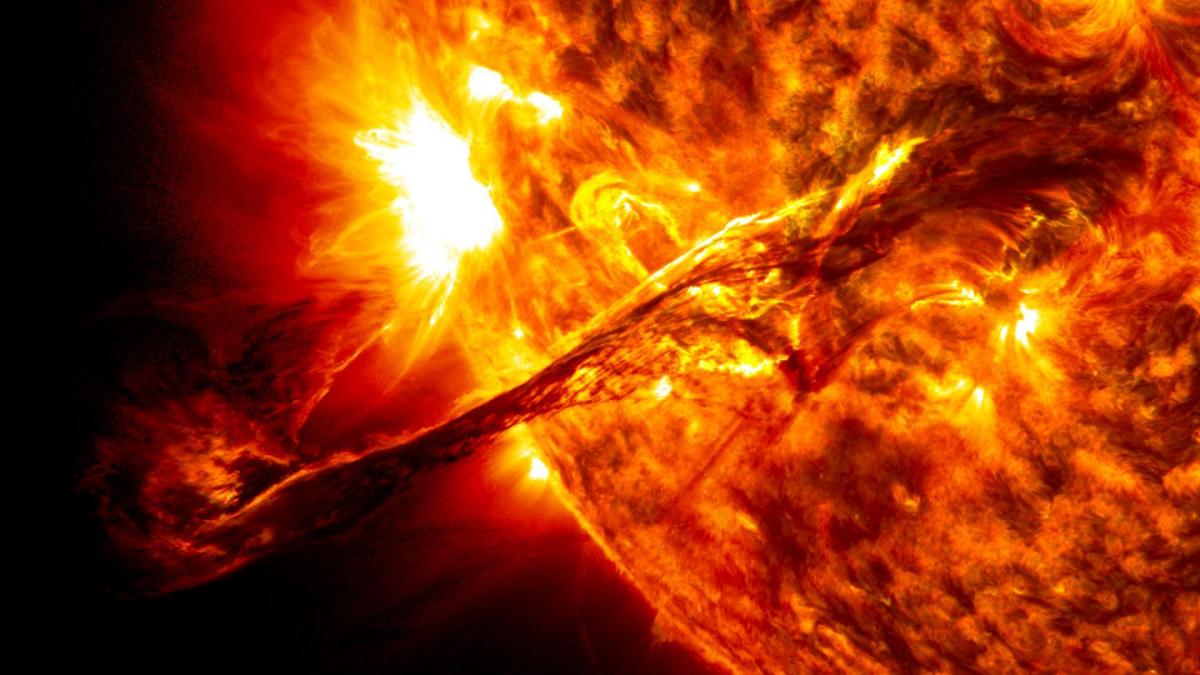
A strong solar storm in May 1921 had a significant impact on the earth, from fires at telegraph stations and railroad systems to the interruption of telephone and radio broadcasts to the shutdown of telegraph lines in the USA and Europe. Because many problems occurred near New York’s Grand Central Terminal, the storm is sometimes referred to as the “New York Railroad Storm”. (Image Credit: Background Image – NASA / SDO, Headings – StarDate).
* The largest geomagnetic storm of the 20th century … 13th-15th centuries May 1921 … a century ago New York City / New York State were particularly hard hit *
overview
The most intense geomagnetic storm of the 20th century occurred during solar cycle 15 over a three-day period from May 13-15, 1921. The storm occurred before the widespread electrical infrastructure dependency we have in the world today, but the effects of an extraordinarily strong coronal mass ejection were still quite extensive. The electrical current from the storm started a number of fires around the world, including one near Grand Central Terminal in New York City. In addition, aurors began to appear across the eastern United States, creating a brightly lit night sky, and telegraph service was virtually disrupted due to blown fuses and damaged equipment. Research over the past few years has shown that this super solar storm of May 1921 was just as intense as the forefather of all super storms in recorded history – the “Carrington Event of 1859”.
The sunspot region is now referred to as “AR1842” as recorded on May 13, 1921. Courtesy of spaceweather.com
Gigantic sunspot
The largest solar storm of the 20th century actually occurred in the waning phase of solar cycle 15, with the culprit being a gigantic sunspot known at the time as the “Greenwich Region 933404”. This sunspot was first seen at the eastern edge of the Sun on May 8, 1921, and turned west over the next ten days. This sunspot probably generated up to six coronal mass ejections (CMEs) directly to the earth during this period, as recorded in ground-based magnetometer measurements (Newton, 1948, p. 178). Scientists around the world were surprised, and probably quite astonished, when their magnetometers went “off the scales” between May 13 and 15 at the height of the storm. Little did they know this was going to be the biggest solar storm of the century – and according to Dr. Spaceweather.com’s Tony Phillips has not seen anything like it since.
The effects were particularly strong in New York City / New York State
The effects of the May 1921 super solar storm were particularly acute in New York City and throughout New York State. For this reason, this event is sometimes referred to as the “New York Railroad Superstorm” (Love et al., 2019). Electric currents induced by geomagnetic activity flowed through telephone and telegraph lines, heating them to the point of burning. The railroad control tower near Grand Central Station in New York City went up in flames. Flames also engulfed the electrical panel north of New York City at Brewster Station on the Central New England Railroad, spreading so far that the entire building was destroyed. A telegraph operator there was driven out of his keys by an “electrical fluid” which suddenly “flared up” (The Bridgeport Telegram, May 17, 1921, p. 11). On May 14, excessive electrical currents on telephone lines caused the Union Railroad station in Albany, NY, to catch fire and burn the station to the ground. The New York Times reported that storm-induced effects were particularly pronounced throughout the eastern United States, where fluctuating electrical currents rose to levels where “hardly any wire worked anywhere” and stray voltages on some wires exceeded 1000 volts. Aurors over New York City were apparently so bright that even the “intense lights of the electrical signs along Broadway could not dim the brilliance of the blazing sky” (The New York Times, May 15, 1921, p. 1; May 17, 1921 , P. 1).
Headlines from the great solar storm of May 1921 (Courtesy of spaceweather.com)
The effects of the super solar storm spread around the world, and fires broke out in numerous locations, including a telegraph exchange in Sweden that went up in flames on May 15. Telegraph systems have malfunctioned in Australia, Brazil, Denmark, France, Japan, New Zealand, Norway, Sweden and the UK. At the height of the storm, “northern lights” were seen from ships at sea that crossed the equator as far as Texas in the US and even in the southern hemisphere in places like Samoa and Tonga.
Daily observations of the number of sunspots since January 1, 1900 Solar Influences Data Analysis Center (SIDC). The thin blue line shows the daily sunspot number, while the dark blue line shows the running annual average. The arrow indicates the period of the May 1921 super storm that occurred during the waning phase of solar cycle 15. (Courtesy of klima4you.com)
Interesting effects on radio propagation
One of the interesting features of this solar storm, according to a recent publication (Hapgood, 2019), was its variable impact on the propagation of long-distance radio signals. There have been reports showing both interference and improvement in radio propagation, with reports of improvement drawing much attention as they were in stark contrast to interference with other telecommunications systems. An example of an improvement was a report in the New York Times (NYT, 1921a), according to which radio signals traveling from Berlin (about 6,400 km away) and Bordeaux (5,800 km) to New York were between 02:30 and 04: 00:00 was much stronger than usual GMT on May 15th. This report is particularly credible because the New York Times was one of several US newspapers that then ran their own radio stations to receive news from Europe (Hudson et al., 2000). The good performance of radio communications in the United States and Bordeaux has also been confirmed in statements from the Radio Corporation of America (Telegraph and Telephone Age, 1921b). Another example of an improvement came from the Pacific region, where Angenheister and Westland (1921a) and Gibbs (1921) reported unusually good conditions for radio links between radio stations in Apia in Samoa and Awanui in northern New Zealand at around 6:15 a.m. Distance of 2,700 km).
To understand the improvement in radio signals during the storm, it is important to know that the radio systems used in 1921 operated in low frequency radio bands below 300 kHz. For example, the radio link between New Zealand and Samoa was operated at 150 kHz (Gibbs, 1921). At this frequency, radio signals couple to the conductive earth’s surface, both on land and in water, and propagate along this surface, following the curvature of the earth in what is known as a “ground wave”. The signals are gradually attenuated by the finite conductivity of the surface with less attenuation when the conductivity is higher, mostly obviously over the salt water that forms the oceans (International Telecommunications Union, 2007). However, the signals can also propagate into the upper atmosphere and be reflected by the ionosphere, creating a “sky wave” that can interfere with the fundamental wave signal and cause signal reception problems. Sky wave interference can also arise from distant sources of natural radio signals, such as lightning and other electrical activity in the atmosphere. This results in good conditions for signal propagation at 150 kHz if sky waves are strongly attenuated by absorption due to a significant plasma density in the lower ionosphere below 90 km (Kredit Hapgood, 2019).
Possible impact on today’s world
Some recent research (e.g. Love et al., 2019) now suggests that this great solar storm of May 1921 was about as intense as the “Carrington event of 1859”, which was recorded as the strongest solar storm in the world History was designated. The super solar storm of 1859 occurred during solar cycle # 10 and was named after British astronomer Richard Carrington when from his own private observatory he was watching the solar flare that resulted in a large coronal mass ejection (CME) directly in Wandered towards earth. Perhaps the most intense storm since the May 1921 superstorm was the March 1989 magnetic storm that caused a power outage in Quebec, Canada.
In today’s world, electronic technologies are embedded in everyday life and, of course, very susceptible to solar activity. Power lines, telephone cables, radars, cell phones, GPS and satellites – all of these could be severely affected by an event like that of 1859 or the 1921 storm. In other words, the world’s high tech infrastructure could stall and disrupt daily activities from buying a gallon of gasoline to using the internet.
Of particular concern are the concerns about what this type of solar storm could mean for the power grid, as voltage spikes caused by solar particles can blow out huge transformers. If numerous transformers were destroyed at the same time, it would likely take a painfully long time to replace them. The eastern United States is particularly vulnerable because the energy infrastructure is highly interconnected, so failures in one location can lead to failures in other regions. A long-term solution to this vulnerability would be to rebuild the aging power grid to make it less susceptible to solar disruption.
On the positive side, observing the sun is a constant in today’s world and a fleet of spacecraft is able to monitor the sun and collect data on solar flares. Also, predictions are better today, and solar scientists could provide a warning about when solar flares might occur and whether a particular storm is on Earth. Improved forecasting allows mitigating action to be taken as the most harmful emissions travel slowly enough to be detected by satellites long before the particles hit Earth. For example, utilities could protect valuable transformers by taking them offline before a solar storm strikes.
One thing is certain, we should be prepared for another massive solar storm on the order of the “Carrington Event of 1859” or the great geomagnetic storm of May 1921 – the strongest solar storm of the 20th century.
Meteorologist Paul Dorian
Peraton
peratonweather.com
Follow us on Facebook, Twitter, YouTube
Like this:
Loading…

Comments are closed.