

From NASA (duh)
April 15, 2021
Pluto Explorer, now 50 times as far from the Sun as Earth, photographs the location of Voyager 1 from the Kuiper Belt
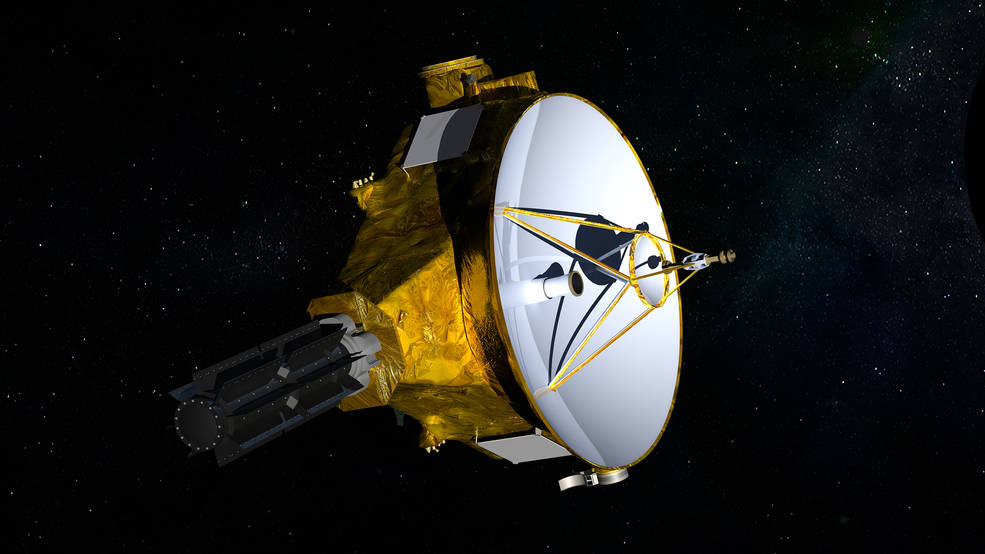
Artist’s impression of NASA’s New Horizons spacecraft en route to an encounter in January 2019 with the 2014 Kuiper Belt Object MU69.Credits: NASA / JHUAPL / SwRI
In the weeks following its launch in early 2006, when NASA’s New Horizons were still near home, it took just a few minutes to send an order to the spaceship to learn that the on-board computer had received the instructions and was ready was to carry it out.
Scale of the solar system
Here is one way to imagine how far away it is 50 AU: Think of the solar system laid out on a neighborhood street. The sun is one house to the left of “home” (or earth), Mars would be the next house to the right, and Jupiter would be only four houses to the right. New Horizons would be 50 houses down the street, 17 houses across Pluto!
As New Horizons crossed the solar system and increased its distance from Earth from millions to billions of miles, the time between contacts increased from a few minutes to several hours. And on April 18 at 12:42 UTC (or April 17 at 8:42 p.m. EDT), New Horizons hits a rare milestone in space – 50 astronomical units from the Sun, or 50 times farther from the Sun than Earth.
After the legendary Voyagers 1 and 2 and their predecessors Pioneers 10 and 11, New Horizons is only the fifth spaceship to reach this great distance. It’s nearly 7.5 billion kilometers away. A remote region where one of these radio commands, even when traveling at the speed of light, takes seven hours to reach the distant spaceship. Then add another seven hours before the control team on Earth finds out if the message was received.
“It’s hard to imagine anything so distant,” said Alice Bowman, New Horizons mission manager at the Johns Hopkins Applied Physics Laboratory in Laurel, Maryland. “One thing that makes this distance tangible is how long it will take us on Earth to confirm that the spaceship has received our instructions. This went from almost instantly to now on the order of 14 hours. That makes the extreme distance real. ”
To mark the occasion, New Horizons recently snapped the starfield where one of its distant cousins, Voyager 1, appears from New Horizon’s unique seat in the Kuiper Belt. Never before has a spaceship in the Kuiper Belt photographed the location of an even more distant spacecraft that is now in interstellar space. Although Voyager 1 is far too weak to be seen directly in the picture, its location is precisely known from NASA’s radio tracking.
Hello Voyager! On Christmas Day, December 25, 2020, NASA’s New Horizons spacecraft directed its Long Range Reconnaissance Imager in the direction of the Voyager 1 spacecraft, the position of which is marked with the yellow circle, from the distant Kuiper Belt on the border of the solar system. Voyager 1, the furthest man-made object and the first spacecraft to actually leave the solar system, is more than 152 astronomical units (AU) from the Sun – about 14.1 billion miles, or 22.9 billion kilometers – and was 11.2 billion miles (18 billion kilometers) across New Horizons when this image was taken. Voyager 1 itself is about 1 trillion times too weak to be visible in this image. Most of the objects in the picture are stars, but some of them with a fuzzy appearance are distant galaxies. New Horizons hits 50 AU mark on April 18, 2021 and will join Voyagers 1 and 2 in interstellar space in the 2040s. Credits: NASA / Johns Hopkins APL / Southwest Research Institute
“This is a breathtakingly beautiful picture to me,” said Alan Stern, principal New Horizons researcher at the Southwest Research Institute in Boulder, Colorado.
“Looking back at New Horizons’ flight from Earth to 50 AU seems almost like a dream,” he continued. “Flying a spaceship across our entire solar system to explore Pluto and the Kuiper Belt had never been done in New Horizons before. Most of us on the team were part of that mission because it was just an idea, and during that time our children have grown up, and our parents and ourselves have grown older. Most importantly, we’ve made many scientific discoveries, inspired countless STEM careers, and even made a little bit of history. “
New Horizons was practically designed to make history. Shipping at 36,400 miles per hour (58,500 km / h) on January 19, 2006, New Horizons was and is the fastest man-made object ever launched from Earth. The February 2007 gravity-assisted flyby of Jupiter not only shaved about three years after his trip to Pluto, it also allowed him to get the best look at Jupiter’s faint ring and to record the first film of a volcano erupting anywhere in the solar system except the earth.
New Horizons successfully completed its first exploration of the Pluto system in July 2015, followed by the furthest flyby in history – and the first close-up of a Kuiper Belt Object (KBO) – flying past Arrokoth on New Years Day 2019. From its unique location in the Kuiper Belt, New Horizons makes observations that cannot be made anywhere else. Even the stars look different from the spacecraft’s point of view.
New Horizons is currently exploring the Kuiper Belt beyond Pluto and is just one of five spacecraft to reach 50 astronomical units on their way out of the solar system and eventually into interstellar space – 50 times the distance between the Sun and Earth. NASA / Johns Hopkins APL / Southwest Research Institute
Members of the New Horizons team use giant telescopes like the Japanese Subaru Observatory to scan the skies for another potential (and long-term) KBO flyby target. New Horizons itself stays healthy, collecting data on the solar wind and space environment in the Kuiper Belt, objects of the Kuiper Belt and distant planets like Uranus and Neptune. This summer, the mission team will be submitting a software upgrade to improve New Horizons’ science skills. For future exploration, the spacecraft’s nuclear battery should provide enough power to keep New Horizons running through the late 2030s.
Last updated: April 16, 2021
Editor: Tricia Talbert
Like this:
Loading…

Comments are closed.