

Sandia starts a data project on the Arctic seabed with new underwater technology
DOE / SANDIA NATIONAL LABORATORIES
Science business announcement
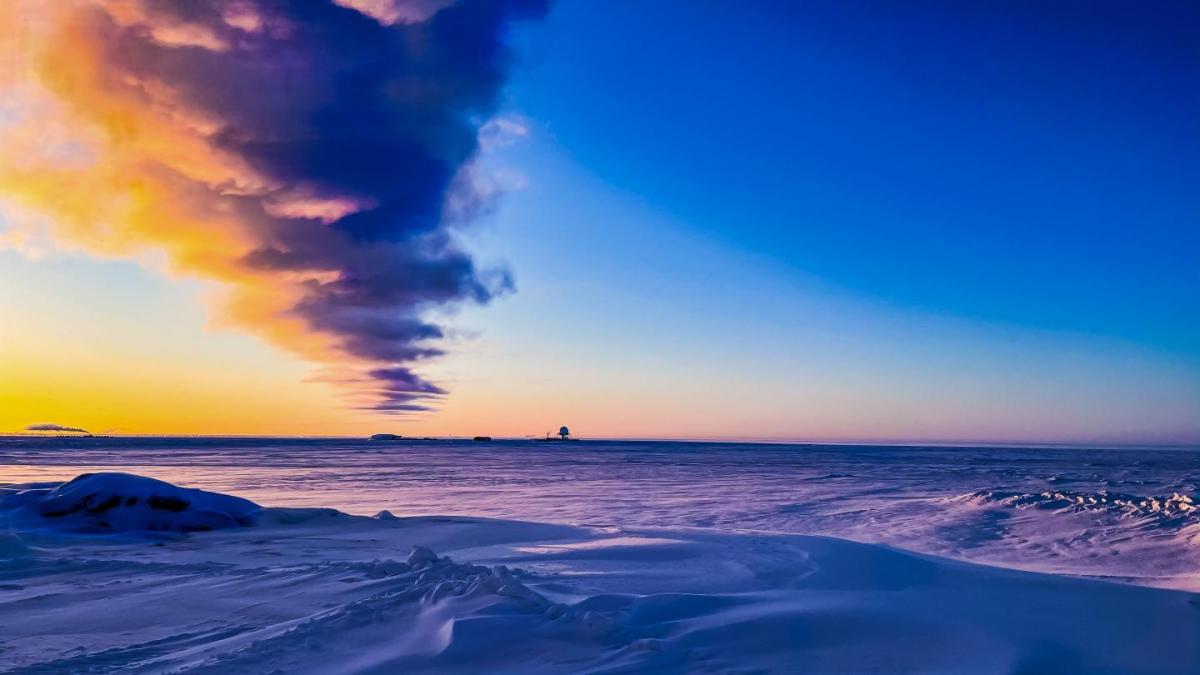
PICTURE: A RARE, PEACEFUL SUNRISE AT OLIKTOK POINT DURING THE FIRST WEEK OF FEBRUARY WHEN SANDIA NATIONAL LABORATORIES RESEARCHERS BEGIN THE FIRST DATASET FROM THE ARCTIC SEA FLOOR WITH DISTRIBUTED ACOUSTICS
ALBUQUERQUE, NM – Sandia National Laboratories researchers begin analyzing the first ocean floor dataset beneath Arctic sea ice using a novel method. They were able to capture ice quakes and transportation activities on the northern slope of Alaska while monitoring other climate signals and marine life.
The team, led by Sandia geophysicist Rob Abbott, connected an iDAS, a distributed acoustic scanning interrogation system manufactured by Silixa, to an existing fiber optic cable from Quintillion, an Alaska-based telecommunications company. The cable reaches the seabed from Oliktok Point. Cable vibrations were captured and recorded for seven days, 24 hours a day, to help researchers better understand what natural and man-made activities are taking place in the low-data ocean.
This is the first time an acoustic scanning distributed interrogation system has been used to collect data on the seabed of the Arctic or Antarctic oceans, and the team sees many benefits for future use.
“This is a unique data collection, and for national laboratories, this is exactly the kind of high risk, high reward research that can make a big difference in how we monitor the Arctic Ocean,” said Sandia manager Kyle Jones . “This is really on the cutting edge of seismology and geophysics, along with climate change and other disciplines.”
The team expects to record climate signals such as the timing and distribution of the breakup of sea ice, the height of the sea waves, the thickness of the sea ice, the fault zones and the severity of the storm. Shipping, whale songs and violations can also be recorded. This new type of monitoring has the potential to permanently record a wide variety of Arctic phenomena in an inexpensive and safe way so that scientists can better understand the effects of climate change on this fragile environment, Abbott said.
The interrogator looks like an electronic box that can be plugged into the fiber optic cable on land and uses a laser to send thousands of short pulses of light along the cable every second. A small portion of this light is reflected – or backscattered – along the cable as the ocean floor moves due to earth, sea ice, ocean currents, and animal activity. The backscattered light enables the interrogator to detect, monitor, and track events along the fiber, and data is stored on hard drives.
“Quintillion’s fiber optic cable is conveniently located on the northern slope of Alaska,” said Abbott. “This technology works for this project for several reasons. We don’t send a boat to plant monitors; We’re not going across the sea ice trying to install sensors. This cable will exist for decades and we can hold good data on it. This is a very safe way to take this measurement in a hazardous environment. “
This was the first of eight-week data collections that will be carried out over the next two years during the project. The team will visit Alaska in each of the four arctic seasons, which are defined as ice-bound, ice-free, freezing, and thawing. A third year is spent on further analysis of the data.
Abbott said the results will be communicated to the broader scientific community and made available to the climate modeling community for inclusion in algorithms. In addition, the team hopes that the results of the project will highlight the need for permanent distributed acoustic sensor monitoring in the Arctic.
“We want to provide data for high-fidelity climate models and raw data analysis,” said Abbott. “I also hope to be able to take a direct measurement of the sea ice thickness, which is currently difficult. Right now you need a plane to fly over or you need to get on the ice. This can be very dangerous and expensive, and you can only do it once or twice a year. With a fiber optic cable, the distributed acoustic sensing system could be available 24/7 and you could potentially take a sea ice thickness measurement once a day. “Encouraging data collected in the first 168 hours
Sandia researchers are just beginning to analyze the first 168 hours of data collected in February, and they’re encouraged by what they’re seeing, Abbott said.
“We see things that indicate ice quakes. We see events up to 20 miles in the ocean where there shouldn’t be any anthropogenic activity, ”he said, referring to the first two hours of data he’d looked at. “We are certainly seeing a natural event. It could be an ice quake, or it could be a microseismic event in the ground, like an earthquake. We are not sure yet. “
Abbott said the team, which is closer to the coast, has most likely registered production and reinjection wells that recycle wastewater and frequencies indicative of ocean tides and currents. One surprising result was that the system picked up the frequencies of a low-flying hoverplane.
The interrogator can record events at a spatial density of three to four orders of magnitude, which is greater than traditional hydrophone or seabed seismometer deployments, Abbott said.
“When we first collected data, we weren’t expecting many currents and icequakes because the entire area had stable ice cover, and yet we’re seeing some of those things, which is exciting,” said Abbott.
Abbott said he looks forward to collecting data on whales and seals during the migration season. In the Arctic, bowhead and beluga whales each have their own songs. The system should be able to record these songs in the same way as earthquakes because vibrations in the ocean are transmitted to the earth which is then transmitted to the cable. In whales, a characteristic pattern develops when the song changes pitch.
“It’s called gliding, where over time the frequencies start low and go up and down again,” Abbott said. “Such frequencies are characteristic of biological sources and can be easily distinguished from other sources such as earthquakes. Whales often sing for more than 30 minutes with single repeated notes that last a few seconds and slide up and down. “The North Slope weather compounded the critical first week of the experiment
The expected but fierce north slope climate was a challenge. In February, the area is dark for about 18 hours a day and with snow blowing most of the time and the roads not well marked, everything continues to look new, Abbott said. The team also faced the bitter cold, and while they were prepared, temperatures were about 10 degrees colder than expected, dropping to minus 45 Fahrenheit (minus 77 including wind chill) at one point. Even the people who make a living there have stopped all outdoor activities, Abbott said.
“The American Arctic is impressive. 30 degrees below zero are common in the winter months,” said Michael McHale, Quintillion’s chief revenue officer. “Much of the region is tundra and difficult to cross when the weather is nice. Working here requires a lot of experience and hard-earned expertise. The technical implications are enormous. Most networks and satellite earth stations do not operate in regions where they have to tolerate 70 degrees below zero. “
Because of the harsh conditions, Quintillion’s fiber optic cable is double-armored with a copper and steel jacket to protect against cut, crush, or abrasion damage, McHale said.
“All of the company’s network components, including cabling, are designed to withstand the extreme arctic environment and protect against network outages,” he added. “The underwater parts of the cable are mostly buried under the ocean floor.”The nerves lingered all week as successful data acquisition was uncertain
The day after the team arrived, the researchers met at the Quintillion cable dock, where the company’s distributed acoustic sensor system was installed. A Silixa team member, from whom Sandia had bought the distributed acoustic sensor system, was also there to help.
According to McHale, Sandia researchers were able to use about 30 miles of the underwater fiber optic cables and the setup went smoothly. He added that the project has been a great experience so far.
“The opportunity to work with some of the most skilled geophysicists and data scientists in the country is exciting and an honor,” he said. “Supporting the work of the scientific community has long been a goal of Quintillion. Achieving this goal with a customer as highly regarded as Sandia Labs exceeded our expectations. “
In the first days of the first collection, the team was likely to be nervous, as this had not happened before. While Abbott used fiber optic cables to record explosions for Sandia, he hadn’t used them on an ocean floor or for anything so large.
The interrogator gathers 2 gigabytes of information every minute, and because it comes in so quickly, it’s difficult to know if the data is good, Abbott said. After three or four days, the team had signs that the system was working well, and it took them all week to feel confident about the experiment.
“I look forward to seeing a lot of interesting phenomena in this data collection. This will likely be the quietest data set with the least amount of icequake or wave motion,” said Abbott. “As soon as we see the ice break and icebergs crash into each other in other seasons, when there is no ice up there, we will see things like tides, currents and storms better.”
###
Disclaimer: AAAS and EurekAlert! are not responsible for the correctness or the like
4.5
2
voices
Item rating
Like this:
Loading…

Comments are closed.