

Gas hydrate deposits in the Black Sea respond to postglacial climate changes
HELMHOLTZ CENTER FOR OCEAN RESEARCH KIEL (GEOMAR)
Research news
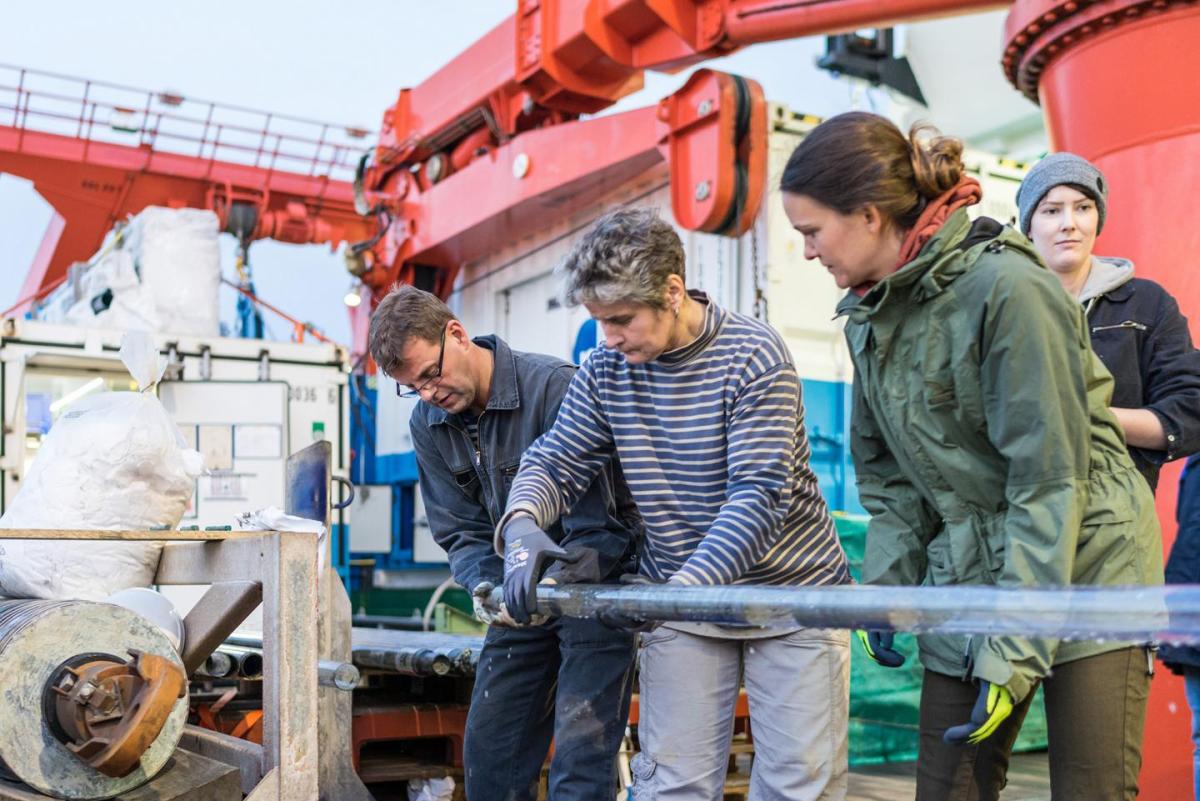
PICTURE: DRILL CORES FROM THE MARUM-MEBO200 ARE OBTAINED ON THE DECK OF THE RV METEOR. show more CREDIT: CHRISTIAN ROHLEDER.
Gas hydrates are a solid compound of gases and water that have an ice-like structure at low temperatures and high pressures. Compounds of methane and water, so-called methane hydrates, occur above all at the edges of the sea – including in the Black Sea. In addition to a possible use as an energy source, methane hydrate deposits are examined for their stability, as they can dissolve with changes in temperature and pressure. In addition to the release of methane, this can also affect the slope stability of submarines.
During a six-week expedition with the German research vessel METEOR in autumn 2017, a team from MARUM and GEOMAR examined a methane hydrate deposit in the deep-sea compartment of the Danube in the western Black Sea. During the cruise, which was part of the joint project SUGAR III “Submarine Gas Hydrate Resources” financed by BMWi and BMBF, the gas hydrate deposits were drilled with the mobile seabed drilling rig MARUM-MeBo200. The results of the research, now published in the international journal Earth and Planetary Science Letters, have given scientists new insights into changes in the stability of gas hydrates.
“Based on data from previous expeditions, we have selected two work areas in which, on the one hand, methane hydrate and free methane gas coexist in the upper 50 to 150 meters of the hydrate stability zone and, on the other hand, landslides and gas seepage points were found right at the edge of the gas hydrate stability zone,” explains Prof. Dr. Gerhard Bohrmann, MARUM expedition leader and co-author of the study. “We used our MARUM-MeBo200 drilling rig for our investigations and broke all previous depth records with a maximum depth of almost 145 meters.”
In addition to taking samples, the scientists were also able for the first time to carry out detailed in-situ temperature measurements down to the basis of the gas hydrate stability under the sea floor. This baseline was previously determined using seismic methods, from which the so-called “Bottom Simulating Reflector” (BSR) was obtained as an indicator for this base. “However, our work has now shown for the first time that the BSR approach does not work for the Black Sea,” explains Dr. Michael Riedel from GEOMAR, lead author of the study. “From our point of view, the gas hydrate stability limit has already approached the warmer conditions in the subsurface, but the free methane gas, which is always located at this lower edge, has not yet risen,” continues Riedel. The reasons for this could be due to the low permeability of the sediments, which means that the methane gas is still “stuck” down there and can only rise very, very slowly on its own, according to the scientist.
“However, our new analyzes of the seismic data have also shown that the methane gas can break through the BSR in some places. A new BSR is currently being established over the “old” reflector. This is new and has never been seen before, ”says Dr. Matthias Haeckel, co-author of the GEOMAR study. “Our interpretation is that the gas can rise at these points, as disturbances in the sea floor favor the gas flow here,” continues Haeckel.
“In summary, we have found a very dynamic situation in this region, which also seems to be related to the development of the Black Sea since the last Ice Age,” says Michael Riedel. After the last glacier maximum (LGM) the sea level rose (pressure rise), and when the global sea level rose above the threshold of the Bosphorus, salt water from the Mediterranean was able to spread into the Black Sea. Before that, this ocean basin was basically a freshwater lake. In addition, since the LGM, global warming has led to an increase in the temperature of the groundwater in the Black Sea. The combination of these three factors – salinity, pressure and temperature – had a dramatic effect on the methane hydrates, which decompose as a result of these effects. The current study illustrates the complex feedback loops and time scales that cause climate change in the marine environment and is therefore well suited to assess the expected consequences of today’s faster global warming – particularly on Arctic gas hydrate deposits.
Cruise guide Gerhard Bohrmann sums up: “At the end of the SUGAR-3 program, the drilling campaign with MeBo200 in the Black Sea once again showed us very clearly how quickly the methane hydrate stability in the ocean deposits changes, even with environmental fluctuations.”
###
Reference:
Riedel, M., T. Freudenthal, J. Bialas, C. Papenberg, M. Haeckel, M. Bergenthal, T. Pape and G. Bohrmann, 2021: In-situ borehole temperature measurements confirm the dynamics of the gas hydrate stability zone in the upper Danube deep-sea fan Black Sea. Earth and Planetary Sci. Lett., Https://doi.org/10.1016/j.epsl.2021.116869.
Left:
http://www.gashydrat.de Gas hydrate research at MARUM
https://www.sugar-projekt.de/sugar SUGAR Project
From EurekAlert!
3.8
4th
be right
Item rating
Like this:
Loading…

Comments are closed.