

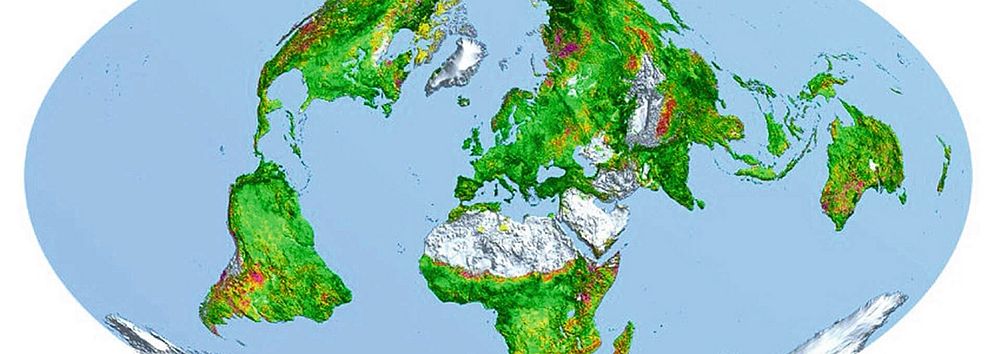
A new study published in Science shows that the fertilizing effect of excess CO2 on vegetation is decreasing worldwide
SPANISH NATIONAL RESEARCH COUNCIL (CSIC)
Research news
When plants absorb this gas in order to grow, they remove it from the atmosphere and it becomes trapped in their branches, trunks or roots. An article published today in Science shows that this fertilizing effect of CO2 is decreasing worldwide. This emerges from the text that Professor Josep Peñuelas from CSIC at CREAF and Professor Yongguan Zhang from Nanjin University wrote together with the participation of CREAF researchers Jordi Sardans and Marcos Fernández. The study, conducted by an international team, concludes that the reduction has increased gradually by 50% since 1982, largely due to two key factors: the availability of water and nutrients. “The formula is not a puzzle. Plants need CO2, water, and nutrients to grow. Regardless of how much the CO2 increases, if the nutrients and the water do not increase in parallel, the plants cannot use the increase in this gas, ”explains Professor Josep Peñuelas. In fact, three years ago in an article in Nature Ecology and Evolution, Prof. Peñuelas warned that the fertilizing effect of CO2 would not last forever and that plants cannot grow indefinitely because there are other factors that limit them.
If the fertilization capacity of CO2 decreases, this has a strong impact on the carbon cycle and thus on the climate. For decades, forests have received a real CO2 bonus that allows them to sequester tons of carbon dioxide, allowing them to photosynthesize more and grow more. In fact, this increased sequestration did manage to reduce the CO2 that was trapped in the air, but it’s over now. “These unprecedented results suggest that the uptake of carbon by vegetation is gradually becoming saturated. This has very important climate impacts that need to be considered in possible strategies and strategies to mitigate climate change on a global scale. Nature’s ability to sequester carbon is declining, and with it society’s dependence on future strategies to reduce greenhouse gas emissions, ”warns Josep Peñuelas.
The study, published in Science, was conducted using satellite, atmosphere, ecosystem, and model information. It highlights the use of sensors that use near infrared and fluorescence and are thus able to measure vegetation growth activity.
Less water and nutrients
According to the results, the lack of water and nutrients are the two factors that decrease the ability of CO2 to improve plant growth. To reach this conclusion, the team relied on data from hundreds of forests studied over the past 40 years. “These data show that the concentrations of essential nutrients in the leaves, such as nitrogen and phosphorus, have also decreased increasingly since 1990,” explains researcher Songhan Wang, the first author of the article.
The team also found that water availability and changes in water supply over time play an important role in this phenomenon. “We have found that plants slow their growth, not only in times of drought, but also when the seasonality of rainfall changes, which is increasingly associated with climate change,” explains researcher Yongguan Zhang.
###
Reference article:
Wang S., Zhang YG, Ju W., Chen J., Ciais P., Cescatti A., Sardans J., Janssens IA, Sardans J., Fernández-Martínez M., Penuelas J. (2020). Most recent global decline in CO2 fertilization effects on photosynthesis of vegetation. Science, DOI: 10.1126 / science.abb7772
From EurekAlert!
Like this:
Loading…

Comments are closed.