

Reposted from Jennifer Marohasy’s blog
March 5, 2021 by Jennifer
I wasn’t the one who took this bite out of that green plate coral. Can you see what looks like a bite mark? It’s about 4 a.m. on the large green plate coral, which is also one of the transect photos taken by Leonard Lim last week on February 22nd at Pixie Reef.
Corals one meter along the second passage at 3 meters in front of Pixie Reef on February 22, 2021. Photo credit: Leo Lim.
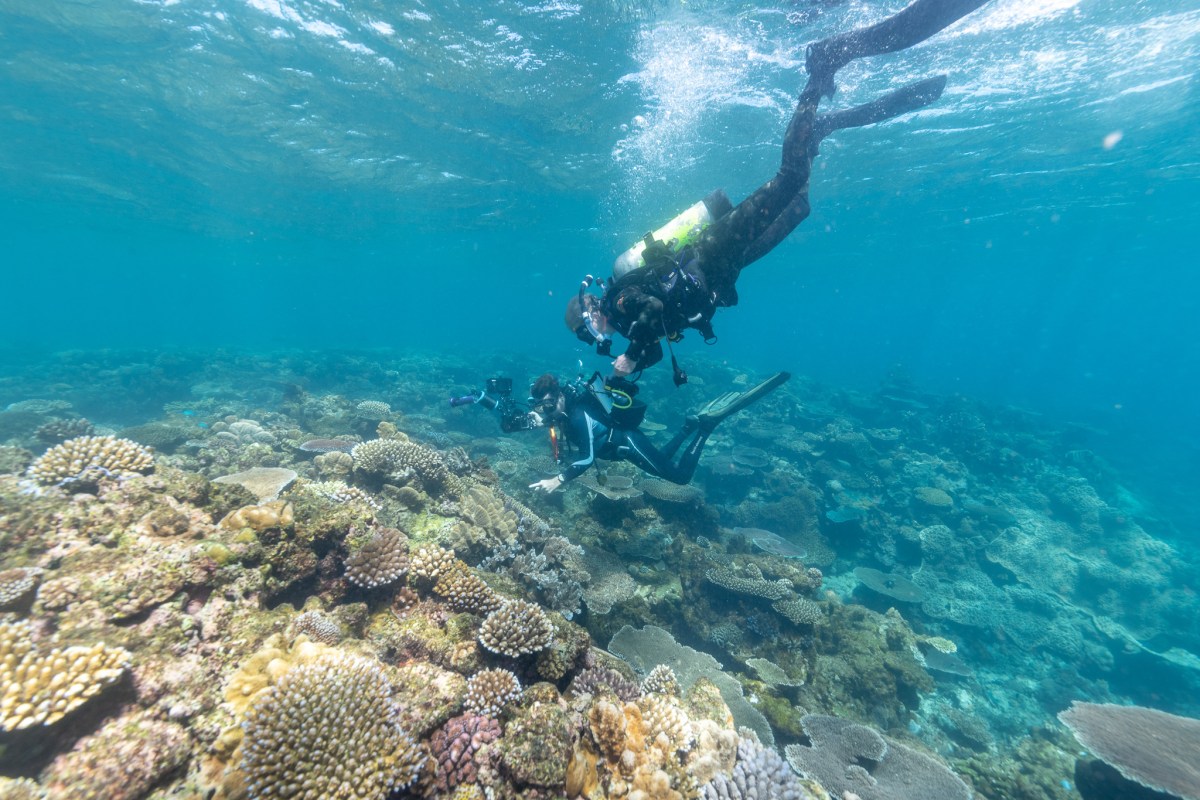
I am so proud of the 360 underwater photos taken along 36 transects laid in four different habitat types: on the reef front, in the back lagoon, on the reef crest, and we also laid three transects at the bottom of the reef Coat of arms – starting at a depth of ten meters on the so-called western flank. It was hard work over two days, but these photos and their videos will provide some evidence of the state of the coral on the Pixie Reef for that moment.
Table 1.2 Photos: Pixie Reef Crest, February 24, 2021
Date: February 24, 2021
Habitat: coat of arms
Locations repeats 1 to 6: 16 ° 32.635’S 145 ° 51.848’E, 16 ° 32.630’S 145 ° 51.855’E, 16 ° 32.629’S 145 ° 51.873’E, 16 ° 32.627’S 145 ° 51.885’E 16 ° 32.624’S 145 ° 51.877’E, 16 ° 32.623’S 145 ° 51.875’E
I was so grateful that we were able to lay transects along the reef front at Pixie. When you click the thumbnails in the table above, you will see some of the photos. Many more will be uploaded to the ‘Pixie Reef Data Page 2021’ over the next few weeks. Leo took 120 photos of the reef front at two different depths: 3 meters and also 6 meters.
Last November I only visited the rear lagoon. Usually the prevailing wind blows from the southeast / front of the reef, making access to this front part of the reef difficult. But on February 22nd the wind was blowing from the northwest. (It was a hot day and we were returning to port under anvil clouds, and Stuart brought his little speedboat safely through a storm that afternoon. Thank you.)
This reef, Pixie Reef, was “surveyed” from the air on March 22nd, 2016 by Terry Hughes of James Cook University during one of his flight histories. From this single observation / view from 150 meters it was concluded that this reef was 65% bleached. The coastal reefs north of Cairns were more or less written off as a ruin – as dead – by experts and the mainstream media. But they are not at all. (And I worry about all the children who now believe that this precious environment / Great Barrier Reef has died of “carbon pollution”.)
Pixie Reef was one of thousands of coral reefs that were “surveyed” from March to April 2016. The general conclusion, published on the front pages of newspapers around the world and now included in school textbooks, was that the Great Barrier Reef is more than half dead: that more than half of the corals have suddenly died from global warming.
I suspect that these Great Barrier Reef coral health ratings, comprised of 1,156 reefs including Pixie Reef as published in peer-reviewed literature by Terry Hughes and others, are another example of the mismatch between official government sponsored taxpayers funded Propaganda disguised as science against reality.
Jen is swimming, with an aerial photo taken just before the thunderstorm on February 22nd, 20 meters above the front of Pixie Reef. Jen was hovering over the reef front, holding a safety sausage that was exactly three feet high. This antenna was recorded by Stuart Ireland at a height of exactly 120 meters.
Only underwater can we see the true condition of the corals.
Of course I found these extraordinary, large and old Porites at Pixie Reef and named them after Craig Kelly MP. I visited ‘Porites Craig’ again on February 22nd. This bolder coral still looks relatively pale from a distance, but up close it’s evident that the massive coral colony / Porites Craig is a lot of color – with all of its coralites intact and healthy.
The massive porites in the aft lagoon at Pixie Reef. Photographed with me on February 22nd by Leo Lim.Porites Craig is massive and a thin veneer of living coral that contains as many corallites as shown in these photos, which I (Jennifer Marohasy) took on January 22nd, 2021.
At Pixie Reef there is such a variety of different types of coral, coral species and in so many different coral colors.
And what about that green plate coral – the bite mark? (Could it be from the elves?)
A green plate coral is missing something / with a bite mark.
I’m assuming the little beige brain coral that you can see just below what I call the bite mark is responsible for this. This may be a species of FavitesSymphyllia, and it could be that it expands its tentacles at night and eats that section of the plate coral right above it. It is very likely that Symphyllia sp. Favites sp. eats in the Acropora sp. away so that it has access to sunlight for its own zooxanthellae.
There are so many of them on Pixie Reef – all types of coral, including healthy plate corals in shades of green and shades of brown as well. You can see them in the transect photos. Click on the new page they will be uploaded to over the next few weeks: https://jennifermarohasy.com/coralreefs/pixie2021/.
So many lovely corals, but no elves.
Addendum
This is part 4 of ‘Measuring Ancient Corals and Coral Reefs’ which was essentially written to let everyone know about the new data page for Pixie Reef. You can access other data pages here: https://jennifermarohasy.com/coralreefs/
There was already a part 1 and a part 2:
https://jennifermarohasy.com/2020/11/measuring-old-corals-coral-reefs-part-1/
https://jennifermarohasy.com/2021/01/measuring-old-corals-coral-reefs-part-2/
The blog post about the garden of ancient Porites in Myrmidon was supposed to be part 3. He is here: https://jennifermarohasy.com/2020/12/gardens-of-old-porites-without-sharks/
And thanks to Leonard Lim and Stuart Ireland for all of Pixie’s photos and videos last week and to the B. Macfie Family Foundation for trusting us.
Pixie Reef on February 22, 2021 from approx. 120 meters to the east. Photo credit: Stuart Ireland.
5
11
be right
Item rating
Like this:
Loading…

Comments are closed.