
Melting giant icebergs is a key stage within the evolution of the Ice Ages – Watts Up With That?

UNIVERSITY OF GRANADA
Research news
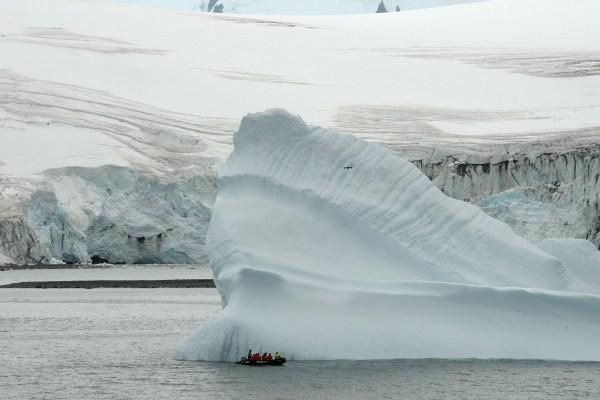
IMAGE: EXAMPLE OF AN ICEBERG DURING THE POWELL 2020 RESEARCH EXPEDITION NEAR THE SPANISH ANTARCTIC BASE “JUAN CARLOS I” / JOSÉ ABEL FLORES More CREDIT: UNIVERSITY OF GRANADA
A new study, in which the Andalusian Earth Sciences Institute (IACT) (CSIC-UGR) took part, described for the first time a key phase at the beginning of the great glaciations and shows that this can happen to our planet in the future. The results were recently published in the journal Nature
The study claims to have found a new connection that could explain the beginning of the ice ages on Earth
According to Francisco J. Jiménez-Espejo, a researcher at the Andalusian Earth Sciences Institute (CSIC-UGR), the iceberg melt in Antarctica could be key to activating a number of mechanisms that cause the Earth to cool globally for extended periods of time. their discoveries were recently published in the prestigious journal Nature.
It has long been known that changes in Earth’s orbit as they move around the sun trigger the onset or end of ice ages by affecting the amount of solar radiation that reaches the planet’s surface. So far, however, the question of how small swings in solar energy reaching us can lead to such dramatic changes in the planet’s climate has remained a mystery.
In this new study, a multinational group of researchers suggests that when the Earth’s orbit around the Sun is just right, the Antarctic icebergs begin to melt further and further away from the continent, moving large amounts of freshwater from the Antarctic Ocean to the Atlantic.
This process causes the Antarctic Ocean to become increasingly salty while the Atlantic becomes fresher, which affects the oceans’ overall circulation patterns, pulling CO2 out of the atmosphere and reducing what is known as the greenhouse effect. These are the initial stages that mark the beginning of an ice age on the planet.
As part of this study, scientists used various techniques to reconstruct past ocean conditions, including by identifying tiny fragments of rock that had separated from Antarctica’s icebergs when they merged with the ocean. These deposits were extracted from marine sediment cores obtained by the International Ocean Discovery Program (IODP) during Expedition 361 off the margins of South Africa. These sediment cores enabled scientists to reconstruct the history of the icebergs that reached these latitudes over the past million and a half years. This is one of the most continuous records known.
Climate simulations
The study describes how these rocky deposits appear to be consistently linked to fluctuations in deep-sea circulation, reconstructed from chemical fluctuations in tiny deep-sea fossils known as foraminifera. The team also used new climate simulations to test the proposed hypotheses. It found that large amounts of freshwater are transported north by icebergs.
The article’s lead author, Aidan Starr, PhD student at the University of Cardiff, notes that the researchers “are surprised to have discovered that this remote link exists in each of the various ice ages over the past 1.6 million years. This shows that the Antarctic Ocean plays an important role in global climate, which scientists have long sensed, but which we have now clearly demonstrated. “
Francisco J. Jiménez Espejo, an IACT researcher, was a specialist in inorganic geochemistry and physical properties on the IODP 361 expedition aboard the research vessel JOIDES Resolution. Between January and March 2016, the research team sailed between Mauritius and Cape Town for two months, collecting sediment cores in the deep sea.
Jiménez Espejo’s main contribution to the study focused on identifying the geochemical variations associated with glacial and interglacial periods. This made it possible to more accurately estimate the age of the sediment and its sensitivity to the various environmental changes associated with these periods.
Over the past 3 million years, the earth began to experience periodic cooling of the glaciers. During the last episode around 20,000 years ago, icebergs continuously reached the Atlantic coast of the Iberian Peninsula from the Arctic. Currently the earth is in a warm interglacial period known as the Holocene.
However, the progressive rise in global temperature associated with CO2 emissions from industrial activities could affect the natural rhythm of glacier cycles. Ultimately, the Antarctic Ocean could become too warm for Antarctic icebergs to carry fresh water north, and therefore a fundamental stage at the beginning of the ice ages – the fluctuations in thermohaline circulation – would not take place.
Ian Hall, also from Cardiff University, who co-led the scientific expedition, suggests that the results could help understand how the Earth’s climate may respond to anthropic changes. Similarly, Jiménez Espejo notes: “Last year, during an expedition aboard the Spanish Navy’s research vessel, Hespérides, we saw the giant A-68 iceberg, which had just broken into pieces near the islands of South Georgia. The warming of the ocean can cause the trajectories and melting patterns of these large icebergs to change in the future, affecting the currents, and therefore our climate and the validity of the models that scientists use to predict this. “
###
Bibliography:
DOI 10.1038 / s41586-020-03094-7
https://www.nature.com/articles/s41586-020-03094-7
From EurekAlert!
Like this:
Loading…

Comments are closed.