

With the International Space Station (ISS) set to decommission in 2030, several nations and commercial space companies are planning to deploy their own successor stations. These include China, which plans to double the size of its Tiangong space station in the coming years, and the Indian Space Research Organization (ISRO)’s proposed Bharatiya Antariksh Station (BAS), whose first module is scheduled to launch by 2028. Then there are private projects like Blue Origin’s Orbital Reef, Airbus’ LOOP, Axiom Station, Vast’s Haven-1 and Starlab Space’s station.
The Russian space agency (Roscosmos) also plans to build a successor station, although its plans have evolved in recent years. According to a recent statement by Oleg Orlov, director of the Institute of Biomedical Problems at the Russian Academy of Sciences (RAS), the new Russian orbital station (ROS) will include the modules that make up the Russian orbital segment of the ISS – Zarya, Zvezda, Poisk, Rassvet, Nauka and Pricha. The announcement was made on December 18 at a press conference at the Russia Today (RT) international multimedia press center in Moscow.
According to Orlov, a special commission has been working on this process for several months. The decision reflects Russia’s geopolitical position amid the ongoing war in Ukraine, marked by international sanctions, canceled agreements and reduced resources.
Evolving concept
This represents a change from Roscosmos’ original plan, which was an evolution of the OPSEK (Orbital Piloted Assembly and Experiment Complex) concept proposed in 2009. This station was intended to include the modules that made up the Russian orbital segment, but the plan was abandoned in 2017 after a feasibility study concluded that it was cheaper to maintain participation in the ISS program. In 2021, Roscosmos announced that its involvement in the ISS program would end in 2024, citing concerns about the condition of its modules (some of which are nearly three decades old).
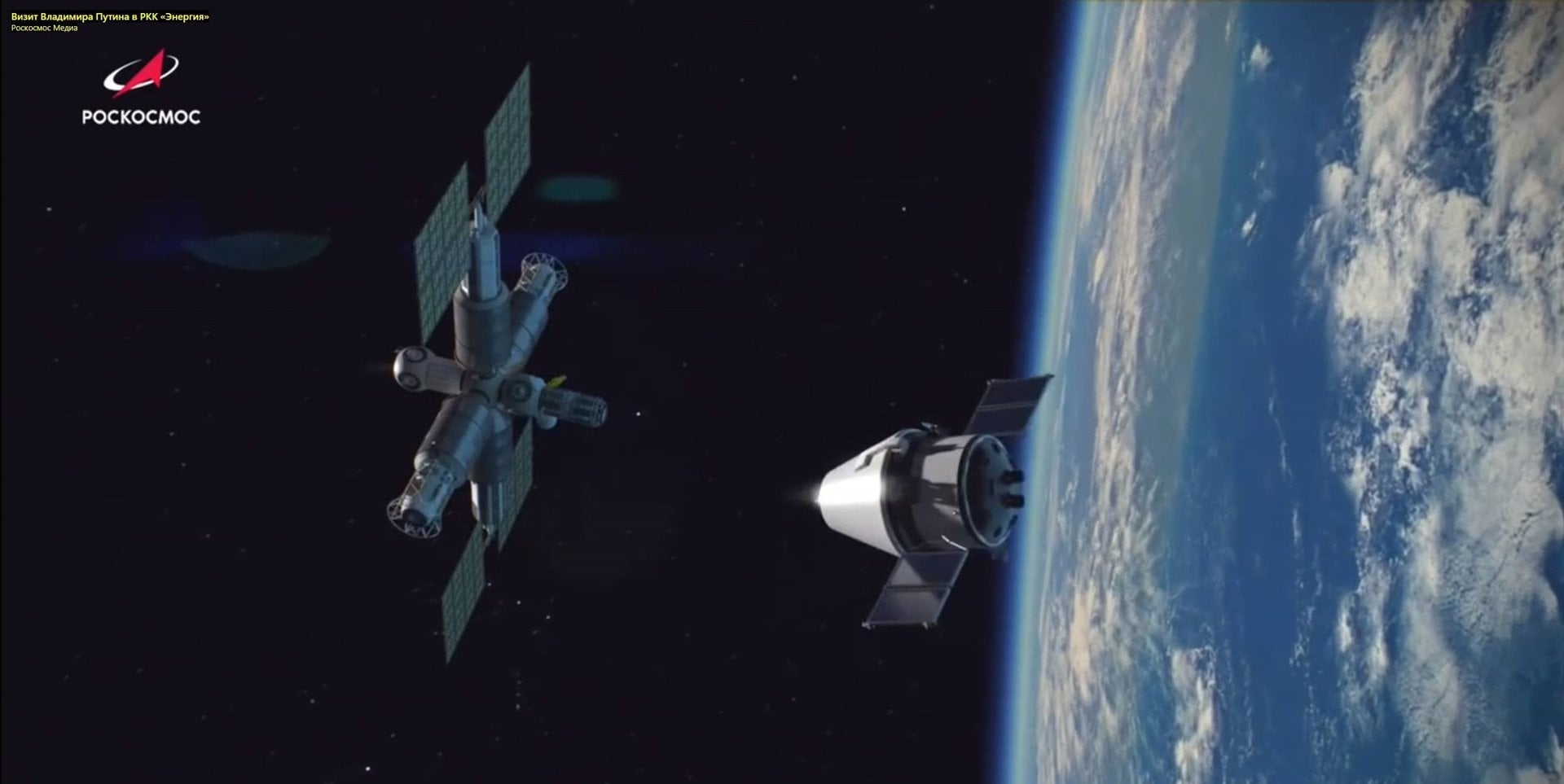
*Artist’s concept for the Russian Orbital Station (ROS). Photo credit: Roscosmos*
At this point, the OPSEK concept was renamed the Russian Orbital Service Station (ROSS), or in Russian *Rossiyskaya orbital’naya stantsiya* (ROS) – not to be confused with the Russian Orbital Segment (also ROS). This updated plan would no longer include the Russian ISS modules, with plans for an initial launch of the Science and Energy module scheduled for 2027. By 2030, Roscosmos planned to launch three additional modules that would form the core of the station, including the Universal Node (UNM), the Gateway (SM) and the Base Module (BM).
Up to three more modules should be added to the station by 2035, with the possibility of a private habitat for space tourism. The planned station would accommodate a crew of two or more cosmonauts and would be able to fly autonomously for months if necessary.
Recycled modules, new orbit
The latest concept for the ROS reflects the changing situation of Roscosmos in recent years due to sanctions and the termination of international cooperation following the Russian invasion of Ukraine in 2022. According to Orlov’s announcement, Russia will separate its modules from the ISS once the program is completed in 2030 and will form the core of the ROS, with more modules to follow. “The Scientific and Technical Council of Roscosmos supported this proposal and approved the deployment of a Russian orbital station as part of the Russian segment of the ISS as the main possible scenario,” said Orlov, who was quoted by Russian state news agency TASS.
Orlov also stated that the ROS would have an orbital inclination of 51.6 degrees, which Orlov said was chosen for geopolitical reasons. This orbit will allow Russia to launch from its newer sites built to reduce Russia’s dependence on the Baikonur Cosmodrome in Kazakhstan – the Plesetsk Cosmodrome in northern Russia and the Vostochny Cosmodrome in the Russian Far East. This is even more important given the recent damage to the Baikonur Cosmodrome, which has temporarily halted all Roscosmos flights to the ISS.
This announcement reflects what Denis Manturov, First Deputy Prime Minister of the Russian Federation, said on December 5 during a press conference at the Rossiya National Center. Manturov explained at the time that at the end of November the RAS decided to change the plan for a station in polar orbit (96 degrees). This would allow orbital observations across Russia and conduct experiments around the North Magnetic Pole (where the Earth’s magnetic field provides virtually no protection from cosmic radiation) to study the effects on living organisms.
This new orbit will continue to allow Russia to launch cargo and crew missions from its domestic launch sites. Manturov also stated that India was considering the same orbit for its Bharatiya Antriksh station and the decision would enable international cooperation between the two stations.
*Artist’s impression of the planned Bharatiya Antariksh Station (BAS) in India. Photo credit: IBEF*
Unrealistic?
However, there are some in Russia who seriously doubt that the ROS will remain functional long enough for such cooperation to take place. Maria Sokolova wrote a sharp indictment of Roscosmos and the RAS’s plan to recycle its ISS modules in the Russian newspaper New Izvestia. The main problem, she wrote, were statements made by the same Orlov in 2022, in which he stated that the growing problem of bacteria and fungi that had accumulated on the ISS over time posed a threat to the safety of the astronauts and cosmonauts stationed there.
The statement was made in an interview with Russian state news agency RIA Novosti. When asked why the modules of the Russian segment could not be used to create the ROS, he answered unequivocally:
An analysis of the results of microbiological monitoring of the habitat of the ISS-RS modules, carried out as part of the full-time medical control operations, shows that the condition of the ISS habitat is deteriorating. It is an objective process. Generalized results show that in 65% of the samples analyzed from recent expeditions, microorganisms were found in quantities exceeding regulatory requirements. Among the representatives of the bacterial flora isolated from the ISS habitat, species were identified that are of medical importance and can cause allergic reactions, as well as some types of soft tissue diseases and diseases of the upper respiratory tract.
These issues have not changed in the last three years; if anything, they have gotten worse. Orlov’s expressed concerns also echoed statements made last year about the aging condition of the modules, which led to the decision not to reuse them. In essence, Russia’s decision to reuse its modules would mean that it would inherit all of the ISS’s current problems, which are biological, technical and structural in nature. This is especially true for the Zarya and Unity modules, both of which are 27 years old, followed by Zvezda (25 years).
These modules experience persistent problems due to extreme temperature fluctuations and radiation, leading to material fatigue and air leaks. This requires ongoing maintenance by the crew, taking time away from scientific research and other activities for which the station was created. After all, the ISS was originally designed to operate for 15 years, but its service life has been extended several times, which means that its scientific benefits are less worthwhile. Unfortunately, the motivation is clear: Russia is in a financial crisis due to the war in Ukraine, and Roscosmos is not immune to its effects.
Further reading: Izvestia, Ars Technica

Comments are closed.