

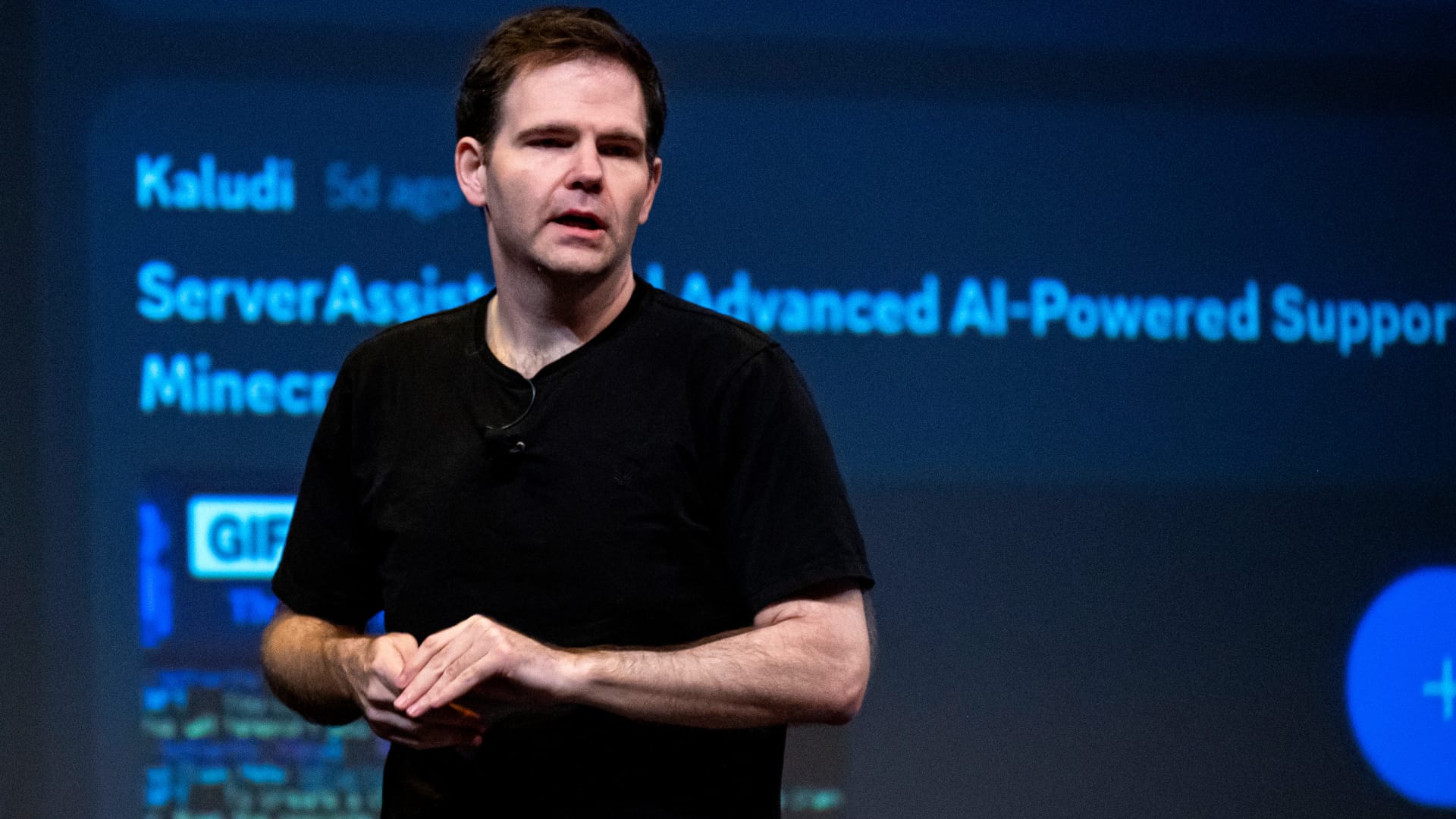
Jonathan Ross, CEO of Groq Inc., during the GenAI Summit in San Francisco, California, USA, on Thursday, May 30, 2024.
David Paul | Bloomberg | Getty Images
Nvidia has agreed to buy assets of Groq, a developer of powerful artificial intelligence accelerator chips, for $20 billion in cash, according to Alex Davis, CEO of Disruptive, which led the startup’s latest funding round in September.
Davis, whose firm has invested more than half a billion dollars in Groq since the company was founded in 2016, said the deal came together quickly. Groq raised $750 million three months ago at a valuation of about $6.9 billion. Investors in the round included Blackrock and Neuberger Berman as well as Samsung. CiscoAltimeter and 1789 Capital, where Donald Trump Jr. is a partner.
Groq said in a blog post on Wednesday that the company had “entered into a non-exclusive licensing agreement with Nvidia for Groq’s inference technology,” without disclosing a price. With the deal, Groq founder and CEO Jonathan Ross, along with Sunny Madra, the company’s president, and other senior executives, will “join Nvidia to help further develop and scale the licensed technology,” the post said.
Groq added that it will continue to operate as an “independent company” under the leadership of finance chief Simon Edwards as CEO.
Nvidia CFO Colette Kress declined to comment on the deal.
Davis told CNBC that Nvidia is acquiring all of Groq’s assets, although the emerging Groq cloud business is not part of the deal. Groq said: “GroqCloud will continue to operate without interruption.”
The deal represents by far Nvidia’s largest purchase ever. The chipmaker’s largest acquisition to date came in 2019, when it bought Israeli chip designer Mellanox for nearly $7 billion. At the end of October, Nvidia had $60.6 billion in cash and short-term investments, up from $13.3 billion at the start of 2023.
In an email to employees obtained by CNBC, Nvidia CEO Jensen Huang said the deal will expand Nvidia’s capabilities.
“We plan to integrate Groq’s low-latency processors into NVIDIA’s AI factory architecture and expand the platform to cover an even broader range of AI inference and real-time workloads,” Huang wrote.
Huang added: “Although we are adding talented people to our ranks and licensing Groq’s intellectual property, we are not acquiring Groq as a company.”
Nvidia arranged a similar but smaller deal in September when it spent over $900 million to hire Enfabrica CEO Rochan Sankar and other employees of the AI hardware startup and license the company’s technology, CNBC reported at the time.
Other tech giants including MetaGoogle and Microsofthave spent heavily in recent years to hire top AI talent through various types of licensing deals.
Nvidia has increased its investments in chip startups and the broader ecosystem as its cash pile has grown. The company has backed AI and energy infrastructure company Crusoe and AI model developer Cohere and increased its investments in CoreWeave as the AI-centric cloud provider prepared to go public this year.
In September, Nvidia announced that it planned to invest up to $100 billion in OpenAI, with the startup committing to deploying at least 10 gigawatts of Nvidia products. The companies have not yet announced a formal deal. That same month, Nvidia announced it would invest $5 billion in the company Intel as part of a partnership.
Groq is targeting $500 million in revenue this year as demand booms for AI accelerator chips designed to speed up the process for large language models to complete inference-related tasks. The company wasn’t looking to sell when Nvidia approached the company, Davis said.
Groq was founded in 2016 by a group of former engineers, including Ross. He was one of the creators of Googles Tensor Processing Unit, or TPU, the search giant’s custom chip used by some companies as an alternative to Nvidia’s graphics processing units.
In its first filing with the SEC, announcing a $10.3 million fundraising in late 2016, Groq listed as directors Ross and Douglas Wightman, an entrepreneur and former engineer at Google
Groq isn’t the only chip startup that has gained traction during the AI boom.
AI chipmaker Cerebras Systems had planned to go public this year, but withdrew its IPO application in October after announcing it had raised over $1 billion in a fundraising round.
In a filing with the SEC, Cerebras said it does not intend to complete a proposed offering “at this time,” but did not provide a reason. A spokesperson told CNBC at the time that the company still hoped to go public as soon as possible.
Cerebras filed for an IPO in late 2024, just as it was taking on Nvidia to develop processors to run generative AI models.
—CNBC’s Jordan Novet contributed to this report.
REGARD: How the enormous power consumption of generative AI is overloading our network

Comments are closed.