

alphabetCompany-owned Waymo has resumed its driverless ride-hail service in the San Francisco Bay Area after a temporary pause due to power outages that hit the city starting Saturday afternoon.
“Yesterday’s power outage was a widespread event that resulted in gridlock throughout San Francisco, with non-functioning traffic lights and disruptions to public transit,” a Waymo spokeswoman, Suzanne Philion, told CNBC in an emailed statement Sunday afternoon.
“Although the loss of utility infrastructure was significant, we are committed to ensuring that our technology adapts to traffic flow during such events,” she added.
Enlarge symbolArrows point outwards
Waymo Service Outage Notification in San Francisco.
Source: Waymo
As power outages spread yesterday, videos shared on social media appeared to show several Waymo vehicles stuck in traffic in various parts of the city.
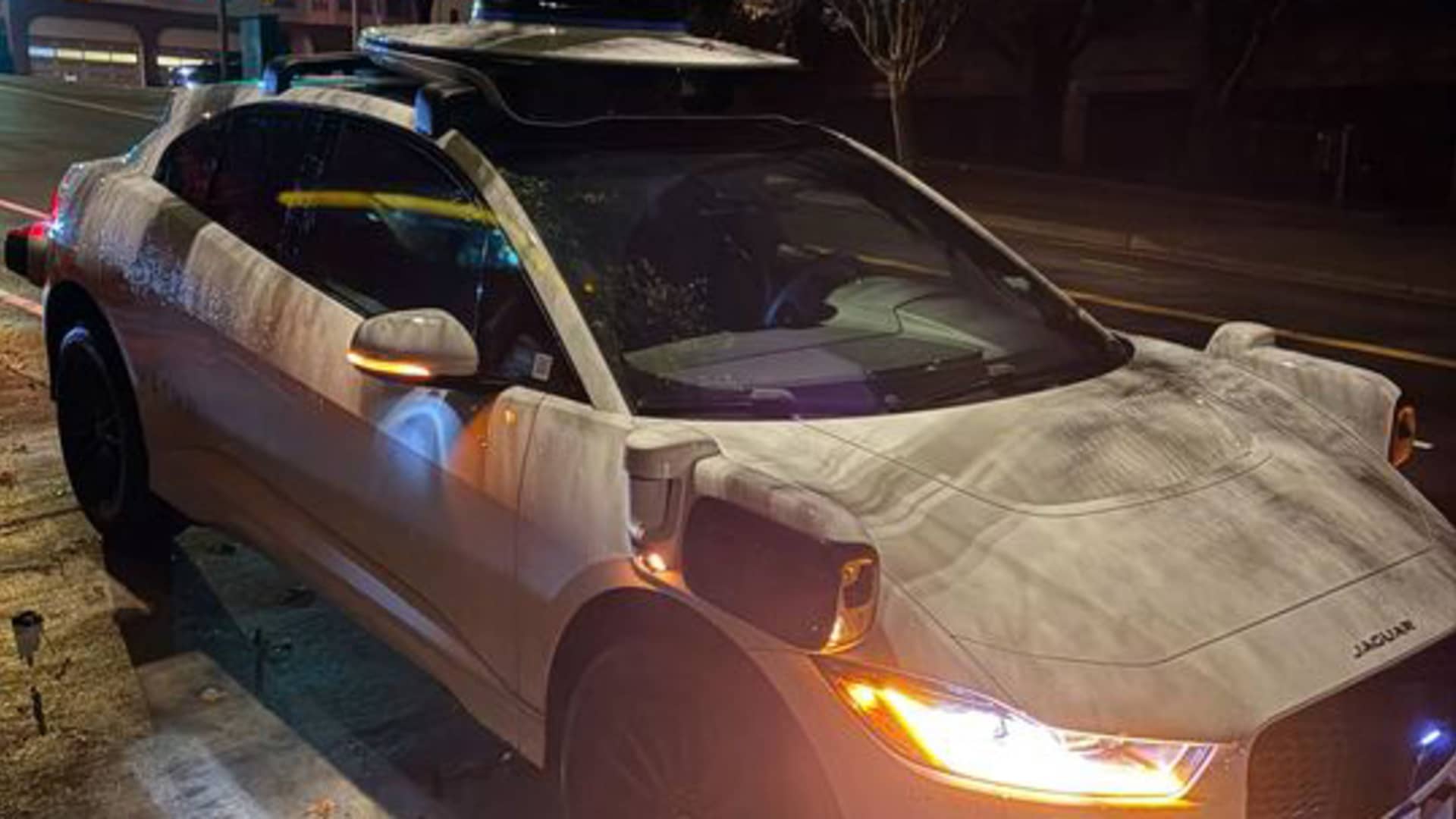
San Francisco resident Matt Schoolfield said he saw at least three Waymo autonomous vehicles sitting in traffic around 9:45 p.m. local time on Saturday, including one he photographed on Turk Boulevard near Parker Avenue.
“They just stopped in the middle of the street,” Schoolfield said.
A Waymo vehicle was stuck between Parker and Beaumont on the north side of Turk Boulevard in San Francisco.
Photo credit: Matt Schoolfield
According to Pacific Gas and Electric, the outages began around 1:09 p.m. Saturday and peaked about two hours later, affecting about 130,000 customers. As of Sunday morning, about 21,000 customers remained without power, mostly in the Presidio, the Richmond District, Golden Gate Park and parts of downtown San Francisco.
PG&E said the outage was caused by a fire at a substation that resulted in “significant and extensive” damage and could not yet provide an exact timeline for full restoration.
San Francisco Mayor Daniel Lurie said in an update at 9 p.m. on X that police officers, firefighters, parking enforcement officers and city ambassadors were deployed in the affected neighborhoods.
Waymo’s Philion also told CNBC, “While Waymo Driver treats non-functional signals as four-way stops, the sheer magnitude of the outage resulted in vehicles stopping longer than usual to check the condition of affected intersections. This contributed to traffic friction during the peak of congestion.”
Waymo “coordinated closely with San Francisco city officials,” she said, and proactively suspended its service starting Saturday evening and through the first half of the day on Sunday.
“Most active trips were completed successfully before vehicles were safely returned to depots or stopped,” she noted.
Amid the disruption, Tesla CEO Elon Musk posted on X: “Tesla robotaxis were not affected by the SF blackout.”
Unlike Waymo, Tesla does not operate a driverless robotaxi service in San Francisco.
Tesla’s local ride service uses vehicles equipped with “FSD (Supervised),” a premium driver assistance system. The service requires a human driver behind the wheel at all times.
According to state regulators — including the California Department of Motor Vehicles and the California Public Utilities Commission — Tesla has not received permits to conduct driverless testing or services in the state without human safety officers at the wheel, ready to steer or brake at any time.
Tesla is aiming to become a robotaxi titan but doesn’t yet operate commercial driverless services. Tesla’s Robotaxi app allows users to hail a ride; However, its vehicles currently have human safety officers or drivers on board, even in states where the company has received permits for driverless operations.
Waymo, which leads the emerging industry in the West, is its main competitor in AVs alongside Chinese players like Tesla Baidu-own Apollo Go.
The outage-related disruptions in San Francisco come as robotaxi services are becoming more common in other major U.S. cities. Waymo is among the few companies offering fully driverless ride-hailing services to the public, although concerns about autonomous vehicles remain high.
A survey by the American Automobile Association earlier this year found that about two-thirds of U.S. drivers said they were afraid of autonomous vehicles.
The Waymo pause in San Francisco suggests that cities are not yet prepared for highly automated vehicles to flood their streets, said Bryan Reimer, a researcher at the MIT Center for Transportation and co-author of “How to Make AI Useful.”
“Something was overlooked in the design and development of this technology, which clearly shows that it was not the robust solution that many would like to believe,” he said.
Reimer noted that power outages are entirely predictable. “Not forever, but in the foreseeable future, we need to combine human and machine intelligence and establish human backup systems around highly automated systems, including robotaxis,” he said.
State and city regulators need to consider what the maximum penetration of highly automated vehicles should be in their region, Reimer added, and AV developers should be held responsible for “chaos gridlock” just as human drivers would be held responsible for how they drive during a power outage.
—CNBC’s Riya Bhattacharjee contributed reporting.

Comments are closed.