

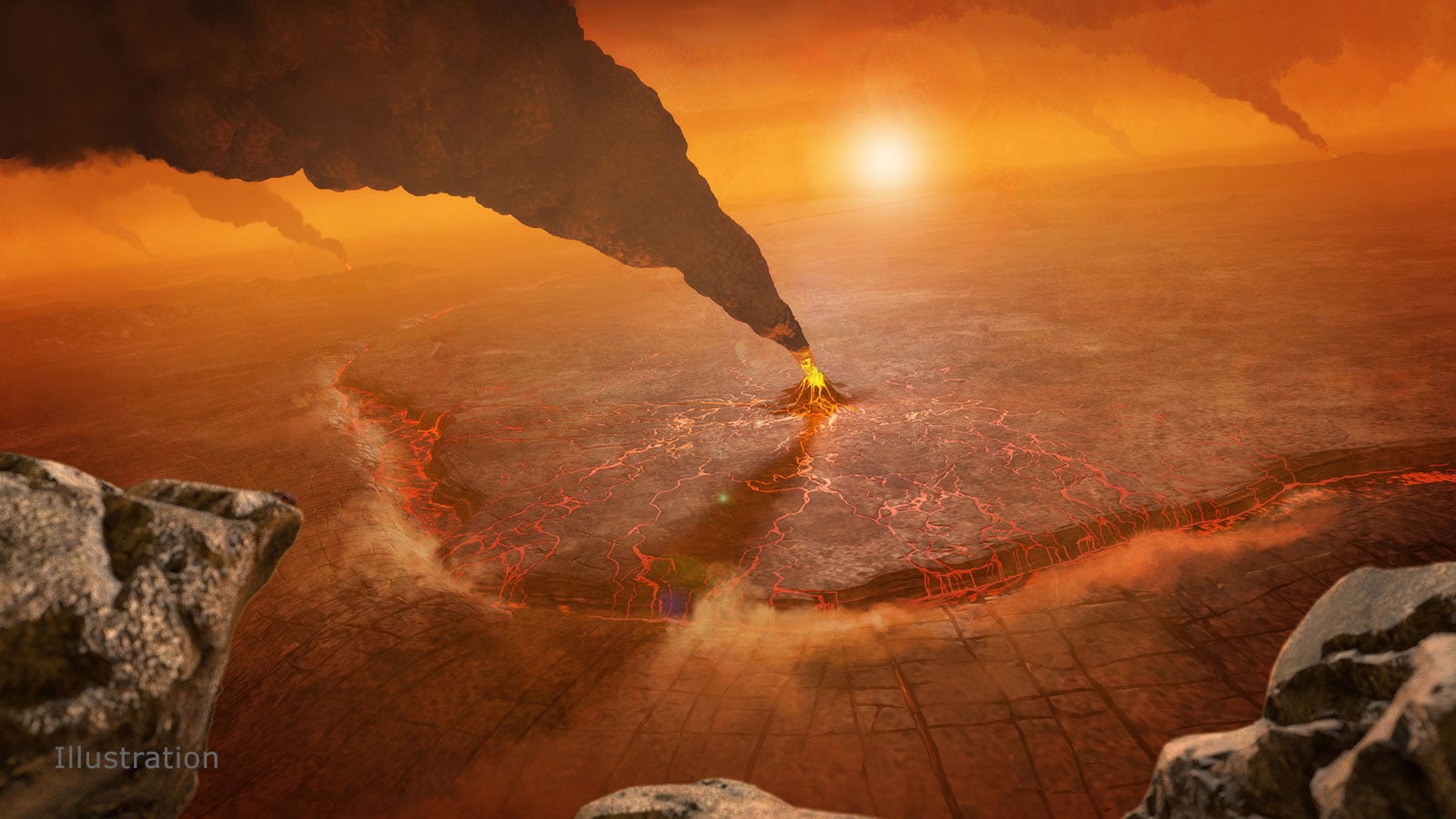
Plate tectonics is a fundamental aspect of Earth’s geological activity and history. In addition to the constant reorganization of the continents, they also play an important role in maintaining the conditions that ensure the Earth’s long-term habitability. However, Earth is the only terrestrial (rocky) planet in the solar system with active plate tectonics. While this is understandable for Mercury and Mars, which are single-plate planets that are largely geologically inactive due to rapid cooling within their interior billions of years ago. But Venus, Earth’s “sister planet,” is still a mystery.
So far, planetary scientists have not been able to figure out why Venus is geologically inactive compared to Earth. However, an international team recently made a significant breakthrough in our understanding of terrestrial planets and their tectonic evolution. Led by researchers from the University of Hong Kong, the team used advanced numerical models to identify six different regimes of planetary tectonics. Their research provides a new framework for classifying the spectrum of planetary tectonics and tools for future planetary exploration.
The team was led by postdoctoral researcher Dr. Tianyang Lyu, together with Professor Man Hoi Lee and Professor Guochun Zhao from the Department of Earth and Planetary Sciences at the University of Hong Kong (HKU). They were joined by Prof. Maxim D. Ballmer from University College London (UCL), Dr. Yun Jan from the Free University of Berlin, Prof. Zhong-Hai Li from the State Key Laboratory of Earth System Numerical Modeling and Application and Prof. Benjen Wu from the University of Nanjing. The paper describing their research and findings was published in Nature Communications.
Snapshots of the six tectonic regimes identified by the research team. Photo credit: Lyu et al. (2025).
Tectonic regimes describe the large-scale deformation of a planet’s surface and the processes that drive it. These regimes are responsible for shaping a planet’s geological activity, internal evolution, magnetic field, and atmosphere composition – all factors that play a large role in the planet’s habitability. For example, the endless cycle of Earth’s lithosphere (the crust and upper mantle) is an essential part of the planet’s carbon cycle, including volcanic activity and the storage of carbon in carbonate rocks. This has ensured that levels of carbon dioxide (a major greenhouse gas) in our atmosphere have remained stable over time.
Meanwhile, Earth’s intrinsic magnetic field is driven by dynamo action in the core, with the molten outer core rotating in the opposite direction to the planet’s solid inner core. This field prevents most cosmic rays that interact with Earth’s upper atmosphere from reaching the surface, where they would cause significant harm to living things. One of the most enduring mysteries in planetary science is why Earth experiences plate tectonics but Venus does not. Given that Venus is comparable to Earth in size, mass, and density, the same mechanism that brought geological activity to a halt on Mars and Mercury should not apply.
Earth’s plate tectonic activity is characterized by a “mobile lid” regime characterized by ridges, faults, and subduction zones. The constant circulation of Earth’s lithosphere, as ridges are pushed up and subduction zones move material downward, resembles a conveyor belt that constantly renews the Earth’s surface. On planets where there is no tectonic activity, craters and other features persist for eons or longer. In previous studies, researchers have proposed additional tectonic regimes, such as the “lazy cap” or the “plutonic-mushy cap.”
But how these regimes relate to each other and to terrestrial planets in general remained unclear to geologists. To answer this question, Lyu and his team conducted a statistical analysis of mantle convection models to create a list of possible tectonic regimes. Like Dr. Lyu in a HKU press release stated:
Through statistical analysis of large amounts of model data, we were able to quantitatively identify six tectonic regimes for the first time. These include the moving lid (like modern Earth), the stagnant lid (like Mars), and our newly discovered “episodic-squishy lid.” This new regime is characterized by a shift between two modes of activity and offers a new perspective on the transition of planets from an inactive to an active state.
Model development and mobility dynamics of the episodic squishy lid regime. Photo credit: Lyu et al. (2025).
A major challenge in the study of geological activity is hysteresis (or the “memory effect”), a phenomenon in which a planet’s tectonic state depends largely on its past, rather than just its current, activity. To solve this problem, the team also developed a comprehensive diagram that outlined how all six regimes could transition from one to the other as the terrestrial planets cool. This showed that the paths of tectonic evolution are surprisingly predictable, especially as lithospheres weaken over time. According to geological records, this happened here on Earth.
As the lithosphere cooled, it became more susceptible to fractures, leading to the formation of plates and the Earth’s current tectonic state. Because this activity was critical to maintaining favorable conditions for life as we know it, these results provide an important clue as to how and when Earth became a habitable planet. Furthermore, it provides a compelling explanation for the geology of Venus that is highly consistent with the “plutonic-mushy lid” or “episodic-mushy lid” regimes identified in their model. In these regimes, the lithospheres are weakened by rising magma, leading to regional, intermittent volcanic activity rather than global, mantle-driven processes.
This represents another interesting finding from the team’s research that could provide insight into the decades-long debate over volcanism on Venus. While planetary scientists once believed that Venus was geologically dead, recent findings have challenged that view by suggesting the presence of active volcanoes. This study supports these results by suggesting that volcanism may persist despite the absence of tectonic plate activity. Essentially, the team’s results provide a theoretical reference and potential observation sites for future missions to Venus. Like Dr. Ballmer stated:
Our models closely link mantle convection to magmatic activity. This allows us to consider Earth’s long geological history and the current state of Venus within a unified theoretical framework, and it provides a crucial theoretical basis for the search for potentially habitable Earth analogs and super-Earths outside our solar system.
Further reading: Hong Kong University, Nature

Comments are closed.