

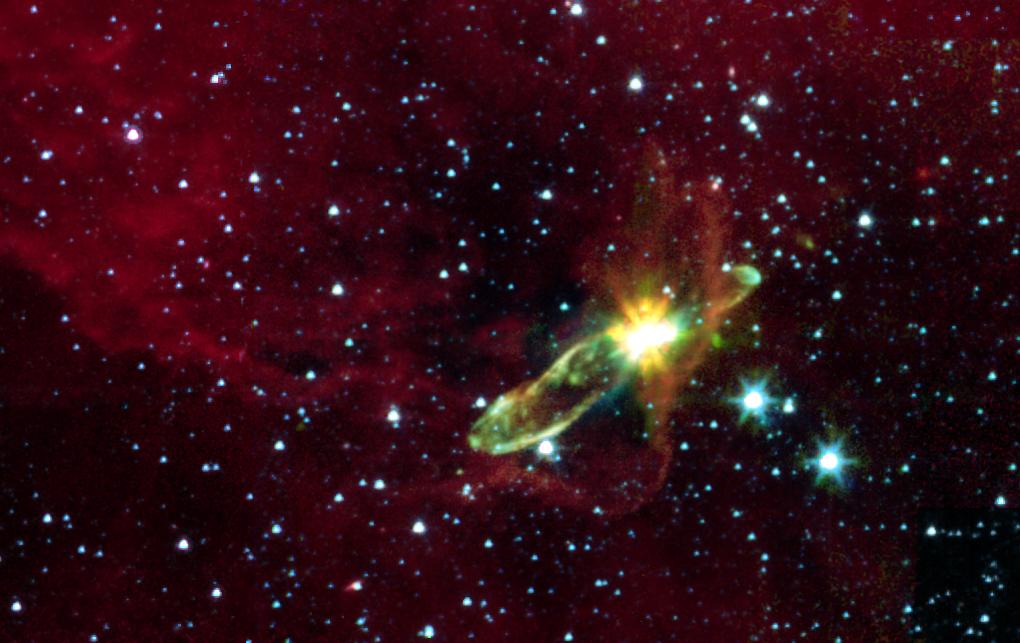
Star formation should be a relatively straightforward process. Dense clouds of molecular hydrogen collapse under gravity and break apart into nuclei that grow into protostars. These young stars are cold, deeply embedded in their parent clouds, and should not produce ultraviolet radiation. They’re not hot enough. But when astronomers used the James Webb Space Telescope’s MIRI instrument to observe five young stars in the Ophiuchus molecular cloud 450 light-years away, they found clear evidence that UV radiation affects molecular hydrogen in outflows around these protostars.
“This is the first surprise. Young stars cannot be a source of radiation; they cannot ‘produce’ radiation. So we should not expect it and yet we have shown that UV occurs near protostars” – Agata Karska from the University of Torun and the Max Planck Institute for Radio Astronomy.
The discovery arose from the analysis of molecular hydrogen emissions, which the JWST can observe in unprecedented detail. Molecular hydrogen is the most abundant molecule in the universe, outnumbering carbon monoxide, the second most abundant, by 10,000 to one. When UV radiation hits H2 molecules, it excites them in specific ways, creating characteristic spectral signatures.
The team initially hypothesized that the UV radiation came from external sources, specifically hot B-type stars scattered throughout Ophiuchus that produced UV radiation. The researchers calculated the expected UV values based on the distances between these massive stars and the observed protostars, then checked them against dust properties, since dust absorbs UV radiation and re-emits it at longer wavelengths.
The UV signatures remained consistent for all five protostars despite dramatically different external UV environments. The hypothesis failed. It appeared that protostars emit jets and outflows as they accumulate material and compress and heat the surrounding gas through shock waves. It is possible that these collisions, either where material falls onto the protostar or along the jets themselves, generate enough energy to produce UV radiation locally.
Infrared images from instruments at Kitt Peak National Observatory (left) and NASA’s Spitzer Space Telescope document the eruption of HOPS 383, a young protostar in the Orion star-forming complex (Credit: NASA)
The results suggest that current star formation models need to be updated. Astronomers have largely ignored UV radiation in protostellar environments because theory says it shouldn’t exist. Now it appears to be crucial for understanding the chemistry and physics of the molecular outflows of young stars.
The research shows how JWST’s mid-infrared capabilities continue to challenge assumptions about star birth. Understanding the source and effects of this unexpected UV radiation could change predictions about which molecules survive in protostellar environments and how planetary systems eventually form from the remaining matter around these young stars.
Source: Mysterious ultraviolet radiation in the birthplaces of stars

Comments are closed.