

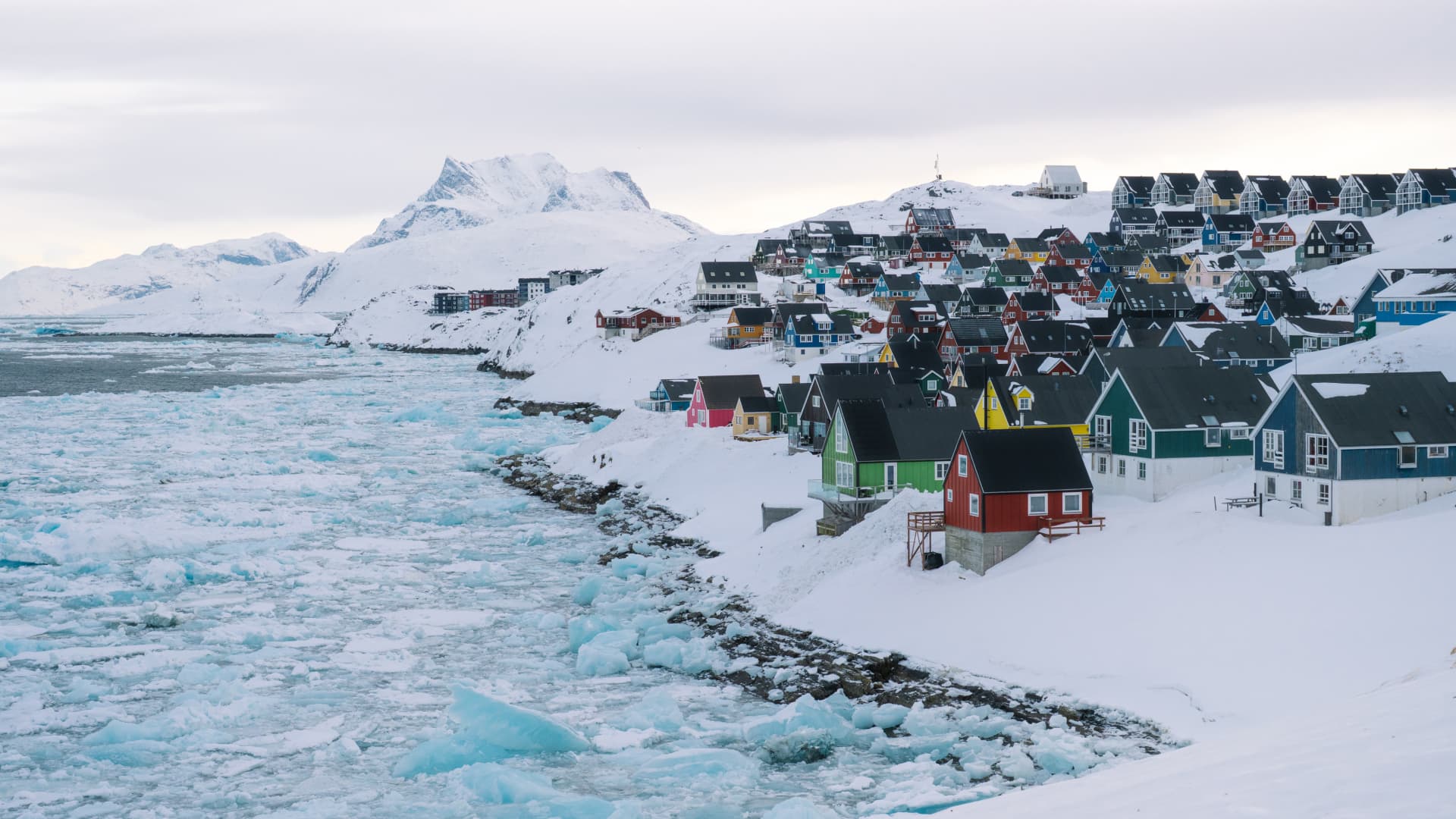
Traditional painted houses overlooking the sea ice in the Old Nuuk district near Mount Sermitsiaq in Nuuk, Greenland, on Thursday, April 3, 2025.
Bloomberg | Bloomberg | Getty Images
A global battle to exploit the Arctic’s untapped resources appears to be in full swing.
To break China’s mineral dominance, countries around the world are increasingly turning to the melting and sparsely populated North Polar region to seize its raw materials and benefit from new commercial trade routes.
US President Donald Trump, for example, has repeatedly highlighted the importance of Greenland, a vast Arctic territory, and called US ownership of the island an “absolute necessity” for economic and national security reasons.
Canada has recently sought to increase investment in the Arctic to tap its resource potential, particularly given strained diplomatic relations with the United States
Russia, which has an extensive Arctic coastline, has long recognized the region as a strategic priority. Indeed, President Vladimir Putin on Tuesday praised the construction of a new nuclear-powered icebreaker ship to navigate Arctic waters, saying it was “important to consistently strengthen Russia’s position in the region.”
“The Arctic is considered a source of many different raw materials, not only oil and gas, but also many strategic materials and rare earths,” Marc Lanteigne, an associate professor at the Arctic University of Norway in Tromsø, told CNBC by phone.
“Greenland is currently a repository for a lot of base metals, precious metals, gemstones, rare earths, uranium… it’s all there. The problem is that until recently it was considered completely unprofitable to actually mine them,” Lanteigne said.
“But given climate change and the ability to sail the Arctic Ocean much more frequently, particularly in the summer months, Greenland is beginning to be considered much more carefully as a potential alternative source of many of these strategic materials for China.”
Greenland has changed due to the climate crisis. A comprehensive analysis of historical satellite images released last year by researchers at Britain’s University of Leeds showed that parts of the autonomous Danish territory’s ice sheets and glaciers were replaced by wetlands, bush areas and barren rock.
For mining companies, major ice loss has inadvertently made some of the island’s strategic minerals more accessible.
Tony Sage, CEO of Critical Metals, which is developing one of the world’s largest rare earth deposits in southern Greenland, said there had been a significant increase in investor interest in Greenland in recent months, particularly since Trump returned to office and raised the prospect of taking control of the territory.
“I remember in his first term, around 2018 and 2019, he wrote a big song about the strategic value of rare earths in Greenland, so even then,” Sage told CNBC by phone.
Perception vs. Reality
In addition to Critical Metals, the mining and exploration company Amaroq is also working to exploit some of Greenland’s resources. Amaroq CEO Eldur Olafsson said the company’s recent discovery of high-quality rare earths in southern Greenland “means a lot to us.”
The project, which will take several years to develop, marked the company’s first foray into rare earths as it expands its interests beyond gold and other strategic minerals.
Just a week after revealing its rare earth discovery, the company confirmed commercial quantities of germanium and gallium at its site in West Greenland on November 11, a development that could prove even more strategically significant, according to Olafsson.
“The germanium-gallium piece is, I think, much bigger news than people understand,” Olafsson told CNBC via video call.
This aerial photo shows icebergs floating in sun-baked waters with buildings in the background off Nuuk, Greenland, on March 11, 2025, on the day of the general election in Greenland, the autonomous Danish territory.
Strange Andersen | Afp | Getty Images
Germanium and gallium are essential components of a variety of goods, from electric vehicles to semiconductors to military applications.
China, the world’s top producer of these metals, first introduced export controls on germanium and gallium in 2023 before imposing an outright ban on the U.S. late last year in response to restrictions imposed by Washington on the chip sector. Beijing has now suspended its ban on gallium and germanium exports to the US, although the metals remain subject to restrictive measures.
“This is a mineral that the United States and the European Union need now. The rare earths are processed by Lynas and MP Materials. This is something that you can access, I wouldn’t say it’s easier, but you can access… germanium and gallium, if you don’t have them then that’s a huge problem,” Olafsson said.
“We now have a short-term mining solution for mining zinc, lead, silver as well as germanium and gallium and are then also developing the export of rare earths.”
Olafsson said it was important for the company to generate cash flow through its portfolio of gold and other strategic metals as it strives to realize its potential in the rare earths space, noting that the rare earths market is still relatively small.
Asked whether the race for Arctic resources could be compared to a gold rush, Lanteigne said: “Perception and reality tend to clash here.”
He added: “For example, there has been a lot of discussion about the rush to develop mineral resources in Greenland, but having been there a few times, I can say that if you want to build a mine you have to bring in literally everything.”
Even under ideal conditions, Lanteigne said, logistical challenges like Greenland’s harsh climate and remote landscape mean it could take 15 to 20 years for companies to start making serious profits.
Arctic Sweden
It’s not just Greenland. The battle for Arctic minerals also includes some of Sweden’s northernmost areas.
The state-owned mining company LKAB is currently trying to develop one of the largest known deposits of rare earths in Europe. The discovery of the so-called Per Geijer deposit, announced in 2023, lies close to the company’s massive iron ore mine in the Arctic city of Kiruna.
It is raining as a general view dated August 21, 2025 shows the LKAB iron ore mine and a sign with the company logo in Kiruna, northern Sweden.
Jonathan Nackstrand | Afp | Getty Images
Niklas Johansson, senior vice president of public affairs and external relations at LKAB, said the company is currently in discussions with European lawmakers to ensure that developing its resources is commercially viable.
“We’ve already put the material on the ground. This has all been paid for by the iron ore. Still, it’s not a given that it’s a business case. It looks like it is for us at the moment, but it’s not something you would say, ‘Oh, this is a piece of cake, just run,'” Johansson told CNBC by phone.
“I also say to them: If this is what it looks like for us, who have most of the infrastructure and everything, what do you think it will look like for others in Europe?”

Comments are closed.