

Dark matter is one of the persistent mysteries facing astronomers and cosmologists today. This theoretical mass was proposed in the 1960s to explain the rotation curves of galaxies, which suggested they had greater mass than their stellar populations suggested. Despite decades of research and observation, scientists have yet to find direct evidence of this mysterious, invisible mass or its composition. There are many theories, ranging from weakly interacting massive particles (WIMPs) to extremely low mass particles (axions).
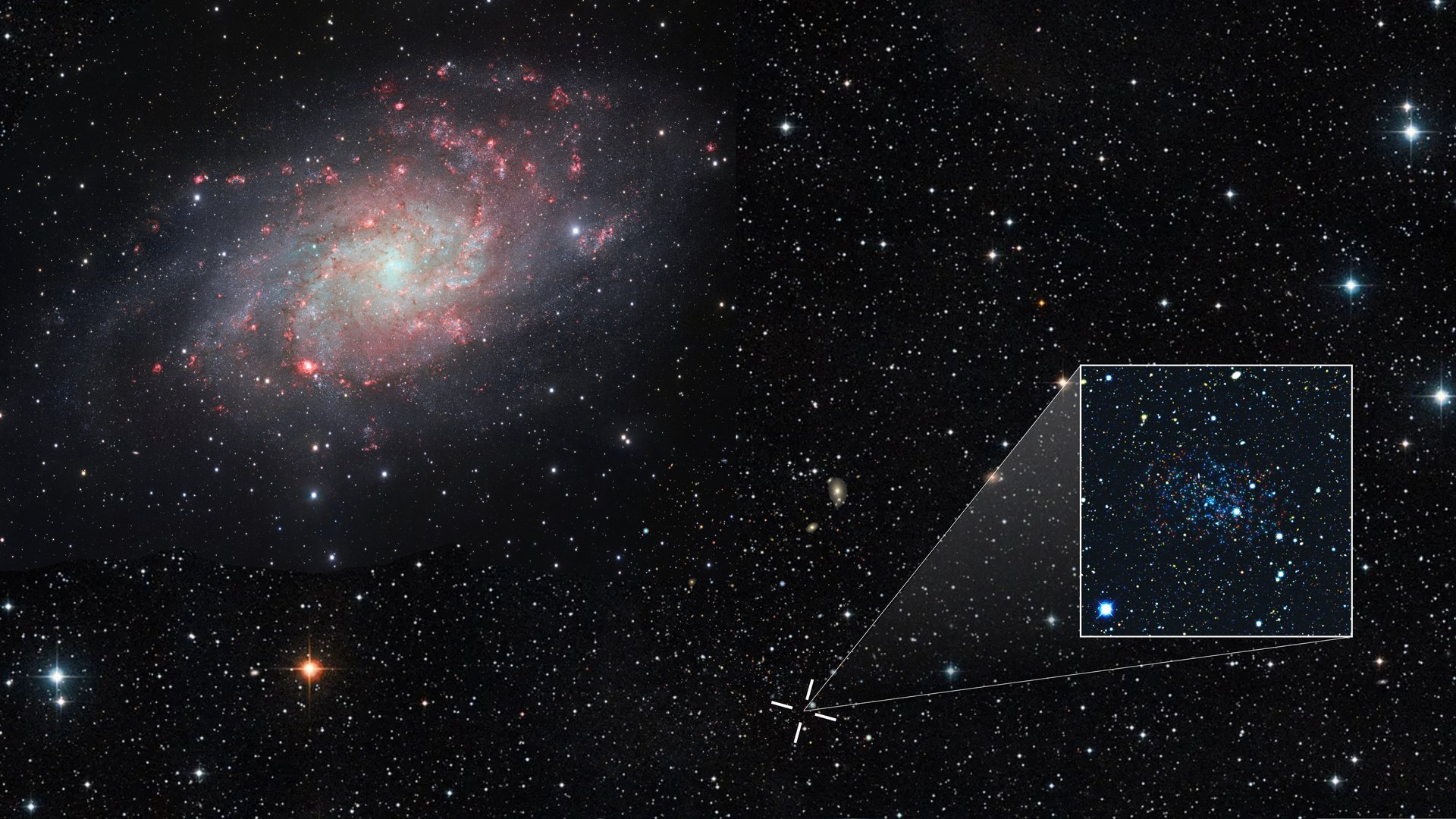
Fortunately, we live in a time when the boundaries of astronomy are constantly expanding and new discoveries are constantly being made. In a recent study, an international team of researchers led by the Leibniz Institute for Astrophysics Potsdam (AIP) has shed light on this decades-long debate by analyzing the stellar velocities of twelve of the smallest and faintest galaxies in the universe. The team found that the internal gravitational fields of these galaxies could not be explained by visible matter alone, further strengthening the case for dark matter.
The team was led by researchers from AIP and included members from the Institute of Physics and Astronomy at the University of Potsdam, the University of Surrey, the University of Bath, the School of Astronomy and Space Science at Nanjing University, the Institute of Astrophysics and Space Sciences at the University of Porto, the Leiden Observatory at Leiden University and the Lund Observatory at Lund University. The article describing their results appeared recently in the journal Astronomy & Astrophysics.
Scientists have been discussing the existence of dark matter (DM) for decades. On the one hand, its existence is inferred from observations and our understanding of gravity (as described in Einstein’s general theory of relativity). On the other hand, there is a lack of direct evidence, which has led to alternative theories such as Modified Newtonian Dynamics (MOND). This theory emerged in the 1980s and assumes that the laws of gravity change at very small accelerations (i.e. at very large distance scales).
*A simulation of the formation of dark matter structures from the early universe to the present day. Photo credit: Ralf Kaehler/SLAC National Accelerator Laboratory/AMNH*
Furthermore, astronomers have long believed that there is a simple relationship between the amount of visible (baryonic) matter a galaxy contains and the gravitational force it exerts – known as the Radial Acceleration Relation (RAR). While this theory certainly applies to larger systems, the new study suggests that it collapses in the smallest galaxies. By studying 12 dwarf galaxies and deriving their mass distributions, they found that the MOND predictions could not reproduce the observed behavior, proving that their gravitational fields could not be explained by visible matter alone.
They then compared their results, using the DiRAC National Supercomputer Facility, with theoretical models that assume the presence of dark matter halos around galaxies. The results of these simulations provided a much better agreement with the observed behavior of these dwarf galaxies. According to Mariana Júlio, doctoral student at AIP and lead author of the study:
The smallest dwarf galaxies have long been in conflict with MOND predictions, but the discrepancy could plausibly be explained by measurement uncertainties or by an adjustment to MOND theory. For the first time, we were able to resolve the gravitational acceleration of stars in the faintest galaxies at different radii, revealing their internal dynamics in detail. Both the observations and our EDGE simulations show that their gravitational field cannot be determined solely by their visible matter, which contradicts modified gravity predictions. This finding highlights the need for dark matter and brings us closer to understanding its nature.
The study challenges the RAR paradigm by providing a better and deeper analysis, allowing astronomers to properly derive the radially resolved profiles of dwarf galaxies. They also confirm what astronomers suspected about dwarf galaxies and why they don’t live up to expectations of their more massive counterparts. Co-author Professor Justin Read from the University of Surrey said:
New data and modeling techniques allow us to map the gravitational field at smaller scales than ever before, giving us new insights into the strange, seemingly invisible substance that makes up most of the universe’s mass. Our results show that there is not enough information based only on what we can see to determine the gravitational field strength in the smallest galaxies. This result can be explained if these galaxies are surrounded by an invisible halo of dark matter, as the dark matter encodes the “missing information.” But MOND theories – at least the ones proposed so far – require that the gravitational field is determined only by what we see. This just doesn’t seem to work.
While the results do not address the peripheral questions about DM (e.g., what it is made of) or confirm its existence, they do narrow the search by helping to rule out alternative explanations. Future observations targeting even fainter and more distant galaxies will further narrow the search, and scientists will do so with confidence that DM is still the most likely explanation for what we’re seeing out there.
Further reading: Leibniz Institute for Astrophysics Potsdam, arXiv

Comments are closed.