

Dr. Kelvin How much
In the first two decades of the 21st century, many countries around the world introduced policies to introduce large numbers of solar and wind power generation systems. These moves were largely politically induced and due to pressure from green activists. These activists believe in an impending global catastrophe caused by rising levels of carbon dioxide (CO2) in the atmosphere. The same activists were also against nuclear power, one has to ask why?
In contrast, the green extremists propagate the image of a highly decentralized electricity generation policy in which individual households and municipal districts would generate their own electricity. This philosophy was linked to romantic ideas that there was no need to rely on large central points of production, but rather that small groups of people would simply satisfy their own immediate needs. This philosophy explains their anti-nuclear sentiment, even though nuclear power emits no CO2 at all. Compared to their exaggerated claims about what could be achieved, such an approach has not proven at all successful. The performance of wind and sun does not meet the romantic demands of extreme greens.
As the reality of the inadequacy of solar and wind energy dawned on many world leaders, they realized that to provide electricity reliability and baseload power, there was no choice but to seriously integrate nuclear energy into their national systems.
Big and small
However, in order for nuclear energy to become available to many countries, various nuclear options had to be created.
These include large traditional pressurized water reactors with 1000 MW to 1600 MW of electrical power, but also small nuclear reactors with up to 300 MW power and even smaller microreactor class reactors with less than 10 MW.
Small reactors can be deployed in different geographical locations and are very versatile in a variety of applications. Certainly the global prospects for small reactors are extremely attractive and exciting. Large and small reactors do not compete with each other, they complement each other. If you own an earthmoving business, you own both a 5 ton truck and a half ton truck. You don’t send the 5-ton truck out to collect a dozen bags of cement. However, your half-ton truck can drive on narrow roads and in tight spaces where the 5-ton truck cannot reach. Everyone for themselves. The same applies to nuclear reactors.
The Kudu design of the HTMR-100 small modular reactor was developed for African savannah conditions. (Architects JKDA Architects of Pretoria)
Africa is calling
But now let’s look at the African countries. You can’t simply replicate a European electricity system in an African country and expect it to work in the same way. Most African countries do not have large reserves of natural primary energy such as coal, oil or gas. Even a primary energy source such as hydroelectric power is rare, and even if one does find a potential hydroelectric source, such as a large lake, it may be extremely unsuitable as water levels in Africa can range from 100% to less than 20% within a year or two due to Africa’s very different rainfall cycles
African countries must ensure their own GDP growth and the resulting health and well-being of their own people. What we have seen far too often, however, is Western countries coming to Africa and convincing governments to install solar and wind turbines on a large scale, usually at great expense, and telling them how they will help “save the planet”. Considerations that African children are dying because of a lack of electricity for vital services are generally not considered factors worth considering. Fulfilling the European political agenda is seen as far more important.
Then the Western country offers a large loan (which must be repaid) on the condition that the African country follows the “donor” instructions and buys equipment from the “donor country”.
Such actions are clear examples of “economic colonialism,” where African countries are forced into financial submission.
reality
The result for an African country is that wind and solar installations are not only very intermittent, but also often very far from consumers due to the long distances that Africa entails. This scenario then requires the construction of very long power lines, the costs of which were often not taken into account in the “attractive” cost forecasts for renewable energy originally presented by the western country. For example, South Africa has an important main power line with a length of over 1500 km. which is unique in Europe. This is approximately the distance from Rome to London. Another example is that the distance from the bottom of Botswana to the top of the country is the same as the distance from Paris to Copenhagen.
Over 1,500 km of 765 kV power lines run through South Africa
It is therefore quite irresponsible for certain European countries to persuade African governments to introduce completely unsuitable energy systems. It is particularly painful when this happens in order to achieve European political goals in the EU.
When all this is said and done, it clearly shows African governments that they must look after themselves in the longer term, otherwise no one will. If one follows a simple logic, it is very clear that an undoubted answer for African countries is to take the path of large-scale introduction of small modular reactors. In this way, they also ensure energy security and have full control over when and where SMR units are placed.
South African development
In South Africa, the HTMR-100 SMR was deliberately designed for gas cooling without the need for a large area of water to cool the system.
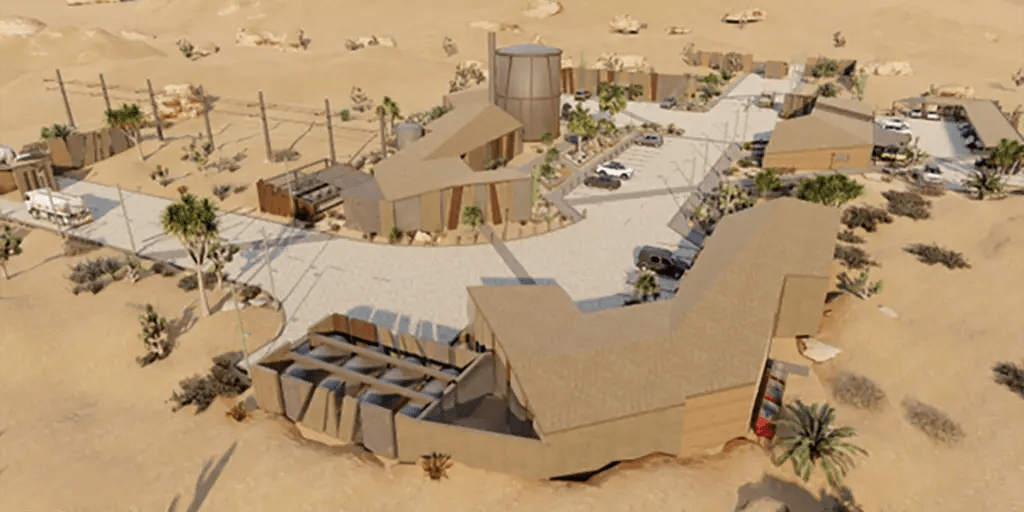
So a potential nuclear site doesn’t need a sea coast or a reliable large lake. An HTMR-100 can be placed in the middle of the desert or on the side of a mountain.
The Oryx design of the HTMR-100 small modular reactor for the Namibian desert. (Architects JKDA Architects of Pretoria)
As African countries consider an SMR future, we encounter the usual sad litany of anti-nuclear sentiment directed against them. Not only are we witnessing the extreme green poison being released; “A nuclear reactor can kill millions of people” or “Your children will have genetic defects,” but we also find major Western companies and governments spreading not-so-subtle anti-nuclear messages like: “You are not ready for nuclear power,” “Nuclear power is too demanding for you,” “How do you deal with highly radioactive waste material?” and so forth.
Usually the messages are also accompanied by the question: “Why don’t you just do a simple, quick thing that’s better for Africa, like solar energy… which we provide… with a large repayable loan.”
The IAEA reports that over 20 African countries have indicated they want to pursue a nuclear future. Some of them are now specifically aiming for a nuclear target. Good for you.
Macro thinking
But now African countries have the opportunity to think macroeconomically. You can look at a large number of countries together.
So what comes from such thinking? Well, many reactors can be connected to each other via the internet, which goes by the silly name “Internet of Things” (IoT).
This means, for example, that monitoring stations can be set up at strategic locations from which operators can monitor critical reactor parameters, e.g. Gas flow rates, reactor temperatures, gas pressures and a variety of other parameters. Any parameter that begins to move outside the normal range could be immediately detected and reported to the various authorities. Such stations would monitor reactors in a number of countries.
A view of part of South Africa’s National Network Operations Center (NNOC) for telecommunications.
Participating countries would belong to a mutually beneficial network of nuclear power plant operators, which in turn would be linked to a responsible organization such as the World Association of Nuclear Operators (WANO). If help was needed at a reactor, it could be organized in a timely manner via the network, long before the event became an extreme case.
Such a system could also be used for standard reporting to nuclear regulators. In addition, the individual reactors with such a system would not have to maintain a comprehensive inventory of spare parts. An exchange system could be developed in which network members could supply each other with parts or with trained specialists for specific tasks. Such an approach would eliminate the need for any new nuclear country to develop a world-class controller and a full complement of trained technicians before installing its first SMR. This type of system currently exists for telecommunications, automobiles, mining equipment and more, so it would be a logical step to use it for nuclear energy as well.
Of course, every African country can also have peace of mind when it comes to nuclear energy, as a reliable fuel supply is not a problem. With an SMR, the host country can choose to maintain, for example, a six-month fuel supply locally. Such a decision would be political and economic in nature and not constrained by technical constraints such as a coal conveyor belt or an oil pipeline. So you don’t have to worry that a severe African storm could disrupt the power plant’s constant supply of fuel by washing away a road, railway line, conveyor belt or gas pipeline. This is really a big plus!
Therefore, African countries should now clearly embrace nuclear power as their future. They owe it to their citizens to convey a clear vision of a stable, reliable and cost-effective electricity supply as the basis for national growth. Without such supply, the future path to GDP will be very rocky, with many sharp curves and unexpected twists.
Africa must harness the wisdom of its ages and combine it with a new vision of the future focused on nuclear energy.
Dr. Kelvin Kemm is a nuclear physicist and former chairman of the South African Nuclear Energy Corporation (Necsa). He is currently Chairman of Stratek Global, a nuclear project management company based in Pretoria, South Africa. The company carries out strategy development and project planning in a wide variety of areas for different customers. They are working on building an HTMR-100 in Pretoria. Kelvin.kemm@stratekglobal.com.
www.stratekglobal.com
Like this:
Load…
Related
Explore more from Watts Up With That?
Subscribe to receive the latest posts by email.

Comments are closed.