

Asteroids are rocky remains from the early solar system, boulders and metal, which are from pebbles to mountains. Most of them turn peacefully in the asteroid belt between Mars and Jupiter, but occasionally the gravitational forces can drive them to earth. The largest asteroid, Ceres, is almost 1,000 km through, while the one who probably killed the dinosaurs was about 10 km wide. Even relatively small asteroids can cause enormous damage, for example, the Space Rock, which was created by Arizona’s famous meteor crater, was only about 45 meters, but produced a crater a little more than 1 km wide.
This image of Meteor crater in Arizona has a resolution of 2 meters per pixel, and the lighting is from right. Layers of exposed limestone and sandstone are visible under the rim of crater, as are large stone blocks that were excavated by the effects (loan: National Map seamless server)
When asteroid size beat stones on earth, the enormous pressure and the heat can often melt surface rocks, which they blow back into the atmosphere. Here they cool down and fall back onto the earth as glassy droplets, which are known as tectites. Australian scientists under the direction of Anna Musolino and Professor Fred Jourdan from Curtin University have discovered some tectites that are quite unusual due to their chemistry and age. It is assumed that they are about 11 million years old, which distinguishes them from all other known tectit groups. So far, they have only been found in an area in South Australia.
To understand how rare this find is, only five different tectite fields are known; The four “classic”, which have been known for almost a century from Central Europe (14 million years), North America (35 million years), Ivory Coast (1 million years) and a large area from China to Australia (780,000 years) and a younger field in Central America (800,000 years). This Australian discovery only represents the sixth field that has ever been identified.
What makes this discovery particularly fascinating is the missing crater. Although the effects must have been immense to create the tectites, the team has not yet managed to find the crater! It is not uncommon for crater to be hidden over millions of years of weathering or geological activity. They can simply be eroded or even buried under volcanic insoles that they hide from the point of view.
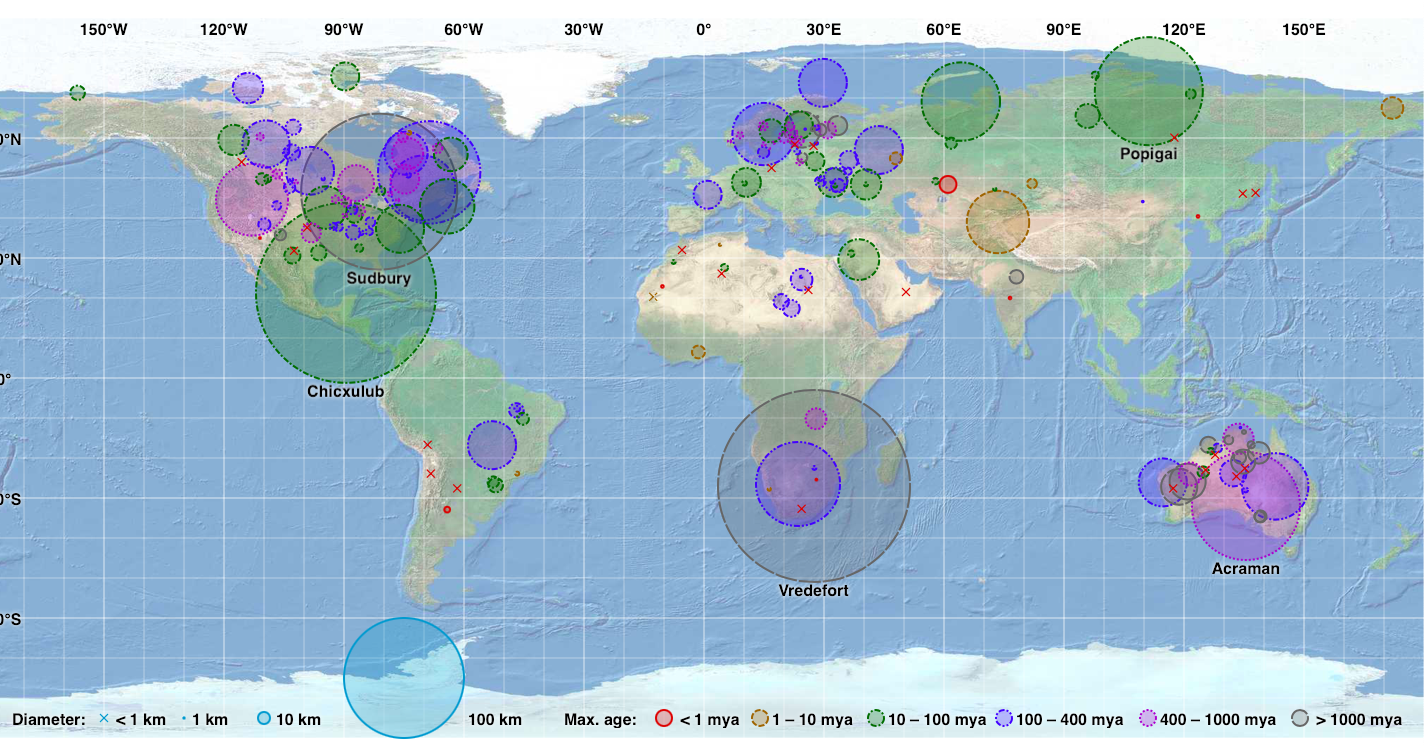
The famous Chicxulub crater in Mexico, who killed the dinosaurs 66 million years ago, was hidden similarly until the 1970s when geologists were buried under limestone and oceanic sediments. The crater is estimated on a diameter of almost 200 km and has filled with oceanic sediment since then.
Free serious strength of the Chicxulub crater structure – coast and state borders as black lines (loan: J. Klokočník, J. Kostelecký, I. Pešek, P. Novák, Ca Wagner and J. Sebera – Klokočník, et al.
The presence of tectites offers us decisive insights into the earth -mpact history. Each tectite field represents a significant asteroid strike and creates a timeline that helps the researchers to understand both the frequency and the scale of these events. This data is invaluable for the assessment of the continued risk of future asteroid effects, and while most asteroids do not pose a threat to the earth, the geological records that were kept in tectite fields reminds of the entire history that major effects have occurred regularly. The discovery of this new Australian Tectite field helps scientists to develop better models for predicting and possibly reducing future threats to civilization.
Source: Cosmic glass that was only found in Australia

Comments are closed.